Hiring the right candidate involves more than reviewing resumes, checking qualifications, or asking interview questions. Employers also need to understand how candidates approach problems, communicate with others, and respond to workplace challenges. This is where behavioral assessments can help.
A behavioral assessment is a structured way to understand job-related behaviors, responses, and working preferences. During recruitment, these assessments can give employers additional information about a candidate’s communication, teamwork, adaptability, and decision-making.
When used alongside structured interviews, skills tests, and relevant experience, behavioral assessments for hiring can help recruiters evaluate candidates more consistently and make better-informed decisions.
But what is a behavioral assessment, how does it work, and how can employers use it effectively? Let’s take a closer look.
What Is Behavioral Assessment?
A behavioral assessment is a method of evaluating how a person typically responds to situations, approaches tasks, and interacts with others. The assessment may involve questionnaires, workplace scenarios, structured interviews, or practical exercises.
In recruitment, a behavioral assessment test helps employers explore behaviors that are relevant to a particular role. These might include teamwork, communication, problem-solving, adaptability, or conflict resolution.
For example, a customer service candidate may need to remain calm when dealing with an unhappy customer. A team leader may need to resolve disagreements, prioritize tasks, and communicate decisions clearly.
A behavioral assessment helps recruiters explore these qualities using a more structured approach. It does not provide a complete picture of a candidate or guarantee future job performance, but it can add useful information to the hiring process.
Why Are Behavioral Tests Used in Recruitment?
Traditional recruitment often focuses on qualifications, previous experience, and interview performance. Although these factors matter, they may not always reveal how a candidate will respond to everyday workplace situations.
This is one reason behavioural tests in recruitment are used by employers across different industries.
A well-designed assessment can help recruiters:
- Evaluate job-related behavioral skills using consistent criteria.
- Understand how candidates approach common workplace challenges.
- Explore communication, collaboration, and decision-making.
- Identify areas that need further discussion during interviews.
- Compare candidates against the requirements of the same role.
- Support hiring decisions with additional evidence.
For instance, two candidates may have similar qualifications but different approaches to handling customer complaints. A relevant situational assessment can help recruiters explore how each candidate would respond.
The purpose is not to find a single ideal personality. It is to understand whether a candidate demonstrates the skills and behaviors required for the position.
Types of Behavioral Assessments Used for Hiring
Different roles require different assessment methods. Employers should select an approach based on the responsibilities of the position and the qualities they need to evaluate.
1. Situational Judgment Tests
Situational judgment tests present candidates with realistic workplace scenarios and ask them how they would respond.
For example, a candidate applying for a management role might be asked how they would handle a disagreement between team members or manage competing deadlines.
These tests can help employers evaluate judgment, prioritization, communication, and problem-solving in job-related situations.
2. Behavioral Interviews
Behavioral interviews ask candidates to describe how they handled situations in the past.
Common questions include:
- Tell me about a time you resolved a disagreement at work.
- Describe a situation where you had to meet a challenging deadline.
- Give an example of how you responded to constructive feedback.
- Tell me about a time you worked with someone who had a different approach.
Recruiters can evaluate answers against predefined criteria rather than relying entirely on general impressions.
3. Work Behavior Assessments
A work behaviour assessment explores workplace-related tendencies, such as communication, collaboration, adaptability, and approaches to different responsibilities.
These assessments may help employers understand how candidates prefer to work and respond to common challenges. Results should be interpreted in context and should not be treated as definitive predictions of performance.
4. Role-Play and Work-Sample Exercises
Some roles require candidates to demonstrate their skills in practical situations.
For example, a sales candidate may participate in a simulated customer conversation, while a customer support candidate may respond to a sample complaint.
These exercises give recruiters an opportunity to observe job-related behavior directly. They can be particularly useful when combined with clear scoring criteria.
5. Behavioral and Cognitive Assessments
A behavioural and cognitive assessment combines information about behavioral tendencies with measures of relevant cognitive abilities, when appropriate.
Behavioral assessments may explore responses to workplace situations, while cognitive assessments can measure abilities such as numerical reasoning, logical reasoning, or problem-solving.
These methods measure different things. Employers should use them together only when both are relevant to the job.
Benefits of Behavioral Assessments for Employers
Using behavioural assessments for employers can support a more structured hiring process when assessments are relevant, reliable, and properly interpreted.
More consistent candidate evaluation
Structured assessments give recruiters common criteria for evaluating candidates. This can reduce reliance on vague impressions and make discussions between hiring managers more focused.
Better understanding of job-related behavior
An employee behavioral assessment can provide additional insight into workplace tendencies, communication styles, and responses to professional situations.
For existing employees, assessments may also support development discussions, provided their purpose is clear and the results are used appropriately.
More informed hiring decisions
Behavioral assessment results can help recruiters identify areas to explore further during interviews. They can also provide another perspective when comparing candidates with similar qualifications.
However, results should always be considered alongside other relevant evidence.
Greater alignment with job requirements
Different roles call for different behaviors. A customer-facing position may require strong communication and conflict resolution, while a project management role may require organization, prioritization, and coordination.
A role-specific behavioral assessment helps recruiters focus on the qualities that matter for the job instead of evaluating candidates against a generic profile.
A more structured recruitment process
When assessments use consistent instructions and scoring criteria, recruitment teams can follow a clearer evaluation process. This can make it easier to document decisions and review how candidates were assessed.
Assessments do not automatically remove hiring bias. Employers must still review their methods for fairness, accessibility, and relevance.
How to Use Behavioral Assessments for Hiring
A behavioral assessment for hiring is most useful when it is connected to the actual requirements of the role.
Step 1: Identify the behaviors required for the job
Start by reviewing the job description and identifying the behaviors that are important for success.
For example, customer support may require active listening and conflict resolution, while a team leader role may require accountability, communication, and decision-making.
Focus on job-related requirements rather than unrelated personality characteristics.
Step 2: Select the appropriate assessment
Choose an assessment method that measures the qualities you want to understand.
Situational judgment tests can explore decision-making, structured interviews can examine previous experiences, and practical exercises can demonstrate how candidates respond to realistic tasks.
Step 3: Use consistent evaluation criteria
Candidates applying for the same role should be assessed using consistent instructions, relevant criteria, and appropriate testing conditions.
A predefined scoring guide can help recruiters evaluate responses more consistently and explain their decisions.
Step 4: Combine results with other hiring evidence
Avoid making a final decision based on a single behavioral assessment test for employment.
Consider the candidate’s experience, interview responses, relevant skills, and assessment results together. If a result raises a question, explore it through a suitable follow-up rather than making assumptions.
Step 5: Review fairness and assessment quality
Employers should check whether assessments are relevant to the role, accessible to candidates, and appropriate for their intended use.
They should also protect candidate information, provide reasonable accommodations where required, and periodically review assessment outcomes.
This helps organizations identify whether their assessments are useful and whether the process creates unintended barriers.
Behavioral Assessment for Employment: Examples Across Different Roles
A behavioral assessment for employment should reflect the responsibilities of the position. Here are some practical examples.
Customer service
A candidate is presented with an unhappy customer who wants an immediate solution. The recruiter evaluates how the candidate listens, explains options, and approaches the problem.
Sales
A candidate participates in a simulated sales conversation. The assessment explores how they ask questions, respond to objections, and communicate the value of a solution.
Team management
A candidate receives a scenario involving missed deadlines and disagreements within a team. Recruiters examine how the candidate prioritizes work, communicates expectations, and approaches conflict resolution.
Technical roles
A candidate is asked how they would respond when a colleague disagrees with a proposed technical solution. The discussion helps explore collaboration and problem-solving alongside a separate assessment of technical knowledge.
These examples show how behavioral testing for employment can be tailored to different jobs. The goal is to assess relevant behaviors fairly, not to favor a particular personality type.
Behavioral Assessment vs. Personality Tests
Behavioral assessments and personality tests are related, but they are not identical.
A behavioral assessment may examine how candidates respond to workplace scenarios, describe previous experiences, or demonstrate job-related behaviors.
A personality assessment generally explores relatively consistent personality traits or tendencies, depending on the instrument used.
For example, a situational judgment test might ask how a candidate would handle competing priorities. A personality questionnaire might explore their typical approach to organization or social interaction.
Employers should understand what each method measures before using it. Neither should be treated as a complete measure of a candidate’s suitability for a role.
How Online Assessment Platforms Support Behavioral Testing
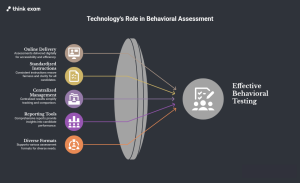
Organizations that recruit across locations or evaluate large numbers of candidates may use online assessment platforms to manage parts of the assessment process.
Depending on the platform and assessment format, features may include:
- Online delivery of assessments.
- Standardized candidate instructions.
- Centralized management of results.
- Reporting tools for reviewing candidate performance.
- Support for different assessment formats.
These features can help recruitment teams organize their workflows, but technology alone does not guarantee a fair or effective assessment. The assessment itself must be relevant to the role and interpreted appropriately.
Think Exam offers online assessment solutions that organizations can explore as part of their recruitment and candidate evaluation workflows. Employers should review the available capabilities to determine whether they meet their specific requirements.
Common Mistakes to Avoid in Workplace Behavioral Assessments
Even a well-designed assessment can be misused. Employers should avoid several common mistakes.
Treating results as final decisions. An assessment provides specific information, not a complete picture of a candidate’s potential.
Using the same assessment for every role. Behavioral requirements differ across jobs, so assessments should reflect the responsibilities being evaluated.
Ignoring candidate experience. Instructions should be clear, testing conditions appropriate, and information about data handling transparent.
Making assumptions about unusual responses. Candidates may interpret scenarios differently. Recruiters should consider context and seek relevant evidence before drawing conclusions.
Failing to review outcomes. Employers should periodically check whether assessments remain relevant, consistent, and appropriate for their intended use.
Avoiding these mistakes helps recruitment teams use assessment results responsibly.
Make More Informed Hiring Decisions with Behavioral Assessments
Hiring the right candidate requires an understanding of both job-related skills and the behaviors needed to perform the role effectively. Behavioral assessments can provide recruiters with another useful source of information when they are designed around real workplace requirements.
From situational judgment tests to structured behavioral interviews, the right method depends on what an organization needs to evaluate. Employers should use relevant criteria, interpret results carefully, and combine assessment findings with other evidence before making a final decision.
Think Exam’s online assessment solutions can support organizations looking to manage digital assessments as part of their recruitment process. The priority should always be to choose assessment methods that suit the role, provide a fair candidate experience, and support informed hiring decisions.