Hiring has become increasingly skills-focused. Instead of relying only on resumes, degrees and interviews, organizations are using online skill assessments to understand whether candidates have the abilities required for a particular role.
As hiring volumes grow, manually evaluating candidates becomes difficult. Recruiters need a reliable way to create assessments, invite candidates, evaluate skills, monitor test sessions and analyze results without compromising the candidate experience.
This is where a scalable exam platform for skill testing becomes important.
A scalable platform should support large numbers of candidates while maintaining assessment quality, security, performance and accurate reporting. It should also adapt to different job roles, assessment types and hiring requirements.
What Is a Scalable Exam Platform for Skill Testing?
A scalable exam platform is an online assessment system designed to handle increasing numbers of candidates, tests and concurrent assessment sessions without significantly affecting performance or reliability.
For hiring, a skill assessment platform can be used to evaluate technical, cognitive, aptitude, communication and job-specific skills before candidates move to the next stage of recruitment.
A scalable platform typically brings together:
- Online assessment creation
- Skill-based test libraries
- Candidate management
- Automated evaluation
- Online exam delivery
- Candidate authentication
- Remote proctoring
- Assessment analytics
- Reporting
- Integrations
- Security and data controls
The goal is not simply to conduct more exams. It is to make skill-based hiring more structured, consistent and efficient.
Why Do Organizations Need Scalable Skill Testing?
A small hiring campaign may involve a few dozen candidates. Large organizations, campus recruitment programs and mass hiring campaigns may need to assess hundreds or thousands of candidates within a limited period.
A platform that works for a small number of candidates may not perform the same way under a much larger workload.
A scalable online skill testing platform can help organizations:
Handle Large Candidate Volumes
Recruiters can conduct assessments for large candidate groups without relying entirely on manual test administration.
Standardize Candidate Evaluation
Every candidate can be evaluated against the same assessment criteria, helping organizations create a more consistent hiring process.
Reduce Manual Work
Automated test delivery, scoring, reporting and candidate workflows can reduce repetitive administrative tasks.
Support Distributed Hiring
Candidates can complete assessments remotely, making the process suitable for campus hiring, remote recruitment and geographically distributed teams.
Make Faster Hiring Decisions
Assessment reports can give recruiters structured information about candidate performance before interviews or other selection stages.
What Skills Can an Online Assessment Platform Evaluate?
A modern skill assessment platform should support different types of assessments because every job requires a different combination of skills.
Depending on the role, organizations may evaluate:
Technical Skills
Technical assessments can measure role-specific knowledge and practical capabilities.
Examples include:
- Programming
- Software development
- Data analysis
- Database skills
- Technical troubleshooting
- Engineering knowledge
Cognitive Skills
Cognitive assessments can evaluate areas such as:
- Logical reasoning
- Critical thinking
- Problem-solving
- Numerical reasoning
- Verbal reasoning
Aptitude
Online aptitude assessments can help evaluate numerical, logical and analytical abilities relevant to different job roles.
Communication Skills
Communication assessments can evaluate written or verbal communication depending on the requirements of the role.
Behavioral and Psychometric Skills
Organizations may also use behavioral or psychometric assessments to understand personality traits, work preferences and other job-relevant characteristics.
Job-Specific Skills
A strong assessment strategy should reflect the actual requirements of the position rather than testing candidates on unrelated knowledge.
Key Features of a Scalable Exam Platform
Building a reliable online assessment platform for hiring requires more than a question bank and an online test interface.
The following capabilities are important for scalability and effective candidate evaluation.
1. Flexible Assessment Creation
Recruiters and assessment administrators should be able to create tests based on specific roles and skill requirements.
The platform should support different question formats, such as:
- Multiple-choice questions
- Coding questions
- Subjective questions
- Case-based questions
- Scenario-based questions
- Video-based responses
- Skill-specific questions
Flexible assessment creation allows organizations to build tests for different departments and job profiles.
2. Skill-Based Test Libraries
Creating every assessment from scratch can take considerable time.
A skill testing platform can provide structured test libraries covering areas such as coding, aptitude, cognitive ability, communication and other job-related skills.
Organizations can then select relevant questions, customize assessments and create role-specific tests.
3. Candidate Management
Candidate management should be integrated into the assessment workflow.
Important capabilities can include:
- Candidate invitations
- Assessment scheduling
- Test links
- Candidate status tracking
- Automated notifications
- Assessment completion tracking
- Result management
This can help recruiters manage large candidate pools more efficiently.
4. Secure Online Assessment
Security becomes increasingly important as assessment volumes grow.
A secure online assessment platform should provide appropriate controls for candidate authentication, access management, test integrity and data protection.
Depending on the assessment, organizations may also require monitoring and proctoring capabilities.
5. Remote Proctoring
For assessments where test integrity is important, remote proctoring can help monitor candidates during an online examination.
Depending on the platform and assessment requirements, proctoring may include:
- Identity verification
- Camera-based monitoring
- Microphone monitoring
- Browser or session controls
- Suspicious activity detection
- Automated alerts
- Reviewable proctoring reports
Proctoring requirements should always be appropriate to the type and risk level of the assessment.
6. Scalable Cloud Infrastructure
Infrastructure is one of the most important considerations when building a scalable assessment platform.
The system should be able to handle increased traffic when many candidates start an assessment at the same time.
For example, a campus recruitment assessment may involve hundreds or thousands of candidates accessing the platform within a short period.
Scalable infrastructure can help maintain:
- Platform availability
- Response times
- Assessment delivery
- Database performance
- Result processing
- Candidate experience
Load testing and performance monitoring should be performed before major assessment campaigns.
7. Assessment Analytics
Assessment data becomes more useful when it can be turned into actionable information.
An assessment analytics platform can help recruiters understand:
- Candidate scores
- Section-wise performance
- Time spent on questions
- Completion rates
- Skill-level performance
- Candidate rankings
- Assessment trends
These insights can support more informed recruitment decisions.
8. Mobile Accessibility
Candidates increasingly access digital services through smartphones and tablets.
A scalable assessment platform should therefore provide a responsive experience across supported devices where the assessment requirements allow it.
Mobile accessibility can be particularly useful for distributed candidate populations and large recruitment campaigns.
9. Accessibility and Language Support
Scalability should not only mean handling more candidates.
It should also mean making assessments accessible to a broader candidate population.
Organizations may need features such as:
- Accessible interfaces
- Screen-reader compatibility
- Clear navigation
- Multiple language options
- Appropriate text and visual presentation
These capabilities can help create a more inclusive assessment experience.
How to Build a Scalable Exam Platform for Skill Testing
If an organization is developing its own platform or evaluating technology for an assessment solution, the process should begin with the hiring requirements rather than the technology alone.
Step 1: Define the Assessment Objectives
Start by identifying what the organization needs to measure.
For example, a data analyst role may require:
- Analytical reasoning
- Excel or spreadsheet skills
- Data interpretation
- Problem-solving
- Technical knowledge
A software development role may require:
- Programming skills
- Debugging
- Problem-solving
- Technical concepts
- Coding ability
The assessment should be directly connected to the skills required for the role.
Step 2: Design the Assessment Structure
Decide what type of test candidates need to complete.
Consider:
- Number of questions
- Question types
- Test duration
- Scoring method
- Passing criteria
- Skill categories
- Randomization
- Assessment difficulty
A clear structure helps create a consistent candidate evaluation process.
Step 3: Build or Select a Question Repository
A strong question repository is essential for scalable skill testing.
Questions should be:
- Relevant to the role
- Clearly written
- Validated where possible
- Categorized by skill
- Organized by difficulty
- Regularly reviewed
A well-structured question bank also makes it easier to create multiple assessments without repeatedly starting from scratch.
Step 4: Add Candidate Authentication and Security
Determine how candidates will access the assessment and how their identity will be verified.
Depending on the hiring requirements, security measures may include:
- Secure login
- Candidate verification
- Unique assessment links
- Time restrictions
- Browser controls
- Activity monitoring
- Remote proctoring
Security should be proportional to the importance of the assessment.
Step 5: Integrate Automation and AI Where Appropriate
AI can support different parts of the assessment workflow.
Potential applications include:
- Question generation
- Automated scoring
- Response evaluation
- Suspicious activity detection
- Candidate insights
- Assessment recommendations
- Performance analysis
AI should complement assessment design and human decision-making rather than become the sole basis for hiring decisions.
Step 6: Design a Simple Candidate Experience
A technically advanced platform can still fail if candidates struggle to use it.
The assessment interface should make it easy to:
- Understand instructions
- Start the test
- Navigate questions
- Save responses
- Submit answers
- Handle technical issues
A simple interface is especially important during mass hiring, where candidates may have different levels of technical familiarity.
Step 7: Test the Platform Under Heavy Loads
Before running a large recruitment assessment, conduct performance and load testing.
Test scenarios should include:
- Large numbers of simultaneous users
- Multiple assessments running together
- High-volume logins
- Concurrent submissions
- Peak traffic
- Result processing
Testing helps identify performance bottlenecks before they affect real candidates.
Step 8: Monitor Performance During Assessments
Scalability does not end after launch.
During a large assessment, administrators should monitor:
- System performance
- Candidate login issues
- Assessment completion
- Server response
- Error rates
- Submission status
- Proctoring alerts
Real-time monitoring can help teams respond quickly when problems occur.
Step 9: Analyze Results and Improve the Assessment
After the assessment, review both candidate performance and the assessment process.
Look at:
- Average scores
- Question difficulty
- Completion rates
- Candidate drop-offs
- Technical issues
- Proctoring alerts
- Skill-level performance
This information can help improve future assessments.
How Can Companies Scale Online Assessments for Mass Hiring?
Mass hiring requires more than simply increasing the number of candidates allowed into an assessment.
Organizations should plan for the complete assessment lifecycle.
Before the Assessment
- Estimate candidate volume
- Test infrastructure
- Prepare question banks
- Configure assessment rules
- Test candidate communication
- Perform device and browser checks
During the Assessment
- Monitor platform performance
- Track candidate access
- Monitor assessment completion
- Manage technical support
- Review security alerts
After the Assessment
- Process results
- Analyze candidate performance
- Generate reports
- Shortlist candidates
- Review assessment issues
- Improve future assessments
This approach helps organizations scale online assessments for hiring while maintaining a consistent experience.
Security Considerations for Online Skill Testing
Security should be considered throughout the assessment lifecycle.
A secure online skill assessment platform should protect candidate information and help maintain assessment integrity.
Important considerations include:
Candidate Authentication
Verify that the person accessing the assessment is the intended candidate.
Data Protection
Candidate information, assessment responses and results should be handled using appropriate security and privacy controls.
Access Management
Only authorized users should be able to create, administer or review assessments and candidate results.
Assessment Integrity
Organizations can use appropriate controls to reduce unauthorized access to questions and assessment content.
Proctoring and Monitoring
For high-stakes assessments, remote monitoring can provide additional visibility into candidate sessions.
Auditability
Assessment activity should be recorded appropriately so administrators can investigate issues when necessary.
How AI Can Improve Skill Testing
AI is becoming increasingly relevant to digital assessment.
A modern AI-powered assessment platform can support areas such as content creation, evaluation, monitoring and analytics.
For example, AI can help organizations:
- Generate draft assessment questions
- Categorize questions by skill
- Analyze candidate responses
- Identify unusual test activity
- Support automated scoring
- Highlight performance patterns
- Generate assessment insights
However, AI-generated or AI-assisted assessments should be reviewed to ensure questions remain relevant, accurate and appropriate for the role.
How to Choose a Scalable Skill Assessment Platform
Organizations do not always need to build an assessment platform from scratch.
When evaluating an existing skill assessment platform, consider:
Assessment Capabilities
Does the platform support the question types and skills your organization needs to evaluate?
Scalability
Can it support your expected candidate volume and concurrent assessment sessions?
Security
Does it provide appropriate authentication, access controls, monitoring and data protection?
Proctoring
Does it support the level of exam monitoring required for your assessments?
Analytics
Can recruiters easily understand candidate performance and compare results?
Candidate Experience
Is the platform easy to use across supported devices?
Integrations
Can the platform connect with the systems used in your existing recruitment or learning workflows?
Support
Is technical support available before and during large assessment campaigns?
These factors are often more important than simply choosing a platform based on the number of features it advertises.
How Think Exam Supports Skill-Based Hiring
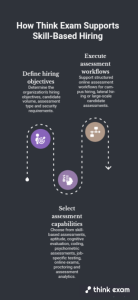
Think Exam provides assessment solutions for organizations that need to evaluate candidates across different skills and hiring scenarios.
Its assessment ecosystem includes capabilities for skill-based assessments, aptitude, cognitive evaluation, coding, psychometric assessments, job-specific testing, online exams, proctoring and assessment analytics.
For organizations conducting campus hiring, lateral hiring or large-scale candidate assessments, the platform can support structured online assessment workflows.
The right assessment approach depends on the organization’s hiring objectives, candidate volume, assessment type and security requirements.
Future of Scalable Skill Assessment
The future of hiring assessments is likely to focus on making evaluation more personalized, accessible and data-driven.
Several areas are becoming increasingly important.
AI-Assisted Assessment Creation
AI can help assessment teams create and organize question content more efficiently, while human reviewers maintain quality and relevance.
Adaptive Assessments
Future assessment systems may increasingly adjust question difficulty based on candidate performance.
Skills-Based Hiring
Recruiters are placing greater emphasis on demonstrable skills rather than relying only on traditional qualifications.
Better Candidate Experiences
Assessment platforms will need to make testing easier across devices while maintaining security and fairness.
More Actionable Analytics
Recruiters will increasingly use assessment data to understand candidate strengths and identify areas requiring further evaluation.
Continuous Skill Evaluation
Assessment may extend beyond pre-hire testing to include employee development, training and internal mobility.
Conclusion
Building a scalable exam platform for skill testing requires more than creating an online test.
Organizations need a combination of flexible assessment creation, relevant skill libraries, candidate management, secure exam delivery, scalable infrastructure, analytics and a simple candidate experience.
For hiring teams, scalability means being able to assess growing candidate volumes without sacrificing reliability, security or assessment quality.
Whether an organization builds its own platform or selects an existing online skill assessment platform, the focus should remain on one objective: creating a consistent and effective way to measure the skills that matter for each role.
With the right combination of assessment technology, automation, analytics and security, organizations can make skill-based hiring more structured, efficient and scalable.