The present online education system calls for proper mechanisms to prevent students and applicants from engaging in malpractices whilst taking examinations. With the growth of remote environments, it has become unavoidable for many institutions and organizations. More than a plain monitoring of the attempts is needed. An innovative AI Proctoring Software that seeks to help prevent cheating in tests is already on the rise. It is fast becoming the nails that construct better assessment structures that encourage adherence to the set standards and policies of exam writing.
How Do AI Proctoring Programs Work?
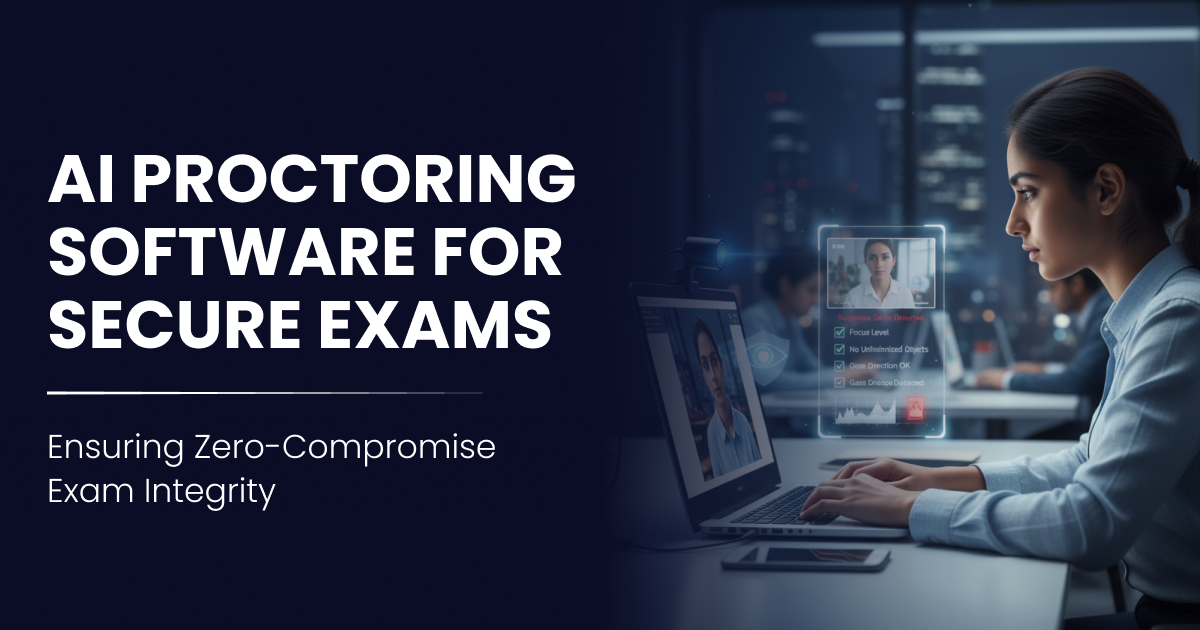
Artificial Intelligence Proctoring Programs are a sophisticated approach to online examination that enables the system to ensure an examination is invigilated and secured. The software utilises awkward techniques like identification of the face, analysis of the behavior, and calculation of the algorithm to determine if cheating, impersonation, and entrance of a non-authorised person are possible. AI proctoring technology does not require time frames like baseline invigilation and thus can monitor people 24 hours a day and seven days a week, making it suitable for different examinations facilitated on a large scale.
There is more than monitoring when it comes to the software. The entire aim of evaluation is to ensure that adequate processes of assessment with proper standards are put in place, regardless of the academic or career focus.
Key Features of AI Proctoring Software
- Facial Recognition for Verification Purposes
The first step consists of capturing the candidate’s face through a facial recognition system. This takes place before the examination begins for the purpose of ensuring that the person sitting for the exam is the same one who has registered for it.
- Monitoring the Behavior
AI generates some algorithms that include abnormal eye movement; they watch for straight head movement as well as other physical anomalies that make one mindful that the person could be cheating. Therefore, any doubtful activity is automatically flagged and stored in the proctors for examination.
- Protection of Browsers and Devices
During exams, this tool secures the web browsers and, alongside, disables the copy-paste function and shields other apps from running.
- On-the-Spot AI Alerts
Distinctive conduct brought out by the candidate during the course of the examination automatically results in a request for review. This ensures that the institutions are not slow in absorbing changes nor is there a departure from the norms and expectations associated with examinations.
- Elaborate Reports
Think Exam provides institutions with AI Proctoring software that consists of different core features.
AI Proctoring software produces instructional and organisational information, which may include behavioral logs and suspicious behavior, along with an analytical summary aiding decision making.
Benefits of AI Proctoring Software
- Improved Security of Examinations
The most significant benefit of AI proctoring technology is that it preserves the sanctity of the examination process. Automated checking mechanisms tend to prevent any form of cheating, which in turn helps the institution to be reassured of the reliability of its examination evaluations.
- Operational Efficiency
AI-based interventions help to deal with the recruitment of countless invigilators, which in turn helps the administration since it is cost-efficient. It also helps since there is no need to worry about the scheduling arrangements, reporting, and reviews of each examination.
- Flexibility and Accessibility
Candidate’s mobility is not limited in any way since the exams are accessible on PC, laptop, or even a smartphone, and tablets are available for the candidates to attempt. The beauty of Think Exam is that such institutions can be accessed ubiquitously and within seconds without any risk of reputation loss.
- Data-Driven Insights
A showing of candidate behavior during the exam, different reporting of patterns witnessed in the exam, as well as varied performance, provides reports of proctoring exams devoid of physical invigilators. These reports supply data concerning candidate behavior that can then be used by the academic instructors for the enhancement of assessments.
Real-World Adoption Metrics
In recent times, the implementation of AI Proctoring Software has risen significantly. Research also indicates that more than 70% of higher education institutions have already adopted AI proctoring to some degree, and the trend is picking up pace in corporations, too. The most conducive factors here are:
- Increase in E-learning: The development of hybrid and electronic education models promotes the need for secure assessment systems that can be upscaled when necessary.
- Compliance: This covers an increasing pressure coming from accreditation agencies that impose conditions for examinations to be performed in a controlled manner.
- Efficiency: Moreover, since there is no actual supervisor, it means fewer expenses.
Think Exam has claimed that its users who use AI Proctoring software experienced between sixty to seventy percentage point drop in the number of cheating cases, thus implying the systems are efficacious in sustaining credibility.
Challenges and Solutions
AI proctoring, though elementary in many aspects, also poses issues, but
- Privacy Problem
Many participants, however, may be unwilling to switch on the camera. Well-known Think Exam and other AI Proctoring software developers tackle this problem by implementing strict data protection measures, blurring out any important information, and seeking voluntary participation by the candidates.
- Technical Issues
AI technologies may not work due to low-bandwidth connections and obsolete devices. Additionally, options for low bandwidth, offline, and mobile monitoring are available in the markets.
- False Alarms
Some innocent activities may trigger the AI alarms. The Diamond standard combines human judgement with AI’s detection abilities in a way that would be accurate to flagging of the alarms.
Future Trends in AI Proctoring Software
Think Exam software gets smarter and more traditional than ever before, or more adaptable than ever, based on the predictions, in a few years, very much AI Proctoring software will actually exist.
- Cheating Detection With an Edge: AI will know the student’s abilities, including the level at which cheating can take place.
- Dynamic Control Levels: Control at a given time will be guided by the current behavior of test-takers, hence saving computational resources.
- Connection to Educational Technologies: Existing learning management systems will remain in place without any disruption for tasks such as setting and conducting exams, reporting, or analysis of the exams.
- Global reforms: it will not be just for local modifications of proctoring principles but also for the global unification of standards for remote evaluation
Conclusively, these developments see to it that online examinations are valid in terms of convenience and security, without compromising anything in regard to the integrity of the assessment system.
Conclusion
Think Exam AI Proctoring software is no longer simply a trend in light of the migration to remote and hybrid examinations. It is a necessity. Such a system combines artificial intelligence, behavioral analytics, and real-time monitoring into a single examination strategy, thereby of fairness and security. Organizations that make use of these applications have operational effectiveness, suffer no operational constraints, and also generate useful reports, while candidates enjoy an easy and flexible process of examination.
In particular, growing adoption of AI proctoring along with technological advances is expected to make it a norm in preserving the integrity of online exams in 2026 and beyond. For those in the education industry, or any other, who value assessment security while complying with the most rigorous standards, it is important to think about investing in high-grade AI Proctoring Software.
FAQs
1. How is AI proctoring software defined?
AI, through a computer, supervises online examinations, using software that asks the attendees to comply with the university’s rules of conduct, award, and obtain an award without cheating or unethical conduct.
2. In what way can AI be said to uphold the security of a chore?
AI keeps a lookout for suspended activity in terms of facial expressions, movement, and behavioral patterns, and sends alerts to the supervisors.
3. Is it possible to conduct proctoring through the use of artificial intelligence on smartphones?
Absolutely, thanks to Think Exam and many modern AI proctoring solutions, exams are no longer restricted to web browsers only; they can now also be presented on screens of both phones and tablets.
4. What are the advantages of AI Proctoring software?
Think Exam discusses a few examples in relation to this, such as, but not limited to, preventing or reducing cases of academic dishonesty by cheating in exams, smooth operational processes, the ability to supervise more students, and better and more availability of data.
5. To what extent has AI Proctoring been deployed?
That’s because more than 7 out of 10 colleges around the world use AI proctoring to conduct online exams. More and more companies have adopted this technology as well.
Reference : Economic Times