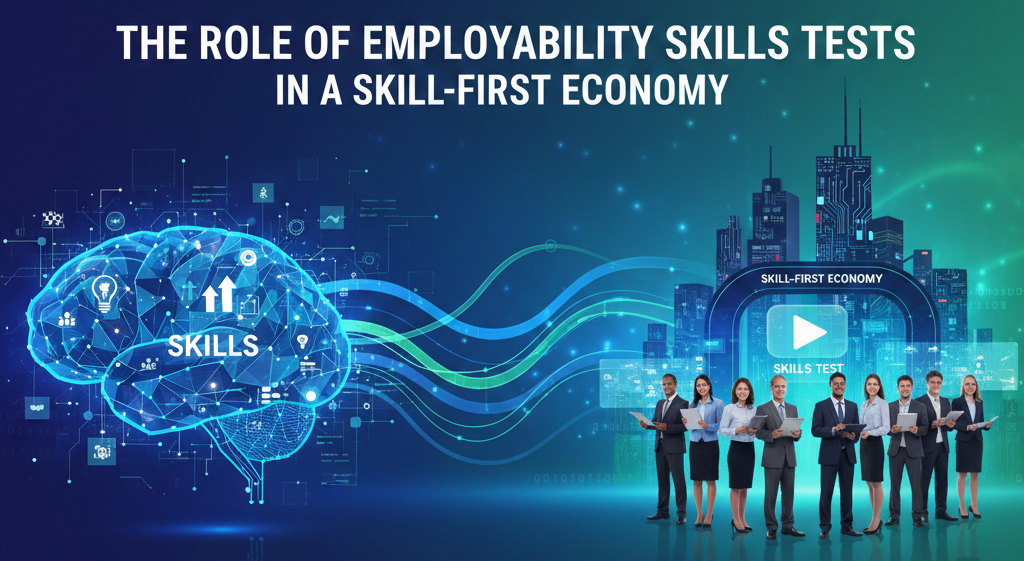
The changing job market has ensured that employers adapt to be more effective. They no longer automatically associate degree, school name, and academic score with professionalism. Hiring agencies prove skills instead of credentials in their hiring process.
This trend has given rise to a skill-first economy, which makes recruiting based on the ability of the candidates. Employability Skills Test is one of the major factors contributing to this success; it is a structured method to assess job-related skills before hiring the person. A modern hiring strategy is often built around an Employability Skills Test.
From Degree-Based Hiring to Skill-First Hiring
Skills Over Degrees is a Real Hiring Trend. The skills-first hiring strategy is now followed by 80% of employers in India, which means that the practical job skills are given priority over educational qualifications.
Source: Business Standard
According to 60% of the employees, the process of hiring based on skills will be very common by 2025.
Hiring for educational qualifications has been the dominant practice for years. A degree was considered proof of competence, discipline, and potential. But the scenario is different now; employers talk about an academic-upskilling gap that is ever-widening and caused by the disconnect between the processes of the university and workplace.
The discrepancies are mostly found in the skills of communication, problem-solving, and flexibility, which are very important for the working environment but might not be particularly learned during lectures.
Certainly, the pandemic as a force has pushed companies to reconsider their very ancient views on their employees. No question, the scenario has made the HR people review their classic assumptions, which were very firmly held for a long time.
Academic credentials alone were never considered reliable predictors of success. Organizations prefer now to rely on structured tools such as the Employability Skills Test to legitimize real talent.
Thus, the shift to skill-based hiring has been reinforced. Practical ability is now more important than academic laurels. Recruiters are no longer just interested in where the candidates were educated; they are now interested in how they perform. Credentials are giving way to learning agility, role relevance, and applied skills.
The Employability Skills Test smoothens the process of change by providing impartial information about the candidate’s job-readiness, regardless of academic background.
What Employers Mean by “Employability Skills”
Employability skills are the ones that help workers to perform well in any role and industry. While technical skills are still a priority, employers are more and more focused on the so-called “universal” skills—those that remain equally significant in the changing work environment.
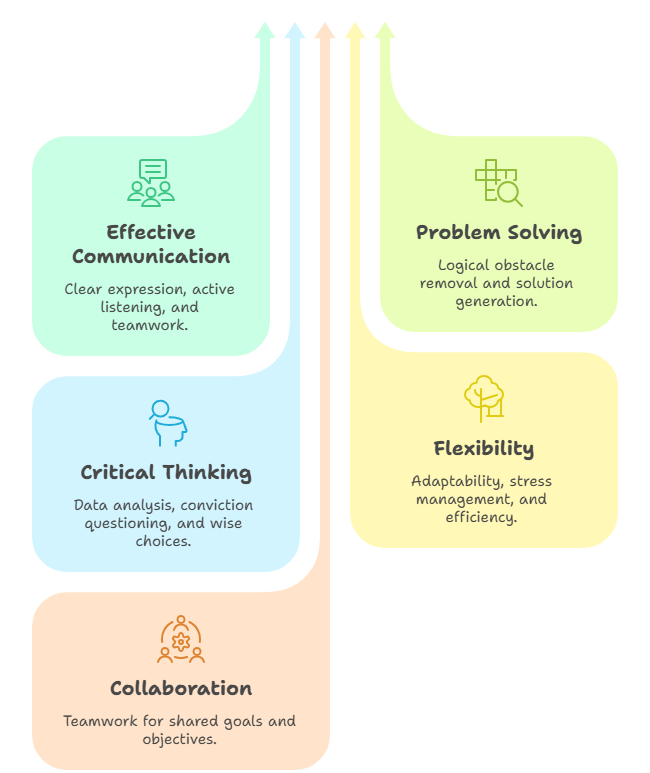
Employability Skills Tests assess these skills by exposing the applicants to organized, real work situations instead of depending on interviewers’ subjective judgments.
How Employability Skills Tests Improve Hiring Accuracy
Skills Are More Predictive of Success Than Resumes. The data highlights the significant impact of skill-based hiring:
- In 2025, 85% of global companies will employ skills-based hiring — an increase from 73% in 2023.
- 65% of employers consider hiring based on skills more effective than resumes in the talent identification process.
- 71% believe that it is a better indicator of actual on-the-job success.
Source: AI Platform
The use of just resumes and interviews for recruitment decisions leads to a scenario that is full of bias and inconsistency.
The implementation of Structured Employability Skills Test frameworks injects objectivity into the hiring process.
The following points reflect ways in which they help employers:
- Hiring bias is minimized by the application of standardized evaluation criteria
- More candidates are matched to the job’s requirements
- Candidates who are capable of dealing with real workplace issues are identified early
- Screening is done faster, but assessment maintains its quality
Organizations that have an Employability Skills Test in the early stages of the hiring process are able to make data-backed decisions while having stronger hires and also having good long-term outcomes.
Key Skill Categories That Need Assessment
Assessing workforce readiness requires evaluating multiple dimensions of ability. A comprehensive Employability Skills Test measures skills across four essential categories.
Technical Skills
These consist of the competencies specific to the role, such as the ability to manipulate numbers, the knowledge of the domain, or being computer literate. They are necessary but only form a small part of employability.
Cognitive Skills
Cognitive skills include the abilities of the brain, such as reasoning, analytical thinking, and decision-making. These skills determine, to a large extent, the effectiveness of the candidate in processing information and solving problems.
Behavioral Skills
Behavioral skills are the characteristics that show how individuals would react in a workplace environment—time management, accountability, stress handling, and ethical judgment.
Soft Skills
Lastly, soft skills refer to the relationship skills, team skills, emotional, and coping abilities. These skills have a strong impact on collaboration and the general culture of organisations.
Reporting and Analytics: Unveiling Hiring Insights from Test Data
Assessment adds value only when insights are actionable. This is where advanced reporting becomes critical.
The framework of the Employability Skills Test by Think Exam provides post-test analytics that extend way beyond the pass-or-fail outcomes. Through hiring managers and educators have access to:
- Identification of strengths and areas for improvement
- Comparative analysis across candidate groups
- Role-aligned scoring insights
Such insights facilitate recruiters in making quicker, well-informed decisions and allow institutions to monitor readiness on a large scale through an Employability Skills Test.
Campus and Corporate Use Cases
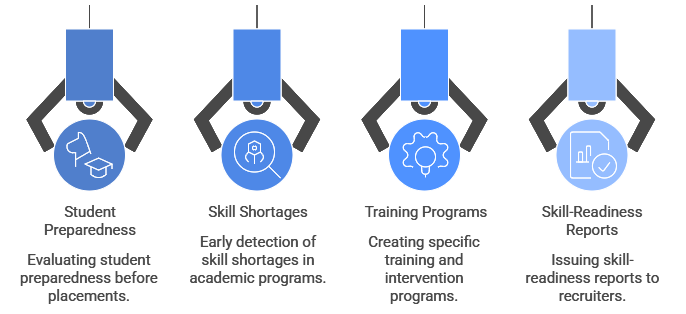
Employability Testing in Colleges and Universities
Related Blog -:
How Pre-Employment Assessment Enhances the Recruitment Process for Businesses
Employability Testing in Corporate Hiring
Companies employability testing at different hiring stages across the board, especially for entry-level and lateral positions.
Some of the common scenarios are:
- Graduate and campus recruiting
- Sweeping recruitment for junior positions
- Skill check during lateral hiring
- Assessment for internal mobility and upgrading
By resorting to a skill-based recruitment facilitated by an Employability Skills Test, companies not only build competent teams but also cut down the costs arising from hiring the wrong people.
Workforce Readiness and Business Outcomes Impact
Employability in India is Actually Getting Better:
- As per a report, the employability rate in India in 2026 was revealed at 56.35%. This is up from the 54.81 % written down for 2025. Source- Jagran Josh
- AI tools are said to be used by more than 90 % of workers, and that is a clear sign of digital skill adoption.
- India is projected to maintain its current position of claiming 16% of the world’s AI talent with further growth to come. Source- NDTV
The gap from education to employment is still a large challenge in the labor market. The frameworks of the Employability Skills Test close this gap by matching the learning outcomes with job requirements
The outcome for organizations is:
- Better productivity of the workforce
- Speedier onboarding and ramping up
- Reduced training costs
- Greater employee retention
Furthermore, the candidates are the ones who benefit from a more just system in which the selection is based on their skills and not on their background.
The firms that are inclined to conduct structured online assessments for employability gain an edge over their competitors. They are the ones who take the most reasonable decisions regarding hiring their manpower and thereby creating great teams, and also getting their employees ready for future challenges.
Conclusion
The skill-based recruitment already shows which way the process of hiring is turning. It is getting more and more important to evaluate real-life capabilities as roles develop and industries change.
The Employability Skills Test has stopped being an alternative option. It is a tactic and a weapon for institutions and employers who want to create a reservoir of talented people ready for the labor market through skills-based hiring.
The organizations adopting structured evaluation of employability are very close to getting a workforce that is capable of adapting and that is ready for the challenges of the future.