While technologies like AI proctoring and remote monitoring play a role, one of the most critical yet often overlooked components is the exam browser. A well-designed secure assessment browser acts as the first line of defense, creating a controlled digital environment where candidates can take tests without external interference.
In a region where data protection, exam integrity, and regulatory compliance are increasingly important, organisations are investing in secure browser technologies to build trust in their online assessment platforms.
So, how exactly does an exam browser ensure safe and compliant online exams? Let’s explore.
1. Creating a Controlled Digital Testing Environment
One of the primary roles of an exam browser is to replicate the control of a physical exam hall in a digital setting.
Why control matters in online assessments
Without restrictions, candidates can:
- Open additional tabs
- Access external resources
- Communicate with others
This compromises the fairness and credibility of the assessment.
How a secure assessment browser solves this
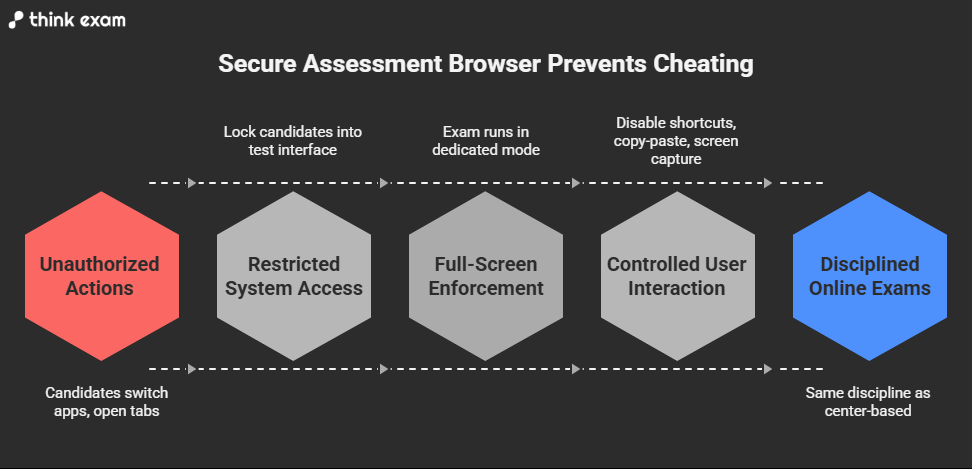
Instead of relying only on monitoring, it prevents unauthorized actions from happening in the first place.
What makes this effective
- Restricted system access
Candidates are locked into the test interface, unable to switch applications or open new tabs. - Full-screen enforcement
The exam runs in a dedicated mode, preventing navigation outside the test window. - Controlled user interaction
Keyboard shortcuts, copy-paste functions, and screen capture options are disabled.
This ensures that online exams in the UAE and GCC maintain the same discipline as center-based assessments.
- Strengthening Exam Security Beyond Monitoring
Most discussions around online exam security focus on proctoring, but prevention is just as important as detection.
The limitation of monitoring alone
Even with AI-based proctoring:
- Suspicious behavior is flagged after it occurs
- Some actions may go unnoticed in real time
The role of an exam browser in security
A secure assessment browser works proactively by:
- Blocking access to unauthorized tools
- Preventing navigation outside the exam
- Reducing opportunities for malpractice
Where it adds real protection
- Application-level restrictions
Candidates cannot open messaging apps, browsers, or external software during the test. - URL whitelisting
Only approved links are accessible, ensuring a secure testing pathway. - Background process control
The system can detect or block suspicious background activities.
This layered approach makes online assessment security more robust and reliable.
3. Ensuring Compliance with Regional Data and Exam Standards
In the UAE and GCC, compliance is becoming a major factor in adopting digital assessment solutions.
Why compliance matters
Organizations must ensure:
- Protection of candidate data
- Transparency in exam processes
- Alignment with institutional or regulatory standards
How a secure assessment browser supports compliance
A properly configured browser helps maintain:
- Data security protocols
- Controlled access to exam content
- Traceable exam sessions
Built for accountability
- Secure data handling
Sensitive exam data is protected during transmission and execution. - Audit-friendly environments
Restricted systems ensure that exams are conducted within defined rules. - Standardized testing conditions
All candidates operate within the same digital constraints.
This is especially important for universities, certification bodies, and enterprises in the UAE that require compliant online exam systems.
4. Enhancing Trust in Remote Assessments
Trust is a major concern when shifting from physical exams to digital formats.
The trust gap in online exams
- Candidates may feel others are cheating
- Institutions may question result authenticity
- Employers may doubt candidate credibility
How an exam browser builds trust
By enforcing strict controls, it ensures:
- Fair conditions for all candidates
- Reduced chances of malpractice
- Greater confidence in results
What builds credibility
- Uniform exam conditions
Every candidate faces the same restrictions, regardless of location. - Reduced dependency on supervision
Security is embedded into the system itself. - Transparent exam processes
Clear rules and controlled environments increase confidence.
This is crucial for digital hiring and academic assessments across the GCC, where credibility directly impacts decisions.
5. Supporting Scalable and Secure Online Exams
As organizations expand, they need solutions that can maintain security without slowing down operations.
The scalability challenge
- Managing large candidate volumes
- Ensuring consistent security
- Avoiding system failures
How secure browsers enable scale
A secure assessment browser ensures that:
- Security protocols remain consistent across all users
- Exams can be conducted simultaneously at scale
- System performance is not compromised
Designed for large-scale deployment
- Consistent enforcement of rules
Every candidate operates under the same restrictions, regardless of scale. - Lightweight system performance
Optimized browsers reduce technical load during high-volume exams. - Seamless integration with platforms
Works smoothly with online assessment software and digital testing solutions.
This makes it ideal for large-scale exams in the UAE, including university assessments and enterprise hiring drives.
- Improving Candidate Experience Without Reducing Security
Security should not come at the cost of usability. Modern exam browser solutions are designed to balance both.
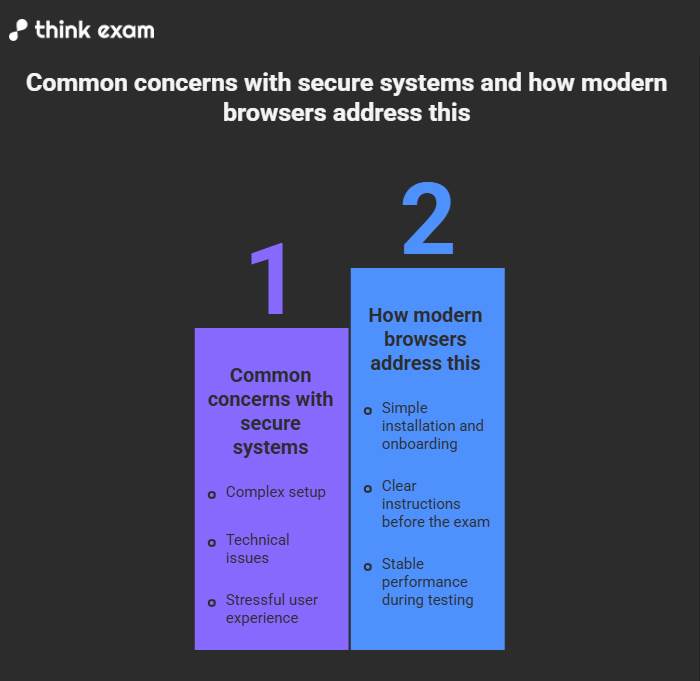
Common concerns with secure systems
- Complex setup
- Technical issues
- Stressful user experience
How modern browsers address this
- Simple installation and onboarding
- Clear instructions before the exam
- Stable performance during testing
Where experience meets control
- Guided system checks
Candidates can verify compatibility before starting the exam. - Minimal disruptions
Optimized performance ensures a smooth testing experience. - Clear user interface
Candidates can focus on the exam without confusion.
This balance is essential for maintaining candidate satisfaction in online exams, especially in competitive environments like the UAE job market.
7. Integrating with Modern Online Assessment Ecosystems
A secure browser does not work in isolation—it is part of a broader online assessment platform.
Why integration matters
- Ensures seamless workflows
- Improves efficiency
- Enhances overall system performance
How it fits into the ecosystem
- Works alongside AI proctoring tools
- Integrates with recruitment and learning systems
- Supports end-to-end digital assessment processes
Enabling a connected experience
- Unified assessment environment
From test delivery to monitoring, everything works together. - Centralized control for administrators
All exam activities can be managed from a single platform. - Enhanced operational efficiency
Reduces manual intervention and improves reliability.
Conclusion
A secure and compliant online assessment is not built on a single feature—it is the result of multiple layers working together. Among these, the exam browser plays a foundational role by creating a controlled and secure testing environment.
By combining:
- System-level restrictions
- Compliance-ready frameworks
- Scalable deployment capabilities
A secure assessment browser ensures that online exams remain fair, reliable, and aligned with modern digital standards.
As organizations across the UAE and GCC continue to adopt online assessment platforms and digital testing solutions, investing in secure browser technology is no longer optional—it is essential for maintaining trust, integrity, and compliance.