The biggest misconception about online exams is that security problems are obvious. Most people assume cheating happens through tab switching, impersonation, or visible misconduct. But the real issue is more subtle.
Today’s candidates understand how proctoring systems work. They don’t always break rules directly. Instead, they work around them. This creates a serious challenge for organisations trying to maintain exam integrity.
The problem is not the lack of monitoring. It is the lack of intelligent monitoring. This is exactly where AI proctoring changes the equation by focusing on behaviour, not just actions.
How are traditional proctoring being overtaken by modern online exams
Traditional proctoring systems are built on fixed rules. These rules are simple:
- If a candidate switches tabs, flag it
- If the face is not visible, flag it
- If sound is detected, flag it
This approach worked earlier, but not anymore.
Candidates today are more careful. They:
- Use brief eye movements instead of turning their head
- Keep secondary devices out of camera view
- Coordinate answers without obvious communication
- Stay within acceptable limits to avoid detection
Because of this, many online exams appear secure on the surface but still allow undetected malpractice. The system records compliance, not honesty.
How AI Proctoring Identifies What Others Miss
The real strength of AI proctoring lies in its ability to analyse patterns instead of isolated actions.
Instead of asking, “Did something go wrong?”, It asks:
- Is this behaviour consistent with genuine test-taking?
- Is there a repeated pattern that indicates risk?
- Does this match known cheating behaviour?
This shift makes online exam proctoring more predictive than reactive.
Pattern-Based Monitoring Instead of Single Triggers
Traditional proctoring treats every violation as a separate event. But in reality, cheating is rarely a single action.
It is a sequence of small signals.
For example:
- Frequent micro eye movements
- Slight delays before answering
- Repeated attention shifts
Individually, these signals mean nothing. Together, they form a pattern.
AI proctoring connects these signals to identify suspicious behaviour. This reduces false alerts while improving detection accuracy in online exams.
Context-Aware Evaluation for Each Candidate
Not every candidate behaves the same way during an exam.
Some candidates:
- Look away while thinking
- Pause frequently
- Move naturally while solving problems
A rigid proctoring system flags all such behaviour as suspicious.
But AI proctoring builds a behavioural baseline during the exam. It understands what is normal for each candidate and identifies deviations from that pattern.
This makes online exam proctoring far more accurate because it evaluates context, not just actions.
Solving the Second Device Problem
One of the biggest weaknesses in online exams is the use of secondary devices.
Candidates often use:
- Mobile phones placed outside the camera view
- Smart devices for quick assistance
- Silent communication methods
A lockdown browser cannot detect this because it only controls the primary device.
This is where AI proctoring becomes critical.
It tracks:
- Eye direction changes
- Attention shifts
- Repeated off-screen focus
Instead of detecting the device, it detects the behaviour of using one. This closes a major security gap in online exam proctoring.
Time Intelligence Adds Another Layer of Security
Most systems focus only on visual monitoring. But AI proctoring also analyses time-based behaviour.
It evaluates:
- Time spent per question
- Sudden changes in answering speed
- Consistency in response patterns
For example, if a candidate struggles initially but suddenly answers complex questions quickly, it may indicate external help.
This makes online exams more secure because behaviour is analysed across multiple dimensions, not just video.
Lockdown Browser Alone Is Not Enough
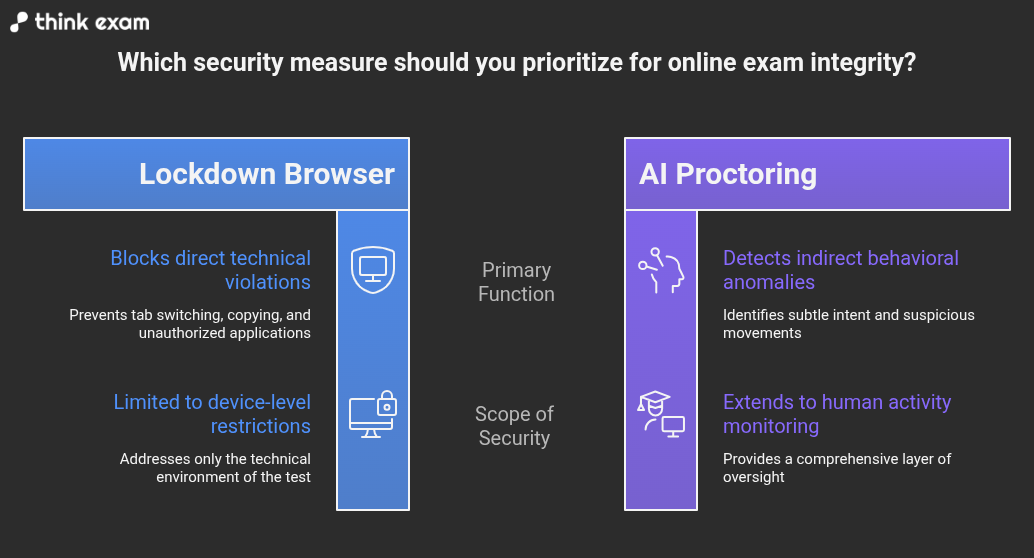
A lockdown browser is often considered a complete solution, but it only addresses part of the problem.
It can:
- Block tab switching
- Restrict applications
- Prevent copying
But it cannot understand intent.
When combined with AI proctoring, the system becomes much stronger:
- The lockdown browser prevents direct violations
- AI proctoring detects indirect and subtle behaviour
This layered approach makes exam online proctoring more reliable.
From Monitoring to Risk-Based Decision Making
Traditional proctoring produces large volumes of recorded data, which is difficult to review.
AI proctoring transforms this into meaningful insights.
It assigns risk levels based on:
- Frequency of suspicious behaviour
- Severity of deviations
- Pattern consistency
This allows organisations to focus only on high-risk cases instead of reviewing every session.
As a result, online exams become easier to manage at scale without compromising security.
Why This Matters for High-Stakes Online Exams
In large-scale online exams, even a small percentage of undetected cheating can affect results.
The challenge is not detecting obvious violations. It is identifying behaviour that appears normal but is not.
AI proctoring addresses this by:
- Expanding detection beyond visible actions
- Reducing reliance on human observation
- Maintaining consistency across candidates
This is why online exam proctoring is becoming essential for institutions and organisations.
The Shift from Prevention to Assurance
Most systems are designed to prevent cheating. But prevention alone is not enough.
Organisations need assurance.
They need confidence that:
- The candidate was evaluated fairly
- The results are reliable
- The process was secure
This level of trust can only be achieved when online exams are supported by intelligent proctoring, not just restrictions.
Why Organizations Are Moving Toward AI Proctoring
Organisations are rethinking their approach because:
- Cheating methods are evolving rapidly
- Manual proctoring cannot scale effectively
- Basic tools fail to detect subtle behaviour
AI proctoring solves these challenges by adapting continuously and improving detection over time.
When combined with a lockdown browser, it creates a secure and scalable system for online exams.
Conclusion
The real issue with online exams is not the lack of monitoring. It is the lack of intelligent monitoring.
Traditional proctoring systems focus on visible violations. But modern challenges require understanding behavior, patterns, and intent.
This is exactly what AI proctoring delivers.
By combining behavioural analysis, pattern recognition, and integration with tools like a lockdown browser, it creates a system that goes beyond restriction.
It builds trust.
And in today’s digital assessment landscape, trust is the true measure of security.