A resume can tell a recruiter where someone has worked. An interview can reveal how they communicate. But neither always shows how a candidate approaches the actual work.
That gap is one reason the online assessment test has become a more common part of modern hiring.
Instead of relying entirely on resumes and interviews, organisations can use assessments to collect additional evidence about a candidate’s skills before moving further into the hiring process.
The shift is not simply from paper tests to digital tests. It is about changing when and how employers gather evidence during recruitment.
Hiring Is Moving Beyond the Resume
The first stage of hiring often produces a large pool of applicants.
Recruiters may have information about:
- Education
- Previous experience
- Certifications
- Skills listed on the resume
- Previous employers
But these details are largely candidate-provided information.
An online assessment test introduces another layer: candidates can be asked to demonstrate specific knowledge or skills through a structured assessment.
For example, a technology role could include coding or problem-solving tasks. A sales role could use situational questions. A customer-service role could assess communication and decision-making.
The assessment is therefore connected to the role rather than simply adding another step to the hiring process.
Assessments Can Move Earlier in the Hiring Funnel
Traditionally, assessments were often associated with later stages of recruitment.
Digital assessment workflows make it possible to introduce them earlier.
A simplified hiring journey might look like:
Application → Screening → Online Assessment → Interview → Final Evaluation
This can help recruiters gather more information before investing significant interview time.
For high-volume recruitment, this can be particularly useful. Instead of scheduling interviews with every applicant who meets basic resume criteria, organisations can use an assessment as one additional evidence point before deciding who progresses.
The assessment does not replace human decision-making. It changes the information available to recruiters when making those decisions.
The Test Can Be Designed Around the Job
One of the biggest changes in modern assessment is the move away from generic testing.
A well-designed assessment can reflect the actual requirements of a role.
For example:
| Role | Possible assessment focus |
| Software Developer | Coding and problem-solving |
| Sales Executive | Situational judgement and communication |
| Customer Support | Response handling and decision-making |
| Data Analyst | Data interpretation and analytical reasoning |
| Graduate Trainee | Aptitude, reasoning and role-specific knowledge |
This makes online assessments more useful when they measure something relevant to the position.
The question becomes less about “Can this candidate score well on a test?” and more about “What evidence does this assessment give us about skills relevant to this role?”
Digital Assessment Platforms Make Hiring More Structured
Managing assessments manually can become complicated when recruitment volumes increase.
Recruiters may need to create different tests, assign candidates, track attempts, review results, and maintain records.
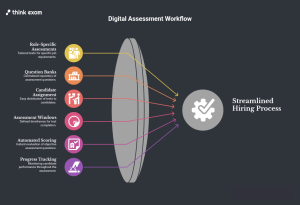
A digital assessment platform can bring these activities into one workflow.
Depending on the platform, recruiters may be able to:
- Create role-specific assessments
- Maintain question banks
- Assign tests to candidates
- Set assessment windows
- Automate scoring for objective questions
- Track candidate progress
- Generate reports
- Integrate assessment data with recruitment workflows
This reduces the need to manage each assessment as a separate process.
Online Exams Are No Longer Limited to Academic Settings
The idea of an online exam is often associated with schools, universities, or certification bodies.
But the same assessment infrastructure can support recruitment.
The difference is mainly in what the organisation wants to measure.
An academic assessment might evaluate subject knowledge. A recruitment assessment could evaluate aptitude, job knowledge, technical ability, behavioural scenarios, or role-specific problem-solving.
A computer based test can therefore become part of an employee-selection process rather than being limited to formal education.
Assessment Data Can Improve the Interview Stage
An assessment should not necessarily end when the score is generated.
Its results can also give interviewers a starting point for deeper conversations.
Suppose a candidate performs strongly in technical problem-solving but struggles with a particular area. An interviewer can explore that skill further during the interview.
Similarly, a candidate’s responses to situational questions can help interviewers develop more focused follow-up questions.
This creates a connected process:
Assessment → Insights → Interview → Deeper evaluation
The assessment becomes part of the hiring conversation rather than an isolated pass-or-fail checkpoint.
Online Assessments Can Support High-Volume Hiring
Recruitment becomes more operationally demanding when hundreds or thousands of candidates apply for similar roles.
Manual assessment processes can create bottlenecks.
Digital assessments can help standardise activities such as:
- Test allocation
- Candidate instructions
- Timed attempts
- Objective scoring
- Result generation
- Candidate tracking
For organisations conducting graduate recruitment, campus hiring, sales hiring, or large recruitment drives, this can make assessment easier to manage at scale.
The important point is that automation handles parts of the workflow—not the entire hiring decision.
Security Becomes Important When the Stakes Increase
Not every recruitment assessment requires extensive monitoring.
But when an assessment plays a significant role in candidate selection, organisations may need additional controls.
Depending on the role and assessment, these can include:
- Candidate identity verification
- Secure browser environments
- Question randomisation
- Activity monitoring
- Remote proctoring
- Attempt controls
These measures can help organisations maintain greater confidence that the assessment result represents the candidate’s own attempt.
The appropriate level of security should depend on the assessment’s purpose, candidate experience, and organisational requirements.
The Role of AI Is Expanding
AI is also becoming part of the assessment workflow.
Depending on the platform, AI can support activities such as:
- Question generation
- Question categorisation
- Candidate monitoring
- Response analysis
- Performance insights
- Automated scoring for suitable question types
But AI should support assessment design and analysis rather than turn the hiring decision into an automated score.
Recruiters still need to consider experience, communication, role fit, interview performance, and other relevant evidence.
The Bigger Change Is How Recruiters Gather Evidence
The growth of the online assessment test is part of a broader shift in recruitment.
Hiring teams are increasingly looking for ways to move from statements about skills to evidence of skills.
That does not mean resumes or interviews are becoming irrelevant. Instead, different stages of recruitment can answer different questions.
Resume: What experience does the candidate report?
Assessment: What can the candidate demonstrate in a structured task?
Interview: How does the candidate explain, communicate, and respond to deeper questions?
Final evaluation: How does the available evidence align with the requirements of the role?
When these stages work together, assessment becomes more than another screening step. It becomes a structured source of evidence within the hiring process.