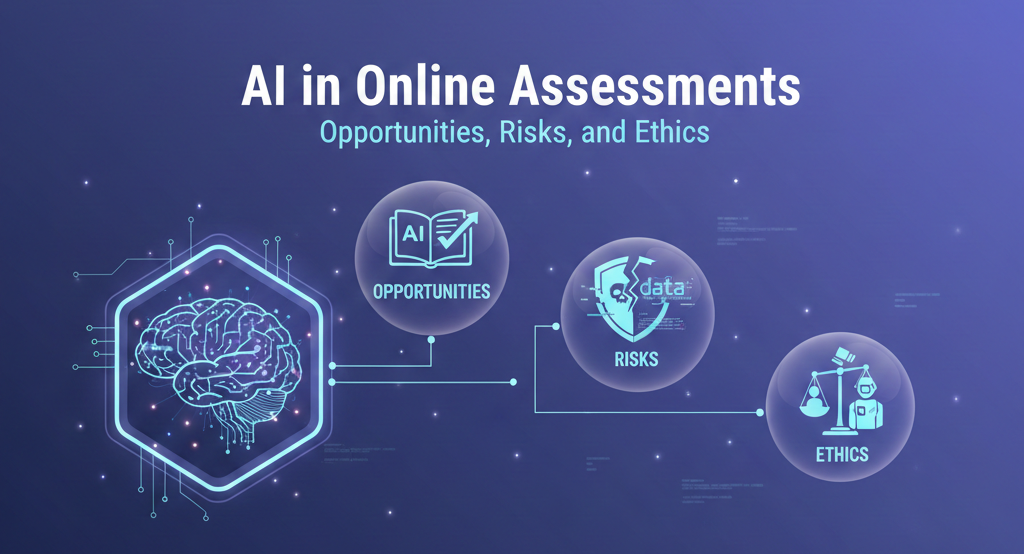
An assessment environment is experiencing development of a different kind. Since examinations are coming online to an unprecedented level, artificial intelligence is fast becoming an inevitable aspect of how complexity, speed, and accuracy will be achieved in many institutions and organizations. It would be misleading to say that AI online assessments are a future proposition because they are now supporting contemporary examination reforms.
Still, as solutions are accepted, the price of their use increases. While AI assessment offers perks in terms of functionality and intelligence, it also poses certain challenges that revolve around fairness, accountability, and morals. Such institutions must consider advantages as well as drawbacks when analyzing the digital performance index over a long period, especially when deploying AI Online Assessment systems at scale.
Industry research claims that over 65% of schools and colleges across the world have fast-tracked their migration to online exams since 2020, with AI-based tools providing a critical pace and control to management. This rapid adoption highlights why AI is now central not optional to modern assessment reform.
Opportunities for a Rise in AI Usage for Online Assessments
Systems that can provide efficient, effective, and affordable examination services are more available than ever before. There are universities, training computer systems and organizations, recruitment personnel, and certifying bodies that administer exams to thousands of people across multiple geographical locations and timeframes.
The candidates in this case are diverse, and traditional assessment approaches are found to be inadequate when dealing with this scale.
Online assessments aimed at addressing institutional challenges increasingly rely on AI Online Assessment, which serves three critical and integrated objectives.
AI-powered assessments are redefining learning and workforce development. Read more in The Ultimate Guide to Learning and Development with AI-Powered Assessments.
-
Scalability Through Intelligent Systems
To begin, scalability. All AI systems help scale the number of candidates without losing consistency. Standard processes remain intact in implementation regardless of examination volume or evaluation complexity.
Recent assessment technology reports indicate that AI-powered online assessment platforms can handle 5–10x higher candidate volumes compared to traditional systems, without proportional increases in administrative effort. With integrated tools such as an AI video maker for creating automated proctoring guides and candidate instructions further streamline processes at scale. This expansion is one of the critical aspects that leads to the consideration of traditional examination systems in the institutions.
-
Cost Optimization and Efficient Operations
Secondly, the problem of cost efficiency. It eliminates or minimizes some tasks such as invigilation, evaluation, and logistical planning. The operational cost of any activity drops while the time efficiency of implementation enhances substantially due to AI-enhanced operations.
-
Faster and Deeper Performance Insights
Thirdly, faster and greater insights. Long waiting periods for results no longer appeal to decision-makers. AI analytics provide assessment performance data, trends, and insights in real time, strengthening the value of AI Online Assessment platforms.
These benefits collectively explain why AI adoption is accelerating across assessment processes.
Benefits of Promoting AI Application in Assessments
The application of AI in assessments improves design, execution, and grading efficiency across examination models.
-
Automated Grading and Quicker Turnaround
Assessment systems powered by AI are capable of automatically grading objective-type questions and supporting structured evaluation workflows. This enables faster result generation without delays or calculation errors.
Faster evaluation enhances the candidate experience and allows institutions to act on outcomes immediately.
Research suggests that automated evaluation systems achieve 99% accuracy in objective question grading, significantly minimizing human error and enabling institutions to meet tighter result declaration timelines.
-
Tailor-Made and Customizable Assessments
AI enables assessments to adjust difficulty levels based on candidate responses. This ensures more accurate evaluation of true skills rather than rote memorization.
This capability is a key strength of AI Online Assessment models focused on skill-based evaluation.
-
Surveillance and Security in Real Time
AI-based monitoring systems track suspicious actions, abnormal behavior, and inconsistencies during assessments. This enhances exam security while reducing dependency on human supervision.
When implemented responsibly, these tools increase confidence in online examinations.
Related Blog:-
AI Proctored Exam: The Future of Secure Online Assessments
-
Data-Driven Insights for Institutions
Online assessments do more than test candidates they enable meta-evaluation. Institutions gain insights into question quality, scoring rubrics, and performance trends across candidate groups.
Such insights help improve test design, training modules, and future assessment strategies supported by AI Online Assessment frameworks.
Key problems: Equity, Responsibility, and Misuse of Information
Despite the advantages, the decision makers need to understand the risks introduced by AI.
-
Inherent Fairness Issues in Technology
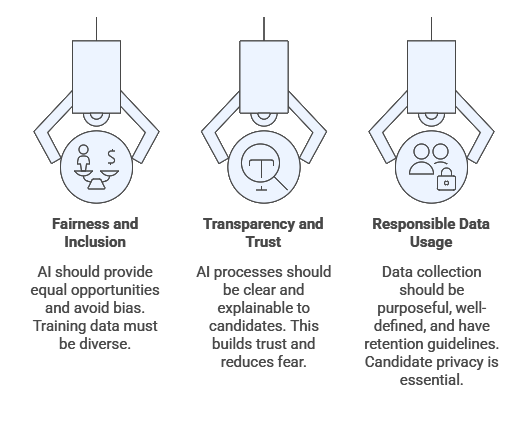
AI systems learn from historical data. Any unbalanced input data, biased intentionally or unintentionally, may give rise to regrettable results.
Depending on the level of this bias, it may tilt some scores, impact specific interventions and candidate profiles, more so in summative evaluations, such as high-recruitment assessment and educational contexts.
In shaping global audits, undisputed AI technologies shall enhance this bias by up to 20%. For this reason, high-stakes assessments must be conducted with periodic bias testing and examination of data sets.
-
Persistent Concerns Around Data Safety
When it comes to most AI-based system management systems, they are bound to be impractical to interpret without restriction. When accountability is required, limited explainability becomes a concern.
Transparency is an essential component of any AI Assessment, which is used for educational, career, or certification-related analysis.
-
Worries about the Security of Data Stay
Assessments include personal and performance data, which is sensitive. Inefficient measures for data protection can easily subject the institution to data misuse, leaks, or even compliance exposure.
Every deployment of AI Online Assessment must put responsible data management at the core of its operations.
Ethical Use of Technology and Its Byproducts
Ethical AI usage is not optional it is a necessity.
Organizational Accountability and Regulation
AI tools should not be used without any control. There are zero excuses for failing Online Assessments.
Institutions are responsible for ensuring that they implement AI appropriately, with ethical practices, scholarly activities, and the peculiar clauses of the law, etc. In the new AI era, these include demarcation of spaces for deployment, instances to engage humans, and systems for carrying out assessments.
There should be systematic ethical funding audit and remedy processes in place. The role of AI is to assist, not substitute, human judgment.
All online assessment platforms providing AI Online Assessment solutions should abide by ‘institution-compliant ‘regulations, policies, and consider ‘strategies’.
Opportunities for Intelligent Assessment Using Artificial Intelligence
Implementations of various effective AI processes for typical test revisions are likely to come with a lot of help in the future. AI technologies will help achieve maximum efficiency when it comes to test delivery, as well as its grading and reporting.
However, effectiveness depends on responsible implementation.
Organizations that mesh technology advancements with ethical principles for management will be able to draw the confidence of competent candidates, experts and other interested parties and authorities. Those who promote not only inclusivity but also transparency and accountability of AI assessment technology will acknowledge and achieve their sustainable business objectives.
AI does not make decisions; rather, it facilitates enhanced and judicious ones.
Appropriately employed AI online assessment is an aspect that enhances the basic traditional examination mechanisms by permeating them with intellectual layers, which benefit all users and are characterized by increased speed and reduced bias.
Closing Remarks
It is estimated that the CAGR of artificial intelligence evaluation systems shall be above 30%, an indication that such firms will have to embrace intelligent evaluation systems rather than heavy data-driven evaluations largely.
The majority of Online Assessments are experiencing an enormous revolution with the application of Artificial Intelligence capabilities. Such innovations, nevertheless, have to remain within certain bounds.
There is a way out one that provides a stable, scalable, secure, and ethical examination ecosystem in the presence of AI.
This balanced approach will define the next generation of trusted digital assessments.
FAQs
1. Define AI Online Assessments.
AI Online Assessments are able to assist examination preparation, distribution, invigilation, and results analysis, among other services. Every aspect of these systems is automated, such as assessment and analysis of irregularities that may occur.
2. What are the advantages of AI in e-assessments?
Organizations have implemented AI mechanisms to overcome obstacles such as congestion during examinations, reduction of expenses associated with examinations, faster compilation of data and result keeping, as well as comprehensive analysis of performance. Online assessments done with AI are less prone to cheating and maintain standards even if such assessments are in different areas of the world and at different intervals.
3. What is the role of AI in ensuring the precision of test delivery?
AI helps in enhancing precision in assessments by reducing the incidence of human errors, ensuring consistent and similar criteria of assessment are used. It also brings efficiencies in the processing of responses on a macro-level. Incompetency testing is also observed in skill-based AI Assessment models.
4. What are the significant dangers associated with AI-driven assessments?
The key dangers include algorithmic bias, opaqueness in AI-supported decisions, and abuse of applicants’ sensitive information. All avoidance of these issues require ability to control and manage governance of the AI Examination system, as they will affect all these: fairness, trust, and compliance.
5. What measures should the organisations adopt and follow as relates to the online assessments with the use of AI?
Online Assessments require fairness, explicitness, and appropriate treatment of data that is obtained. Institutions are to regularly perform bias tests, make the evaluation process open, get appreciation if required, and established strong rules in data management and preservation.