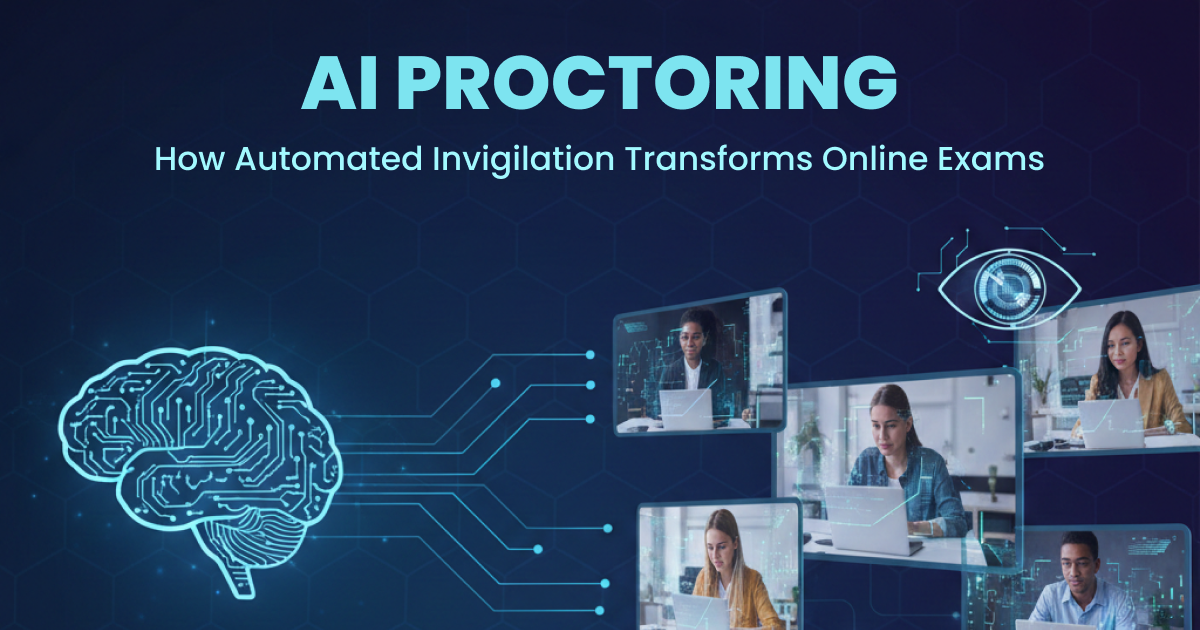
In today’s world, online exams have transitioned from being perceived as a choice to an inevitability. This is to say, schools, colleges, employers, or body assessments are mainly conducted in mass assessments and in most cases in different countries or time zones. Yet, it has highlighted a great issue: how will an individual keep exam security in the absence of any physical invigilation or monitoring?
In such a situation, AI Proctoring has proven to be a revolution. With the replacement of invigilators with advanced technologies, automated invigilation is changing the dynamics of online assessments—making them safe, just, and organized. AI Proctoring is now central to how institutions rethink assessment credibility.
Why Online Exams Need AI Proctoring
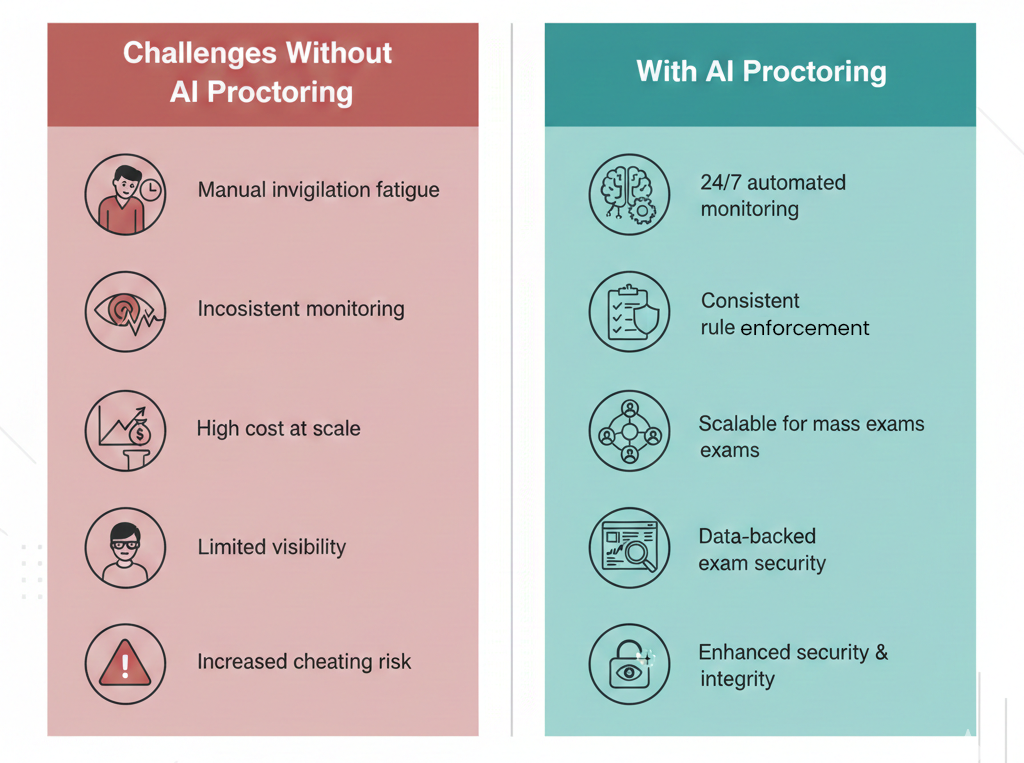
1. Scaling up Human Invigilation: The Basic Flaw
The model of conventional examination invigilation takes place within closed classrooms involving participants as such and does not entail such practice where millions log in through remote proctoring environments, something Remote Proctoring was specifically designed to address.
In the case of online mode of assessments, the human component of examining also has its limitations.
2. Fatigue and Cognitive Depletion
Initially, the depletion of energy and cognitive functioning is an inevitable occurrence. Watching several active screens for long intervals diminishes the precision levels, increasing the possibilities of violations going undetected—an issue that AI Proctoring eliminates through continuous monitoring.
3. Lack of Uniformity
Later, the issue of uniformity comes to the fore. The different actions taken by different supervisors according to their own interpretations result in inconsistent application of the regulations.
4. Cost and Scalability Challenges
Following this, financial constraints as well as an aspect called scalability create barriers to any further expansion. Organizing, conducting such exams at a high level and efficiency, and controlling geographically spread invigilators comes at a very high cost.
5. Limited Visibility
Human examiners only encounter screens and therefore, some of the cheating practices or unfair methods get particularly missed from human eye.
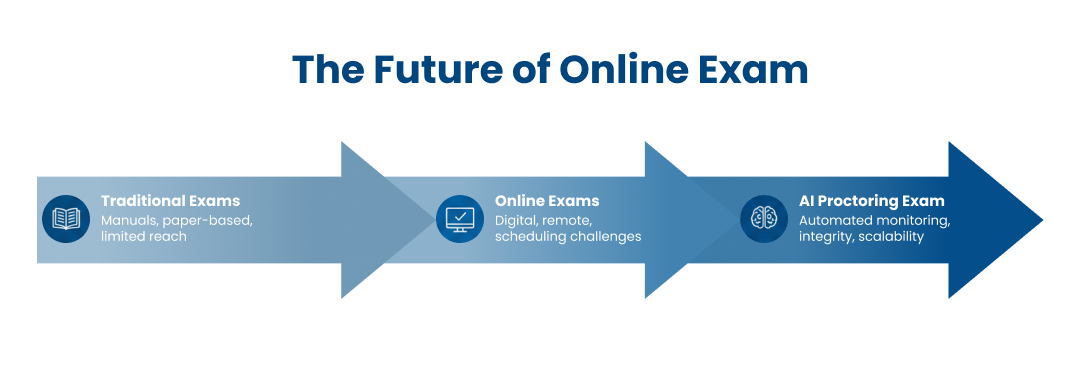
Overall, given the existence of online examinations, such fundamental tactics are considered obsolete. This gap led to the rise of automated invigilation, where Proctoring provides scalable and consistent oversight.
What AI Proctoring Really Does (Beyond Webcam Watching)
It is commonly believed that AI proctoring technologies only aim to capture the candidates’ images with the help of an installed camera. In fact, instead of stopping at merely capturing images, many AI Remote Proctoring systems operate in a real-time continuous mode.
In other words, AI doesn’t just let events happen while a passive recorder collects images or audio but helps to understand the environment, behavior, and activities in the absence of a person—this is the real value of AI Remote Proctoring.
The surveillance covers the way the head moves, where the eyes look at, how many faces can be seen in front of the monitor, how loud the room is, changes in a screen, and also alarming regularities. The system either throws up flags straightaway, or the flag is raised after the exam and during the report analysis stage.
This strategy thus brings a shift from trying to manage exam activities to how we manage exam security prior to the exam and attempts to preclude any form of malpractice by assuring consistency and fairness through AI Remote Proctoring.
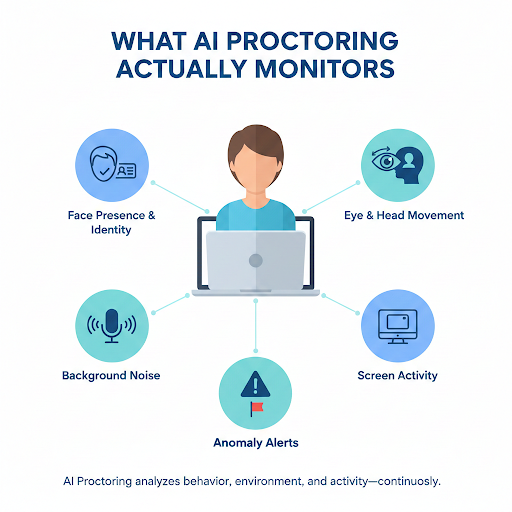
Core Technologies Powering AI Proctoring
It is efficient only in relation to other measures. Here, the pertinent technology helps protect the assessment and limit cheating through AI Proctoring.
Face Recognition
This is a technology that cautions that a different person, other than the rightful candidate, instead of taking the test, is actually the one taking it.
The system controls login by performing an identity check and monitors the user’s activity by detecting face presence. Anytime out-of-screen presence of the candidate or presence of another individual is noted, the system raises a red flag.
This curtails impersonation while doing away with the need for manual facial verifications, strengthening Online Proctoring outcomes.
Behaviour Analysis
There is always an analysis of the things that candidates do when it is their turn to take the exam.
Head movement disorders, glances, or repeated looking away are all tracked. AI models are developed in a way that allows discrimination between usual conduct and suspicious activity, removing the inconsistency human invigilators often have.
Detection of Anomalies
Anomalies detection entails detecting deviations from the usual conduct of exams.
This may include unexpected screen alterations, restrained application usage, unusual sound emission, or uneven exam progression. Time stamps of such activities are logged alongside the anomaly, forming an audit document—an essential part of AI Proctoring systems.
The combined layers create an efficient automated invigilation system that ensures equity without excessive human surveillance.
Securing Exams while Respecting Privacy
AI Proctoring has faced resistance primarily due to privacy concerns. Institutions worry about misuse of information, excessive surveillance, and candidate discomfort.
Current technologies address these issues effectively.
Such principles refer to ethics in AI that restrict the gathering of data to the least necessary ones, and these are the cornerstones on which the technology is constructed. Data is encrypted, and only a few authorized persons can access it as the storage is secure.
Transparent consent mechanisms explain what is being observed and why. Configurable security settings allow institutions to balance exam security with privacy expectations.
Exam security and privacy are not opposites—they coexist within responsible AI Remote Proctoring frameworks.
Real-World Adoption of AI Proctoring
AI Proctoring is no longer experimental. It is actively used in sectors where assessment integrity matters.
Educational Systems
- Higher education institutions use Online proctoring for semester exams, admissions, and distance learning programs.
- Automated invigilation allows exams to be conducted for large candidate volumes without academic compromise.
Employee and Evaluative Activities
- Companies switch to online assessments for recruitment, performance evaluations, and compliance testing.
- Remote proctoring secures the evaluation processes and guarantees the making of reliable decisions.
Rewards and Qualification Examinations
- High-stakes exams demand strict control.
- AI proctoring enables safe exam delivery across regions without physical centers, building trust and accessibility.
Adoption Readiness Checklist for AI Proctoring
Before implementation, institutions should evaluate readiness:
- Is exam-taking conducted at scale?
- Is exam security and fairness critical?
- Are manual invigilation costs or availability problematic?
- Are candidates geographically distributed?
- Is basic infrastructure available?
- Are data protection policies defined?
- Is bias-free monitoring required?
- Is future scalability important?
If most answers are “yes,” AI Proctoring can significantly enhance your assessment framework.
The Future of Online Exams Is Intelligent
It is no longer only about using online exams for their convenience, but they also carry a message of credibility.
AI Proctoring has enabled institutions to make secure, scalable, and fair assessments without putting an extra burden on the operations. The use of automated invigilation and intelligent monitoring together provides a level of supervision that no human system can reach.
As the digital assessment becomes more sophisticated, AI Proctoring will not just be a helper in the online exam process—it will set the norm.
Read more about- AI proctoring software and secure online exam management.
FAQs
1. What does AI Proctoring in online examinations mean?
AI Proctoring makes use of intelligent algorithms that are capable of assessing the candidates’ behavior, identity, and surroundings without the need of physical invigilators during the online testing process.
2. How is AI Proctoring distinct from traditional proctoring?
The human factor plays a very important role in traditional proctoring, while AI Remote proctoring just makes use of analyzing students’ behavior, facial movements, and looking for any anomalies to ensure consistent and scalable security during the exam.
3. Do the candidates get recorded for the whole time they take an exam?
The AI Proctoring systems might strictly monitor video, audio, and screen activity for the sake of invigilation only and that too, with secure storage and limited access.
4. In what way does automated invigilation prevent cheating?
It can tell the presence of more than one person, the direction of the gaze in various directions, noise created from the background, switching of the screens, and unauthorized persons gaining entry, which would thus make the exam more secure.
5. How reliable is AI Proctoring in spotting malpractice?
AI Proctoring relies on several behavioral markers that have been trained on vast datasets, which ultimately results in a decrease of false positives and an increase in detection accuracy.
6. Is AI Proctoring respectful of candidate privacy?
The answer is yes. AI Proctoring makes use of data minimization, consent, and compliance standards that are meant to ensure a balance between the security of the examination and the privacy of the candidate.