In today’s world, choosing the right kind of online assessment platform is a necessary process and not simply standard practice anymore for a large number of organizations. Exams have become increasingly constructive and are utilized for academic grading, campus recruitment, and internal training and certification in the corporate sector.
The workforce development, IT talent recruitment and performance management, and human resource development are a few of the many platforms that most promise to do all the activities listed above through an Online Assessment Platform. However, the critical engagement is how the buyers select the platform that meets their desired objectives.
This document will help buyers distinguish what really matters apart from other features and aid in making an affirmative, futuristic purchase when choosing an Online Assessment Platform.
1. Buyer’s Dilemma: Feature-Rich vs Fit-for-Purpose
One of the biggest, if not the biggest, mistakes buyers make is thinking that the more features a platform has, the more interesting and beneficial it automatically becomes.
The modern Exam Platform they use contains extended dashboard management, customization, and enhancement capabilities. While they sound good in theory, everything that is excessive is very expensive, very difficult to use, and very difficult to adapt.
What truly matters is relevance.
- The goal of a university in using an online assessment platform could be Scalability and exam integrity.
- An enterprise may have analytics and hiring insights as goals.
- Training institutions may look for user-friendly environments with quick-to-deploy learning solutions.
An Online Assessment Platform must match your requirements or objectives and not your wish list. The idea here is to get not the best but the most suited tool for this specific function.
2. Essential Functionalities That One Must Consider
Do not commence the selection process before ascertaining that the platform can satisfy these basic requirements. In the absence of these requirements, even the most complex tools will be useless.
Question and Test Management
The exam platform ought to offer varied question types, i.e, descriptive, coding, case-based, and multiple choice questions. Reusing questions and maintaining consistency will require question banks, tagging, and versions.
Delivering Tests And Accessibility
Good assessment software should enable candidates to take tests seamlessly across all devices and browsers. The candidate should not experience any difficulty in delivering a test, irrespective of the circumstances.
Assessment And Marking
Scoring, grading, and evaluating objective Kohser questions have to be done. Such scoring should be allowed to also allow for the creation of steps based on compensating for manual grading where necessary.
Reliability
It does not matter if 50 tests are conducted or 50,000, for the Online Assessment Platform must work with stability without breaking down or slowing down.
=======================================================
Related Blog -:
Best Online Assessment Platform for Modern Hiring
=======================================================
3. Security, Scalability & Compliance: The Deal-Breakers
It is important to mention that these three aspects are not for consideration when it comes to institutions and companies – they are conclusive.
Security
Eliminate any risk through login technologies, encryption of data, and limits for data availability. A secure Exam Platform ensures data protection as well as the prevention of unauthorized access to assessment materials.
Performance
Depending on the nature of the exam, some assessment cases have a good pace during their showdown, but in actual circumstances, they are slow. It is necessary to confirm that the assessment software can handle miscellaneous assessments without a hitch.
Compliance
It is important to employ the principles of data management and protection alongside organizational guidelines where possible. Long-term use and risk protection are achieved with compliance preparedness.
A robust Online Assessment Platform fundamentally looks at security and compliance as its architectural issues and not as mere appendices that can be fixed into its structure.
4. Analytics & Reporting: From Scores to Insights
There was a time when scores and scores alone sufficed to evaluate any process.
The distinction between an effective and ineffective exam platform is the presence of an analytical tool that generates alerts.
Such report-generating tools should assist the user in knowing:
- Which parts of the test had the highest number of candidate failures?
- Which are the most frequently failed skills?
- How many candidates had problems with that portion of the test?
Sophisticated analytics enable universities to enhance teaching and learning as well as assist organizations in customizing sourcing and training.
In a survey of engaged assessment software, data is transformed into insight void of chaos through a capable Online Assessment Platform.
5. Vendor Evaluation Checklist (Use This Before You Decide)
There is a prepared list of questions that would allow an unbiased comparison of various vendors:
- Does the Online Assessment Platform fit your requirements?
- Is the User Interface of the Product simple enough for both the examinee and examiner to use?
- Can the assessment tool be developed further without compromising its utility in any form?
- Are procedures for securing and ensuring compliance effectively articulated?
- Does the exam platform provide significant analytics, rather than simply reports?
- Does the support team understand the user’s needs and resolve their issues quickly?
- Is it possible to enhance the platform when the number and type of assessments that must be done change?
This is the key objective of this checklist – minimizing bias while maximizing the assessment of actual deliverables, not promises.
6. Final Decision Matrix for Institutions & Enterprises
To finalize your choice, evaluate each platform across four dimensions:
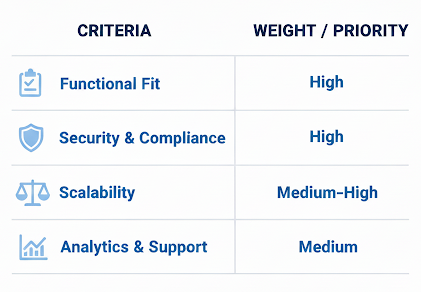
Each Online Assessment Platform has to be evaluated honestly according to these parameters. The platform that gets the highest overall alignment, not the one that has the most features, is the ideal one.
Final Takeaway
The exam platform that fits within the bounds of practicality, monitors the conduct of the exams, and helps in resolving environment-related issues is the most appropriate, not a perceived ‘fit-for-all’ solution.
FAQs
1. What is an Online Assessment Platform?
Online Assessment Platform is the digital measure of creating, presenting, following up, and assessing exams or tests from remote locations or controlled settings. Through its applications, anything from academic exams to recruitment assessments, certifications to performance evaluations, can be done on a large scale with a guarantee of accuracy and integrity.
2. How is an Online Assessment Platform different from traditional software for assessment?
Traditional assessment tools typically just focus on creating and scoring tests. A truly advanced Online Assessment Platform will go into full detail about the secure ways of actually delivering this test, the scalability of the platform for enormous numbers of test-takers, advanced analytics to utilize measured data, and a compliance-ready architecture to legally fit into educational institutions and more.
3. What are the primary features to look for when deciding on an assessment platform?
Some things to consider are as follows:
- Question and test management
- Secure and reliable test delivery
- Automated and manual evaluation options
- Scalability for peak usage
- Analytics and reporting capabilities
This platform should be well optimized and practical, and it should match its functionality to the one envisaged without a multitude of functionalities.
4. Why is security so critical in online assessments?
Safeguards prevent the leakage of the exam, the participants’ details, and the results. Lack of adequate security measures in assessments results in compromising leakage of information, impersonation, and even cheating. For this reason, security is usually considered the most important aspect of any Online Assessment Platform.
5. How do I evaluate multiple vendors objectively?
Engage a checklist-based technique that emphasizes requirements for a given scale, security, scalability, analytics, and support. It becomes apparent only through comparison that some software evaluations truly serve the targeted purposes.