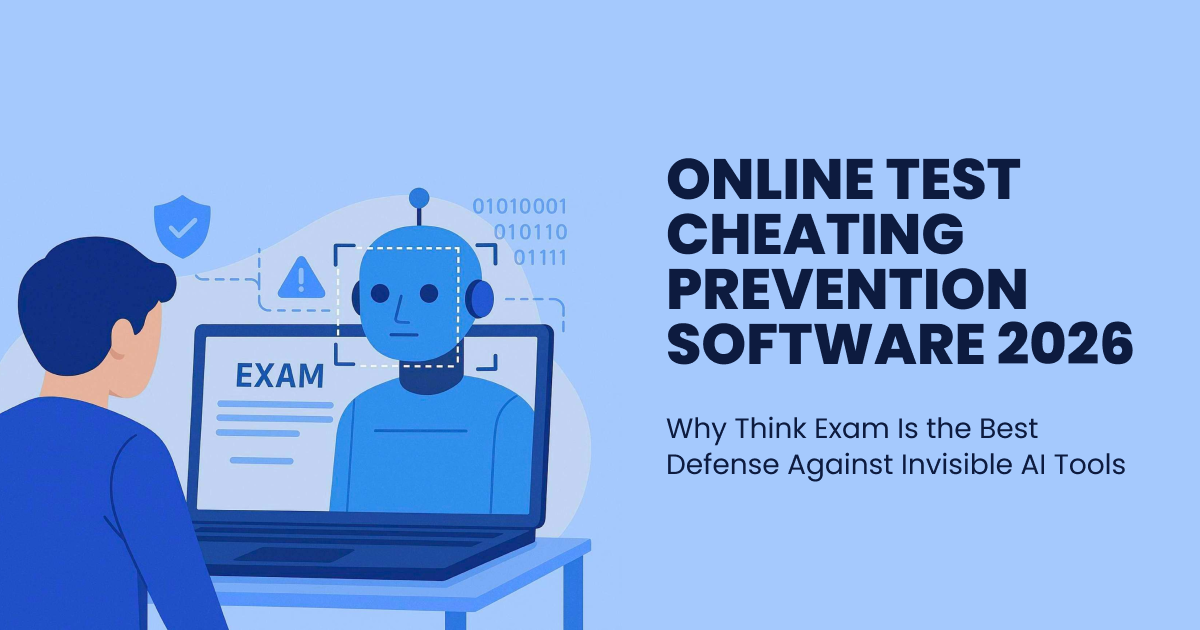
The impact of Generative AI is not confined solely to testing—it demands a reinvention of assessment, a new language for interviews, and new strategies for examination systems. What used to be a simple remote assessment centered around the learner has now evolved into a battle against unseen cheating tools. The enemy is no longer a distracted student looking over another’s shoulder; it is AI working silently in the remote test-taking environment.
Cheating today is subtle, algorithmic, and almost invisible. It isn’t whispering answers to a classmate—it’s overlays that sneak up on a candidate’s eyeline, hidden audio assistants, or silent plug-ins that generate fully formatted answers. Traditional proctoring systems were built on assumptions based on human cheating behavior and exception reporting. But AI doesn’t cheat as humans do.
This is why institutions worldwide—including schools, colleges, certification bodies, government institutions, and corporate training platforms—are shifting to Online Test Cheating Prevention Software.
Among the leaders in this domain, Think Exam not only prevents cheating—it fundamentally rebuilds integrity, fairness, and trust in assessments.
The Fall of Old Ways – The Beginning of AI Deceptions
Traditionally, cheating behaviors consisted of whispering to someone else, looking down to copy notes, or diverting to another open application on the computer during a test. Such patterns indicated observable forms of cheating, and proctoring technology was devised accordingly.
But this system doesn’t hold good anymore. We needed something better.
Cheating with the Help of AI: How Does It Happen
This new form of digital dishonesty is dangerously effective and eerily silent:
- Speech-based assistants feed answers during interviews in real time.
- Semi-transparent overlays hover above exam screens, invisible in screenshots and recordings.
- Speech-to-text programs listen and type answers without candidate interaction.
- Synthetic voices mimic a candidate’s vocal profile to respond during live interviews.
The candidate looks calm. Their tone is confident. Their answers sound polished. But each response is engineered by AI—hidden in software layers, chatbots, or silent companions.
Educators and assessment administrators are forced to ask questions they never imagined:
- How do we detect invisible overlays?
- How do we identify AI assistance when the system sees only one person?
- What happens when the breach originates from external software—not from the candidate?
Why Traditional Proctoring Has Become Obsolete
Older proctoring systems rely on one flawed assumption:
Cheating exists in the physical, visible world.
Legacy systems target:
- Mouse movement anomalies
- Background noise
- Browser tab switching
- Eye movement
- Suspicious physical posture
But AI cheating is:
- Static
- Silent
- Undetectable by cameras
- Does not require keystrokes
- Does not trigger tab changes
This is why institutions are turning to Advanced Online Test Cheating Prevention Software engineered for AI cheating—not human cheating.
Think Exam’s Online Test Cheating Prevention Software: Built for the Cheat Era
Think Exam’s Online Test Cheating Prevention Software redesigns exam security from the ground up. Instead of retrofitted camera monitoring, its platform interprets digital, behavioral, linguistic, and audio anomalies in real time.
It focuses on patterns of cheating—not the person physically sitting on camera.
1. Real-Time Prevention — Not Post-Test Scolding
Most tools detect cheating after the exam ends. This leads to:
- Appeals
- Wasted administration
- Brand damage
- Distrust
Think Exam’s Online Test Cheating Prevention Software works differently:
When prohibited AI tools activate, the system stops them immediately.
- Overlays fail to launch
- Unauthorized apps are terminated
- Digital co-pilots are blocked mid-session
This is not detection. This is Test Cheating Prevention Software designed to prevent cheating from even starting.
Prevention > Investigation.
3. Trust People — Without Giving Cheaters Free Space
Monitoring shouldn’t feel like surveillance.
- Students deserve fairness
- Institutions deserve integrity
- Employers deserve trustworthy results
Think Exam’s Online Test Cheating Prevention Software protects all three.
It does not demonize candidates. It simply removes invisible assistance — whether:
- AI robots
- Coaching platforms
- Whispering assistants
- Transparent overlays
- Mobile device copilots
Cheating vanishes without humiliating users.
The Coming AI Cheating Epidemic
What you see now — AR glasses and whispering assistants — is only the beginning.
Soon:
- AI copilots will embed into operating systems
- Assistants will mimic human typing speed
- Real-time inference will occur mid-exam
- Voice clones will answer questions
The future is not speculation. It is already here.
Institutions that do not use Online Test Cheating Prevention will face:
- Credibility collapse
- Policy challenges
- Reputation damage
Think Exam’s Online Test Cheating Prevention Software was engineered for this moment.
Integrity Is the New Strategy
Today, assessments are not simply about knowledge measurement. They are about trust.
Online Test Cheating Prevention Software transforms assessments into environments where:
- AI overlays are blocked
- Synthetic voices are rejected
- Hidden copilots fail
- Algorithmic intrusions cannot operate
Talent matters. Institutions matter. Confidence matters.
Those who adopt prevention technology shape the future of assessments. Those who delay merely respond to its failures.
FAQs
1. Can Think Exam’s Online Test Cheating Prevention Software detect AI cheating that isn’t physically visible?
Yes. Think Exam identifies digital behavioral patterns, invisible overlays, etc, not just camera footage.
2. Does Think Exam stop AI in real time?
Absolutely. When AI-based programs attempt interference during tests or interviews, they are blocked instantly. The offending applications are terminated to ensure fairness.
3. How is Think Exam’s Online Test Cheating Prevention Software different from old proctoring tools?
Traditional proctoring monitors human actions like gestures, tab switching, or eye movement. Think Exam monitors digital anomalies and AI interactions, making it preventive rather than reactive.
4. Is Think Exam suitable for corporate evaluation and educational exams?
Yes. Online Test Cheating Prevention Software by Think Exam is widely used by:
- Universities
- Certification bodies
- Government authorities
- Corporate HR and training departments
5. Can Think Exam prevent cheating on mobile devices?
Yes. The system detects:
- Voice assistants
- Overlay apps
- Unauthorized background software
It works seamlessly across smartphones and tablets.