
In modern academic and recruitment settings, the most essential is time. It is completely unacceptable for students to sit for exams and not have their results in a moment. Be it a university, training body, or a corporate assessment team, a delay in result processing causes a lot of stress, misunderstandings, and delay of work.
This is where the Computer-Based Exam System comes in, as there is no more manual correction, but only computers that assess papers. The institutions’ process results 60% faster than previously, whilst taking into consideration all the other factors, since they have incorporated automated scoring and result processing.
Computer-Based Exam System: What is it?
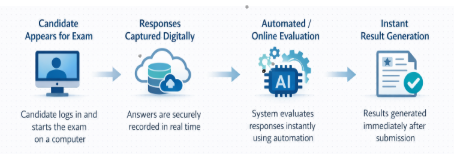
A Computer Based Exam System is an electronic means of administering exams where candidates undertake the tests on computers as opposed to using paper. The system takes the recorded responses either in manual or written forms or online, assesses them, and provides results in the shortest time possible.
The system gets rid of the process of paper marking or physical scripts; thereby, it enhances and makes the entire system of examinations simple, faster, and safer.
Why Result Turnaround Time Critical?
Time for and rate of the delivery of results affect a lot – students, schools, and those in control of decision-making.
- This relieves the stress and tension associated with the wait for the release of the grades.
- This also enables academic institutions to stick to their academic calendar as scheduled.
- It speeds the decision, approvals, and employment acceptance.
- It also allows for less time spent on administrative workload.
- It works towards making students believe more in the online examination and assessment systems in terms of their integrity.
- If the results are not released on time, then other post-exam activities will also be postponed.
Release of results at the required time takes away any possible challenge and encourages satisfaction of all the participants.
Challenges in Traditional Exam Evaluation
Manual processes are the main factors of traditional paper-based exams.
Evaluators get response sheets that have been collected, and only after that are they sorted and transported. A time-consuming process occurs where each response is checked manually, marks are entered by hand, and results are verified multiple times to avoid errors.
When exams are held in different places, the logistics become even more complicated. The entire timeline is affected by any mistake or delay at one stage. Compiling final results even takes days or weeks after evaluation.
Traditional evaluation is, therefore, slow and difficult to scale due to these challenges.
What 60% Faster Results Mean in Practice?
This is achieved by eliminating the paperwork from exams and allowing automation of the system by integrating all the evaluation functions. Thus, processes reduce the turnaround of results in a Computer-Based Exam System by over 60 percent.
Moreover, results that typically took weeks to be released can be posted in a matter of days or even hours in the case of objective-type exams.
For the academic sector, this facilitation means that there will be a speedy process of admissions, re-exams, and semester arrangements. With respect to businesses, it ensures/removes the need to hold corporate recruitment programs for a long time. Certification authorities are able to provide certificates without having individuals wait for long periods of time.
Winning strategies are the in-place results that are ‘faster’.
Key CBT Features That Drive Faster Results
The modern CBT Platform attempts to eliminate any delay in results.
Key functions are:
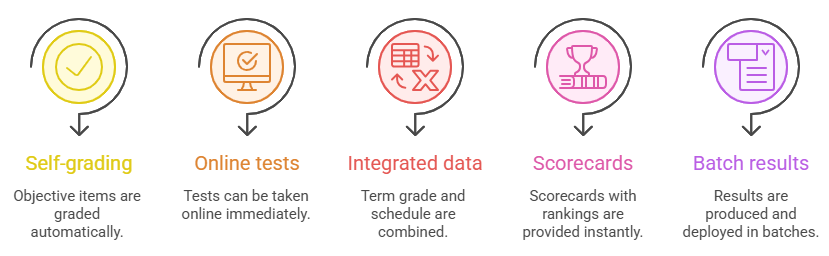
All the processes are within the same system, so there is neither waiting time nor repetition of tasks between the various evaluation processes.
Role of Automation and Analytics
Automatic processes minimize process times, but also ensure the accuracy and clarity of tasks performed. The adoption of the Computer-Based Exam System addressed this to a larger extent; in this way, such score cards offer themselves automatically.
No more ranking, percentile determination, or performance manual that relies on calculation.
The in-built analytics come in handy for an institution, as they get to see how various groups within their students, subjects, or locations are performing; no external applications or undeloads are required.
What is more, this is accomplished within a much shorter time frame and with verifiable statistics.
Related Blog:-
How Computer Based Examination System Helps Improve Test Reliability and Validity?
Year-on-Year Growth of CBT Exams
Over the years, there has been constant growth in the number of computer-based exams conducted.
Piles of paper no longer threaten the exams in any institution, as the demand for exams has increased, and so the period within which they are expected to be returned has increased.
Although the traditional way has its advantages, the advancement of a CBT Platform in terms of testing is limited to its scalability and does not take into account the consistency and pace of the process.
As the digital infrastructure gets better, computer-based exams continue to become the avenue of choice for very high-stakes assessment, certification, and other large testing programs.
Speed as a Strategic Advantage
It is worth mentioning that there is more to time than merely the ease in conducting assessments.
Quicker result turnaround is instrumental in building confidence among students as well as candidates’ stakeholders. Apart from this, it also eliminates the hassle of administrative efforts, aids planning accuracy, and minimizes expenses.
A Computer Based Exam System is one where modern world expectations can be achieved without the loss of examination standards. It reduces the turnaround time by approximately sixty percent, depending on the current situation trends, and helps the organization grow competitive and ready for the future.
FAQ’s
1. How does a Computer-Based Exam System reduce result turnaround time?
The Computer-Based Exam System is a digital platform that generates and scores objective tests and consolidates the results without any human mediation. It obviates the need for examining the papers physically, making entry of the results, and services are completed much faster, up to 60% less.
2. Are computer-based exam results accurate?
Certainly, it does not. With automation, it minimizes the chances of making errors, and the scoring of results is comparable across all centers. There is a complete set of logs and reports that is also generated with these systems, making it further convenient when it comes to accountability.
3. Can subjective exams be evaluated using a CBT platform?
Of course. A CBT Platform has tools such as OsM that allow the assessors to access the essays online rather than collecting an e-copy for marking. This operation cuts off both time wastage and the inconveniences involved in the transport of answer books.
4. Is a Computer-Based Exam System suitable for large-scale exams?
Yes, it does. Computerization aims to provide exam services in multiple places at once and yet still allow each test center to maintain control and generate quicker results.
5. How quickly can results be published using computer-based exams?
The Computer-Based Exam System allows non-essays to be marked on the same day. Subjective format exam results take longer, but not as long as weeks; they are usually released within a few days.