The Reliance on online exams as an interim option is a thing of the past. Institutions, universities, and business entities now find them as an integral component of evaluating knowledge and skill. One more factor in favor of this trend is the growing importance of remote proctoring as a crucial system that enhances fairness, authenticity, and credibility.
Still, not everyone in power is convinced. There are concerns about data protection. Effectiveness is also questioned. There is much anxiety regarding the use of such monitoring exams, as many do not really appreciate their mechanism.
This blog clears the confusion.
We break down the myths, real process, and best practices of remote proctoring—based on how modern, responsible exam systems are designed and used today.
Popular Myths About Remote Proctoring
Let’s start with the common misconceptions.
Myth 1: “Remote Proctoring invades privacy.”
This is the most common perception. And it is false, as remote proctoring does not involve spying on candidates.
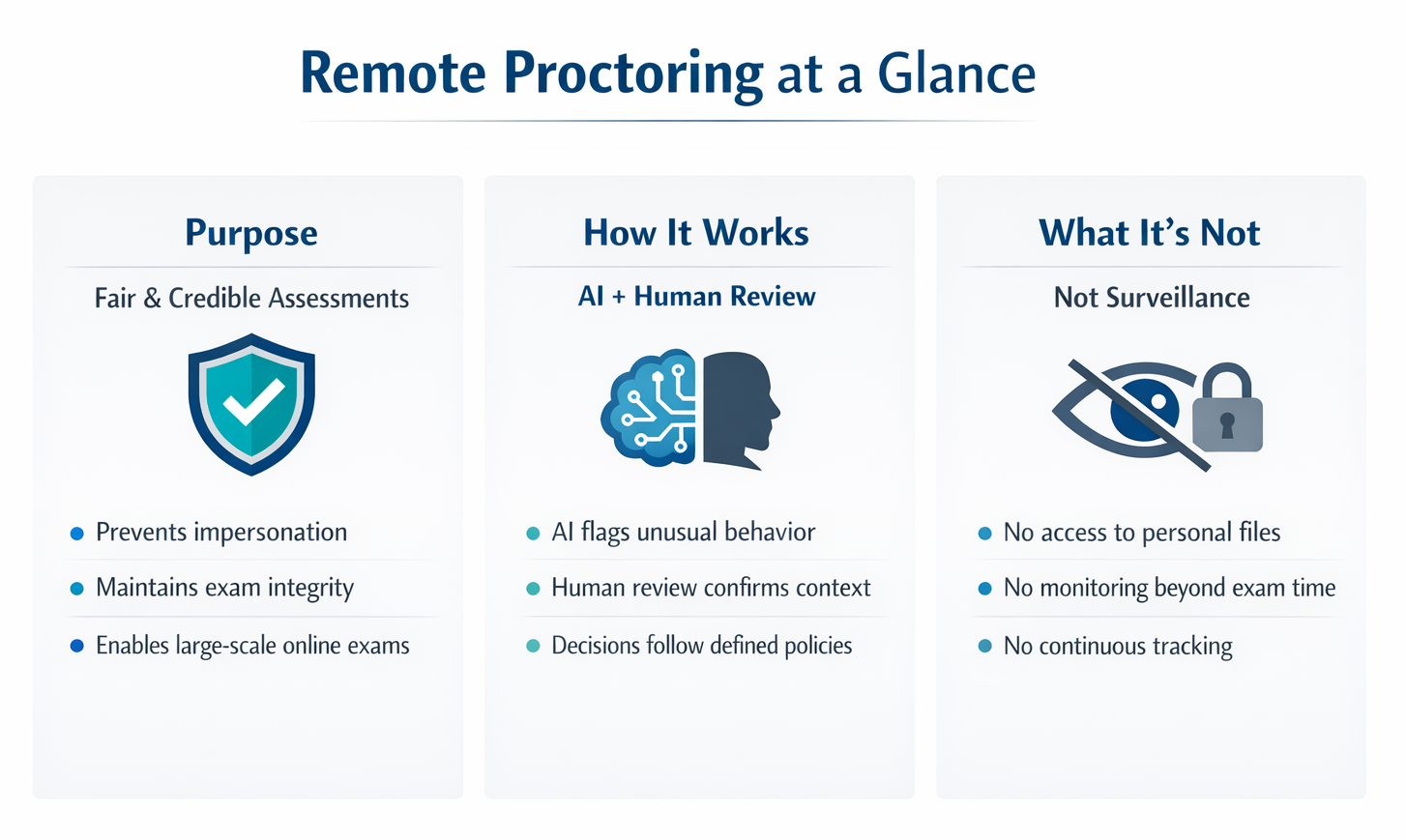
Tools developed for proctoring activities are only concerned with exam-related activities. The access does not extend to personal files, emails, or any such data. The monitoring is done for the exam window only and under a strict consent policy.
Privacy-first platforms clearly inform candidates about:
- What is monitored
- When monitoring starts and ends
- How data is stored and deleted
When used correctly, remote proctoring respects personal boundaries.
Myth 2: “AI proctoring is always inaccurate.”
It is often misunderstood. AI proctoring does not make final decisions on its own.
AI helps flag unusual behavior patterns. Human reviewers or defined rules then evaluate these flags. This combination reduces bias and false positives.
Enhanced accuracy is achieved when AI complements human activity instead of acting as a decision-maker.
Myth 3: “Candidates get anxious and nervous.”
Fear is the outcome of inadequate information and not of the technology.
Once candidates understand the actions performed, how the systems will operate, and for what purposes, the levels of acceptability increase.
Openness affects opinions.
The Reality of Proctored Test
To understand remote proctoring, let’s walk through the real workflow.
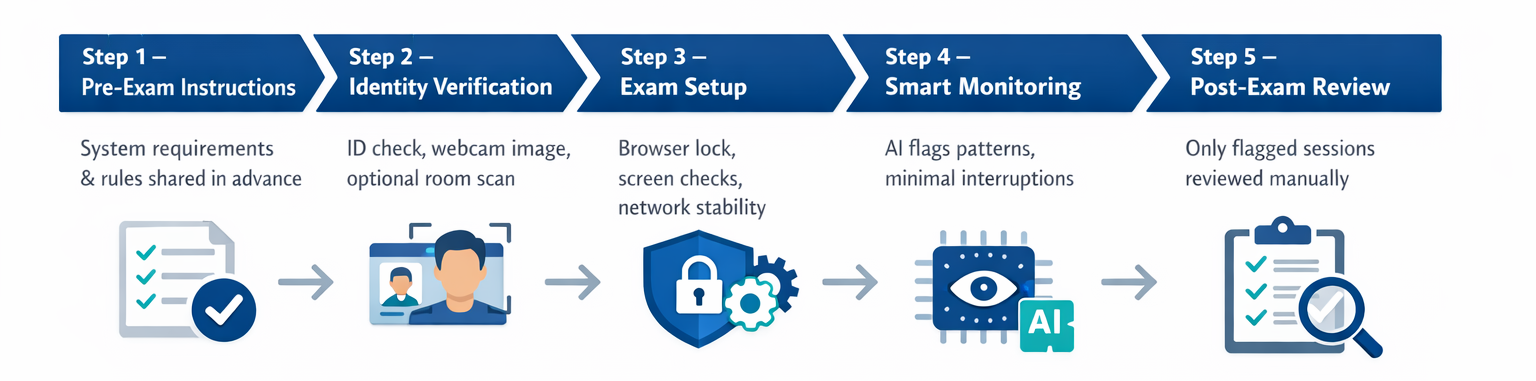
Step 1: Instructions before the test.
Examinees receive specific instructions before the examination:
- System requirements
- Allowed and restricted actions
- Monitoring methods used
This step sets expectations and reduces anxiety.
Step 2: Identity verification
Candidates verify their identity using basic checks like:
- ID confirmation
- Webcam snapshot
- Environment scan (if required)
This ensures the right person takes the test.
Step 3: Exam environment setup
The system checks:
- Browser restrictions
- Screen activity
- Internet stability
This prevents technical disruptions during the exam.
Step 4: Live or AI-supported monitoring
During the exam, exam monitoring focuses only on relevant signals:
- Screen behavior
- Face presence
- Audio or tab switching (based on settings)
AI proctoring flags suspicious patterns but does not interrupt unnecessarily.
Related Blog:-
Comparing Remote Proctoring Methods and Their Effectiveness
Step 5: Post-exam review
Manual review is required for only those sessions that are flagged for any reason. The rest all pass exams without any manual checks.
This keeps the process easy, efficient, less time-consuming, and respectful.
Accuracy vs Surveillance: A Look at the Contrast
One of the nagging issues is whether it surpasses the boundaries and transitions into surveillance in the event of remote proctoring.
The answer lies in intent and design.
Surveillance watches everything. Proctoring watches only what matters for exam integrity.
Good proctoring systems:
- Monitor behavior, not personal data
- Use minimal alerts instead of constant tracking
- Focus on patterns, not isolated movements
Accuracy improves when monitoring is purpose-driven, not excessive.
Candidate-Friendly Proctoring Practices
Candidate experience plays a huge role in success.
Here’s what makes remote proctoring more acceptable and human-centered.
1. Clear communication
Candidates should never feel confused.
Explain:
- Why is proctoring used?
- What data is collected?
- How is fairness ensured?
Clarity builds trust.
2. Practice tests and demos
Mock exams help candidates:
- Test their setup
- Understand the monitoring flow
- Feel confident before the real exam
This small step reduces stress significantly.
3. Fair alert thresholds
Not every movement is suspicious.
Candidate-friendly systems avoid:
- Over-flagging
- Interruptions for minor actions
- Unnecessary warnings
This creates a calm testing environment.
4. Transparent policies
When candidates know their rights, acceptance improves.
Clear policies around data usage and retention matter.
Institutional Success Indicators
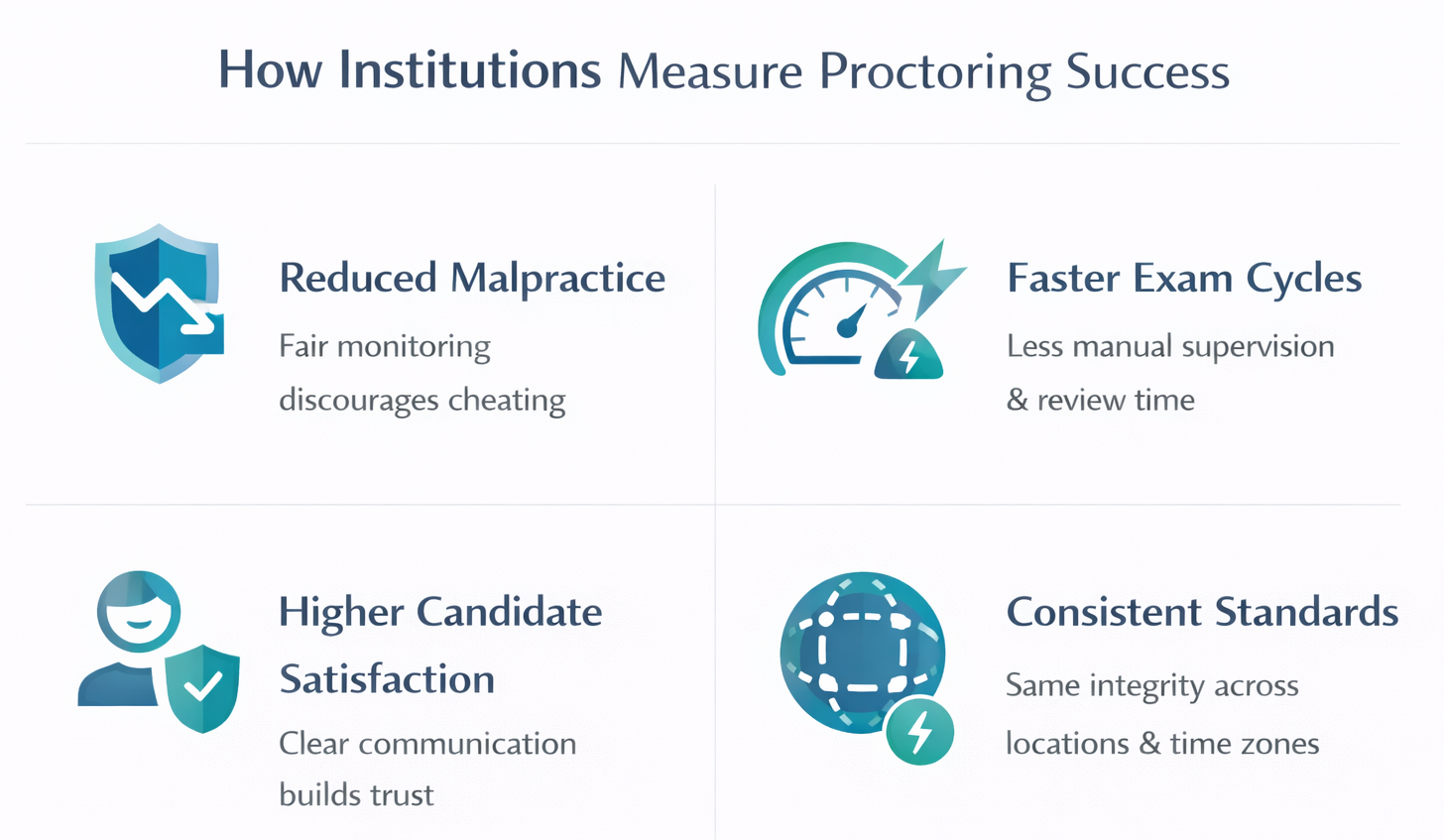
How do institutions know remote proctoring is working?
Successful adoption shows clear signs.
-
Reduced malpractice incidents
Fair monitoring discourages dishonest behavior without creating fear.
-
Faster exam cycles
Digital exams with AI proctoring reduce:
- Manual supervision
- Logistical delays
- Post-exam investigations
This saves time and cost.
-
Higher candidate satisfaction
When communication is clear, feedback improves.
Candidates value fairness when they understand the process.
-
Consistent assessment standards
Remote proctoring allows institutions to maintain the same integrity across:
- Locations
- Time zones
- Candidate groups
This consistency is key to credibility.
Best Practices Framework for Remote Proctoring
To close, here is a simple framework institutions can follow.
1. Define your risk level
Not every online exam needs strict monitoring. Match proctoring intensity with exam importance.
2. Be transparent from day one
Never surprise candidates with monitoring rules. Early communication builds confidence.
3. Use AI as support, not authority
Remote Proctoring solutions must endeavor to complement human judgment rather than supplant it.
4. Data protection and privacy should be prioritized
Highly suitable are systems that have a significant level of compliance, encryption, and data policies.
Choose systems with strong compliance, encryption, and clear data policies. Trust depends on responsibility.
5. Review and improve continuously
Use reports and feedback to refine settings. Proctoring should evolve with user needs.
Final Thoughts
Remote Proctoring does not involve control. It refers to the honor of assessment, fairness in examinations, and the belief in the digital proliferation of learning and assessment.
It can benefit individuals and organizations when used correctly. Platforms like Think Exam approach remote proctoring as a balanced system—where technology supports integrity without compromising experience.
The future of exams is digital. The future of fairness lies in responsible proctoring.
FAQ’s
1. Explain remote proctoring and how it operates.
Remote Proctoring is a tool designed to monitor candidates’ behavior during an exam, so the instructor does not need to be present in the exam hall. The system performs the identity check of the candidate and inspection of the exam environment before commencement of the test. During the exam, only activities related to exams are monitored. The application of AI monitoring systems effectively records irregularities that are observed, and these can be confirmed at a later date.
2. Is there any violation of the privacy of candidates while using Remote Proctoring?
No. During an exam, remote proctoring is used for the exam only. Such a technology does not tamper with the privacy of individuals. The candidates are given beforehand information on what is going to be monitored and therefore expect such a process.
3. How effective is AI proctoring in online exams?
AI Proctoring is effective as long as it is used properly. It does not take any decision regarding the guilt or innocence of the candidate. It only gives an alert of offending behavior, if any. Since all final judgments are made based on explicit policies or approved human judgment, this process is objective.
4. What is the difference between exam monitoring and surveillance?
Exam monitoring is specified and targeted for only the parts that are needed to protect the exam. Surveillance watches everything continuously. Remote Proctoring does not mean surveillance. It is not something that will keep an eye on a student all the time. It is functional only for the duration of the examination and stops working once the examination is over.
5. What factors influence institutions to implement remote proctoring for online exams?
Remote Proctoring makes it possible for institutions to conduct the examination wherever the candidates are. It reduces the threat of compromising the examination, saves time, and enables high standards of the examination to be achieved in the absence of the candidate.