Let’s be real: The classic “pen-and-paper” examination appears to be a fossil from another era. In this global and distributed age, traditional testing is becoming a barrier to conducting high-stakes examinations. You can’t just fly 500 candidates to a testing center anymore—it’s expensive, slow, and frankly, unnecessary.
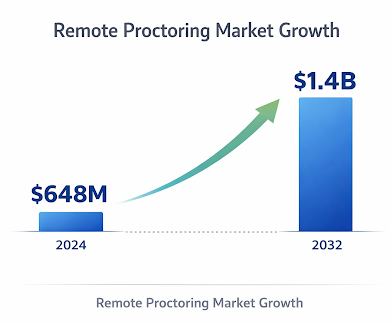
The numbers back this up. The global market is predicted to experience a rise in revenue from $648 million in 2024 to an expected $1.4 billion in 2032.
Things are not the way they used to be; organizations want more than mere, traditional digital ‘watchdogs.’
They want intelligent systems that can think, flag, and scale without a room full of human monitors. And this shift is not accidental. It is driven by clear operational and leadership priorities.
This blog explains why.
The Invisible Hurdles in Enterprise Testing
Enterprises face a very different assessment reality compared to small teams or academic institutions.
Hiring now happens across locations, time zones, and roles. A single hiring drive may involve thousands of candidates appearing remotely. Manual supervision or basic webcam monitoring does not scale at this level.
Besides that, there are also the pressures related to compliance and accountability. Organizations need to demonstrate that their evaluations are proper, protected, and subject to audits. Any weakness in their procedures may result in legal risk or harm to their public image.
For leadership teams, the core challenge is simple: How do you ensure assessment integrity without slowing down hiring or increasing costs?
1. The Logistics of a Global Workforce
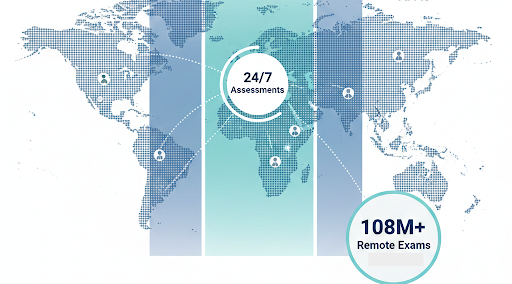
Enterprises don’t sleep. Coordinating an exam for a candidate in London and another in Bangalore at the same time is impossible. Without enterprise proctoring tools that work 24/7, integrity becomes a localized gamble. This isn’t a small-scale issue; over 108 million exams were pushed through remote platforms in 2023 alone (Source: Market Growth Reports).
2. The Cost of a “Close Enough” Hire
In the business sphere, a “bad hire” is not only an uncomfortable team environment but also a financial loss. According to the U.S. Department of Labor, a bad hire can result in a cost equivalent to 30% of the person’s salary for the first year.
If you’re hiring for a $100k role, a cheating candidate who slips through is a $30,000 mistake you can’t afford.
3. The Legal Minefield
Compliance is not merely a term; it is a wall built. The lines of GDPR in Europe and CCPA in California make the treatment of candidate data very much like that of a live wire. If your proctoring tool isn’t built with these guardrails, you aren’t just risking a cheating scandal—you’re risking a multi-million dollar fine.
Why “Human-Only” Proctoring is Flawed
It’s tempting to think a live human behind a webcam is the ultimate security. It isn’t.
- The Cost is Suffocating: Scaling human-led proctoring is a math problem that doesn’t resolve. It’s roughly 70% more expensive than AI-assisted models (Source: Intel Market Research).
- The “20-Minute” Fatigue: Science tells us human attention spans dip significantly after 20 minutes of repetitive monitoring. A proctor blinks, checks their own phone, or loses focus, and a candidate pulls out a second screen. It happens.
- Subjectivity: One proctor might flag a candidate for looking away, while another ignores it. This inconsistency is a legal liability when a candidate challenges a rejected application.
The Secret Sauce: What Makes Proctoring “Intelligent”?
Intelligent proctoring is not about watching harder. It is about analyzing smarter.
Modern remote proctoring solutions use AI to observe behavior patterns during an assessment. Instead of flagging everything, the system focuses on risk.
Tracks Behavior, Not Just Video
Instead of just a video feed, AI monitors over 50 distinct cheating indicators simultaneously eye tracking, head movement, and even the “hidden” presence of mobile phones. The accuracy? Over 92% (Source: Intel Market Research).
The 5% Rule (Risk Scoring)
HR teams are busy. They don’t have time to watch hours of footage. Intelligent systems use “Risk Scoring”. Each session is assigned a risk level based on combined signals to flag the most suspicious behaviors, allowing managers to ignore the 95% of honest candidates and focus their review where it actually matters.
Digital Evidence
If a candidate uses a background voice or a second person enters the frame, the system doesn’t just “see” it—it logs it with a timestamped metadata trail. This creates an objective, indisputable audit trail. And only high-risk moments are highlighted for review.
This reduces manual workload while increasing accuracy.
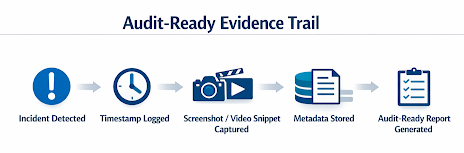
For enterprises, intelligent proctoring brings consistency. Each candidate is assessed based on the same parameters without human bias. Decisions are based upon data, not guesses.
Related Blog: How Artificial Intelligence is Enhancing Remote Proctoring?
Brand Protection and the Credibility Factor
Your reputation is your most valuable asset. A single viral post about a “cheating ring” in your recruitment process can tank your employer brand for years.
To prevent this, enterprises should look for the Experience, Expertise, Authoritativeness, and Trustworthiness in their proctoring partners.
It’s no longer enough for a tool to “work”; it must demonstrate a proven track record (Experience), deep technical validation (Expertise), industry-leading standing (Authoritativeness), and bulletproof data security (Trustworthiness).
The “Skills-First” Shift
Executives now believe AI is essential for filtering talent fairly. Intelligent proctoring supports this “skills-first” movement by ensuring the data you’re using to hire is actually real.
The Real-World ROI
Every enterprise decision eventually comes down to return on investment.
Intelligent proctoring delivers ROI in multiple ways.
- Cost Efficiency: An automated system will not only enable you to do a test on 10,000 people but also on 10 people, with a cost that is much lower than that of physical test centers.
- Reduction in operational costs: fewer human reviewers are needed to do the work. Only incidents that have been flagged will be checked, and because of this,
- Review time will drop sharply.
- Speed to Hire: The majority of companies typically take between 33 and 49 days for the entire hiring process. With intelligent proctoring, the scheduling delay of human invigilators is eliminated, and thus, you can move from “test” to “offer” in record time.
- Better candidate quality: When the assessments are secure, the hiring decisions reflect the actual skill, not the shortcuts.
- Retention is the Objective: A powerful assessment process results in an 80% improvement in new hire retention. Hiring people with the skills they actually possess will cause them to stay longer and perform better.
What Should You Look For?
Enterprises do not adopt tools impulsively. Their evaluation criteria are clear and leadership-driven.
They look for:
- Proven scalability for large candidate volumes
- Strong data security and privacy controls
- Clear reporting and audit readiness
- Seamless integration with existing hiring systems
- Reliable support and platform stability
Most importantly, they ask one question:
Does this solution reduce risk while improving decision quality?
Intelligent remote proctoring meets this expectation far better than manual or basic alternatives. Hence, businesses are consistently choosing to integrate them into their broader recruitment strategies.
Conclusion
Remote proctoring has turned from being a “nice-to-have” to a “must-have” now. It’s the defensive line for your company’s talent pipeline. By moving to intelligent mechanisms, you aren’t just catching cheaters—you’re building a faster, cheaper, and more reliable way to grow your team.
Think Exam delivers the AI-powered backbone that turns high-stakes assessments into a competitive advantage.
FAQs
1. What are remote proctoring solutions?
Remote proctoring solutions are digital systems that help to keep an eye on the test-takers during online exams in order to make sure that no one is cheating and the exam is held in a fair manner. The systems make use of different technologies such as webcam monitoring, screen tracking, and AI-based behavior analysis to figure out if anyone is doing something suspicious without the need for physical invigilators.
2. Why do enterprises prefer intelligent remote proctoring solutions?
Intelligent remote proctoring solutions are preferred by enterprises as they are highly scalable, manual labor is significantly reduced, and uniform monitoring of a large number of candidates is easily made possible. These systems emphasize the identification of risks, allowing for a considerably trusted, quick turnaround for different verticals in the business landscape.
3. What sets intelligent proctoring apart from basic proctoring?
Basic proctoring usually records video or relies on human watchers. Intelligent proctoring is a more sophisticated version employing behavioral trend analysis, risk score assignments, and a system of auto alerting in case of anomalies. As a result, assessments become faster, more prompt, and safer from the dangers associated with human bias.
4. Are the remote proctoring solutions secure and regulatory for corporate use?
Definitely, the high-end remote proctoring solutions are designed with protection of data, controls for privacy, and preparedness for audits. In addition, these solutions make it possible for organizations to abide by the laws and regulations while maintaining logs and reports for any subsequent verification.
5. Can remote proctoring be used for corporate hiring and internal assessments?
Certainly. The use of remote proctoring in the hiring process of corporations and employee upskilling assessments, certification exams, and internal evaluations is growing. The technology simulates the ability of an enterprise to assess the talent remotely and, at the same time, ensures the process is not compromised in terms of credibility.
6. How does Think Exam support enterprise-level remote proctoring?
Think Exam provides smart remote proctoring solutions that cater to the needs of enterprises. The platform brings together AI-driven monitoring, a scalable infrastructure, and compliance-ready reporting to back up the secure and efficient remote assessments.