The global job market is changing at an unprecedented rate. As artificial intelligence, automation, and digitalization transform industries, by 2026, companies will be looking for more than just a highly educated workforce. They will be searching for professionals with the ability to adapt to changes, analyze complex situations, and look for people who can start working effectively almost immediately. At certain events, for example, job recruitment, this has emphasized what is called Skill Assessment at the core of the recruitment process and learning strategy.
Around the globe, firms are switching to quantitative assessments that measure expertise; otherwise, estates and interviews might be counterproductive and increase the chaos. In the case of campus recruitment, entrance or experienced candidates, or learning and development of the existing workforce, a ‘Skill Assessment’ provides the edge of fairness, precision, and flexibility, respectively, to its users.
In the present paper, we will discuss the ten professional competencies that employers will seek by the year 2026, and the efficient ways of assessing them with the use of advanced Skill Assessment techniques or tools such as Think Exam.
1. Knowledge in Digital Technology
At the year of our Lord 2026, every job will will be … of every industry will be focused on digital tools. Employees do not have to understand free technical concepts, but rather have an ease of adoption to use the digital platform, dashboards.
Development:
Use the Skill-Based Assessment examination that checks for the threshold level of skill in the usage of digital tools, such as knowledge of basic technologies and the ability to learn new software.
2. Analytical Reasoning and Solving Issues
As AI replaces several human executions, people’s functions change towards more heads working better, or rather, problem-solving skills. That is why employers look for people with the ability to reason and make decisions given the circumstances.
Development:
Analytical people can be identified using Skill Assessment tests like case studies, situational questions, and logical reasoning.
3. Communication Skills
For hybrid, remote and on-site work such as that one, his basic communication abilities both written and verbal are essential. Employers focus to look for people who are able to speak effectively and follow clear directives.
Development:
Make use of communication Skills Assessment instruments in the form of written assignments, grammar assessments, audio visual response assessment, etc.
4. Creativity & Innovations
Creativity is no longer confined to the marketing or design circle. Companies also require employees to be able to offer new ideas, try new ways of implementing tasks and think outside the conventional pattern.
How to assess:
Use gamified sections of Skill Assessment, brainstorming and open-ended questions for creative thinking assessment.
5. Emotional Intelligence (EQ)
EQ, as it stands, is becoming a key recruitment component. Empathetic, patient and capable of building relations workers enhance and sustain better teams and client relations.
How to assess:
Tools for assessing behavioural skills, psychometric. Skills, and situational judgment tests can do that for EQ.
6. Adaptability & Learning Agility
In the year 2026 learning, unlearning and then relearning is an important skill. Shorter learning curves in employees is what companies desire which is why they prefer people who can cope effectively with change in roles and technology.
How to assess:
People’s ability to adopt most recent and new ideas is tested through Adaptive Skill Assessment tests as well as cognitive ability assessments.
7. AI & Data Literacy
Awareness about Ai based solutions and principles of data literacy are required from even more non-technical positions. Employees need to know how to read dashboards, interprete analytics and work with processes that have Artificial Intelligence on them.
How to assess:
Employers should administer technical Skill Assessment tests on AI awareness, administer data challenges and provide hands on analytics using data.
8. Collaboration
In the workplace, more and more ad hoc committees are being created, and that is a very beneficial thing. As a result, individuals who can manage cross-functional teams of any kind are, understandably, in increasing demand
How to assess:
The use of Behavioural Skill Assessment instruments, personality tests and team simulation in order to assess the ability to work together.
9. Time and task management
Promoting rhetorical containment couldn’t be challenged officially.
Modern offices need employees that can not only take on responsibilities but also be clear in goal delivery and the target achievement. Management of time is among key factors of productivity.
How to assess:
Skill Assessment; skills include soft skills: situational tasks, workflows and planning.
10. Leadership & Ownership
Leadership has long since ceased to be viewed and interpreted in purely hierarchical terms. Employers want every worker, no matter their level, to demonstrate that they are able to take on things, to be responsible, and to make choices.
How to assess:
Skill Assessment programs targeting leadership evaluation, leadership decision-making tests, leadership cases and scenarios are efficiently used for early identification of leadership.
Importance of Skill Assessment in Recruiting These Traits
The Human Resource business has changed, recruitment and selection processes can no longer be traditional. Interviews are not sufficient to determine one’s abilities, particularly in categorizing soft skills. This means organisations all across the world use Skill Assessment solutions such as Think Exam for the following –
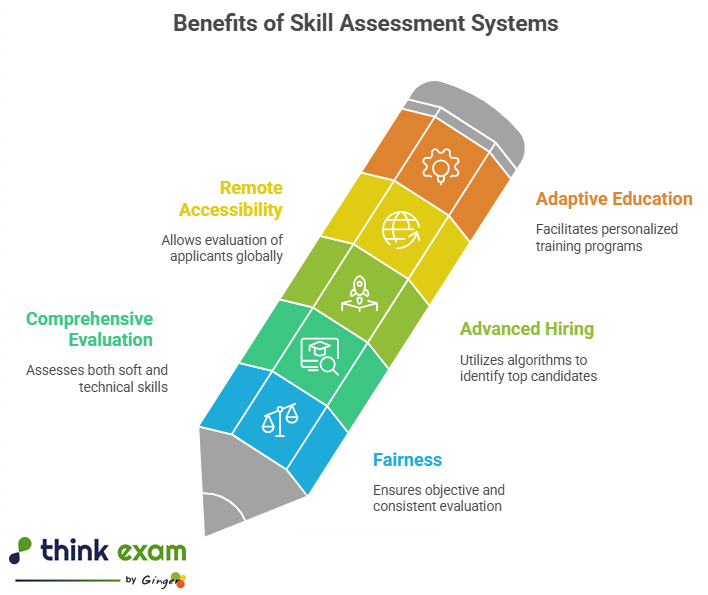
The Importance of Conducting a Skill Assessment by 2026
In today’s globalized economy, educational success may take a backseat to skill acquisition in the future. In a context where millions will be searching for jobs and market requirements will constantly change, Skill Assessment is the most effective method to:
- Find and hire competent candidates
- Avoid recruiting mistakes
- Enhance the effectiveness of recruitment and campus drive activities
- Make sure employees do not leave the organization
- Create a culture of performance
- Devise well-defined ways of how to help someone acquire skills and knowledge
Platforms such as Think Exam, by utilizing AI, strict assessment well-supported proctoring and robust adaptive test engines assure every test taken is up to the standards.
In Conclusion
The last time the recruitment techniques were useful was the beginning of industrial revolution and 2026 is another turning for organizations towards the real skills. To begin with, the most rated skills by the employers such as; critical thinking, digit literacy, communication, adaptability and leadership cannot be measured precisely out of the conventional Skill Assessment methods.
Skill-Based Assessment enables to choose and develop people who will fit this objective to be it for recruiting graduates, middle level employees as well as the own existing staff evaluations.
FAQ’s
1. Define the Meaning of Skill Assessment
It is a well-organized process of assessing the applicants’ professional and personal skills, behaviors, any proficiency, and even knowledge using a robotic system, including test series.
2. For which reasons should employers introduce the Skill Assessment programs in 2026?
Because it is paired with reliable, objective data pertaining to how the candidates perform in practice, which in turn helps in hiring immediately trainable staff and helps in cutting down staff turnover.
3. Do Skill Assessment Solutions cover soft skills like communication or emotional intelligence?
Yes. These days, any Skill Assessment solution has relevant behavioral characteristics tests, video commentaries, essays, and different types of questionnaires all of which assess soft skills.
4. In what ways does Think Exam work for Skill Assessment?
Skill Assessment is not just about gathering knowledge. Think Exam offers turnkey solutions along with web-based artificial intelligence, secure monitoring, various structures of tests, and ways to deliver tests remotely.
5. Can an organization use Skill Assessment to its benefit in developing the existing employees?
Yes, it assists with recognizing the skill gaps, crafting specific training modules for the relevant section of employees, and increasing the output of the personnel in general.