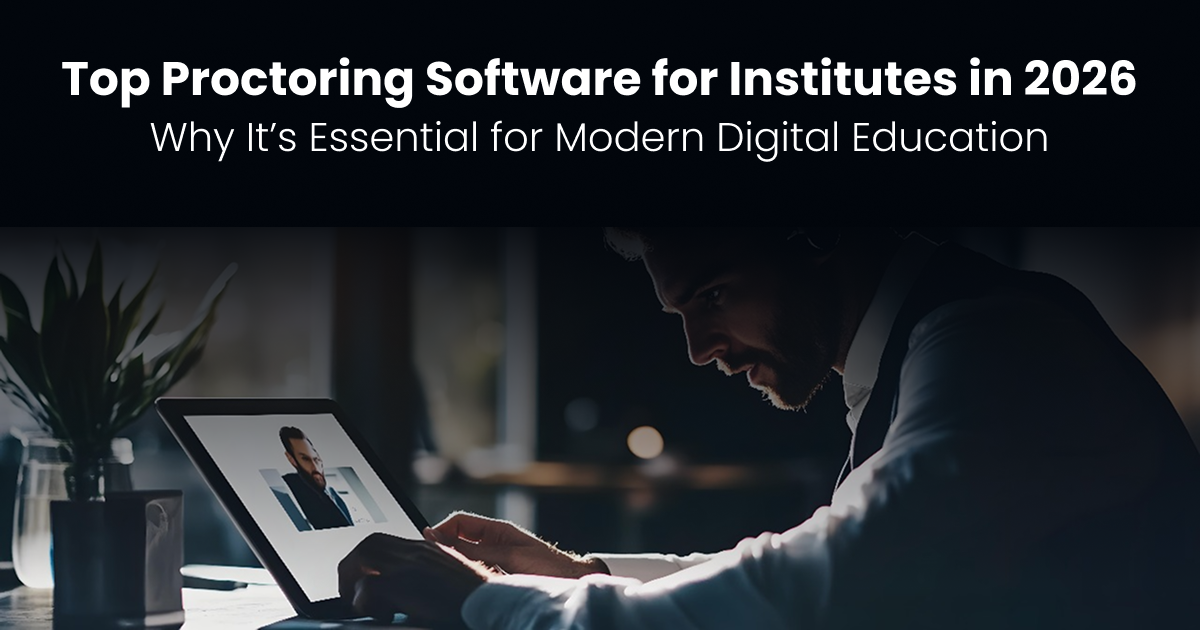
The changes within the education setups brought by digital means of learning have caused a total overhaul of the traditional way examinations are administered. Although virtual learning tools and resources have been available since the early 2000s, their use increased exponentially due to the outbreak of COVID-19. At the moment, digital learning is being adopted in educational organisations ranging from admissions in colleges and universities, to coaching institutions and primary and secondary learning institutions. However, these easy-to-reach and stress-free assessments come with the twin problems of arrangements of cheating, doing assessments on someone else’s behalf, Proctoring Software assessment management, and AI tool usage, to name a few.
Therefore, in 2026, the implementation of Proctoring Software for Institutes has become an imperative condition of educational development. Many institutions already rely heavily on Proctoring Software to maintain trust, transparency, and academic fairness.
We are no longer in an age where proctoring software was regarded as an unnecessary or inconvenient service. It is an element that ensures equity, academic integrity, and confidence in online assessment. Institutions geared towards maintaining competitiveness, relevance, and acceptability will be compelled to enhance their systems’ competitiveness by introducing controlled proctoring environments with capabilities to monitor, detect, and forestall possible cheating conduct.
Here is a list of reasons why the Proctoring Software is necessary for institutes and how this is changing the trends in learning.
1. Digital exams without effective mechanisms to protect integrity
In contrast to face-to-face examinations, the students undertake online tests from their home, an internet cafe, or even remote locations. Since these environments are not regulated, there is an opportunity for abuse. Learners are tasked to make every effort to close down any unauthorized tab, not use a cell phone, talk to anyone, or even call upon the services of artificial intelligence to answer the questions presented.
Online Proctoring Software offers a bleeding-edge solution by alleviating these challenges through:
-
AI and a trained workforce
-
Security features of the Internet browser and locking down of websites
-
Surveillance using a webcam and a microphone
-
The facility of having access through more than one device
-
Irregularities monitoring
Through the supervision of activities and the verification of identities, organizations can ascertain that the individual who is conducting the test is the legitimate candidate and not an impersonator. Thus, securing the quality of tests and preventing a fall in reputation. This is why Proctoring Software for Institutes has become a central pillar of academic integrity in remote learning.
2. Remote Learning is Here to Stay
The call for online examinations has become institutionalized. Even after the situation improves, many institutions worldwide have implemented:
-
Blended classrooms
-
Entrance tests in a virtual environment
-
Competency or any other skill assessment
-
Overseas qualifications (diploma applications)
-
Dissertations and presentations as a defense or viva voce via technology
For comfortable conduction of exams without physical attendance, assurance of strict adherence to rules has been met, replacing unnecessary costs associated with internal arrangements, its best to use Remote Proctoring Software. This decreases logistical expenses significantly but increases the possibilities for international involvement.
A digital system with Proctoring Software for Institutes enables:
- Organize interactive exams for a huge number of candidates concurrently.
- Carry out assessment programs with no infrastructural capacity.
- Run a high-stakes admission and recruitment process conveniently.
- Cater for students who require accessibility.
Digital assessment has even become a competitive advantage—rather the ability to proctor is an inherent advantage, and institutions that rely on Proctoring Software for Institutes often achieve greater examination credibility.
3. Cheating on Exams in the Era of AI
In the past, cheating was fairly straight forward as exams entailed a few methods and forms such as: Bringing a note with answers scribbled on it, swapping answer sheets and most frequently, visit designated rest rooms to use phones. The year 2026 has brought new challenges to the fore:
- GPT applications produce answers instantly
- Screen-sharing approaches support remote collaboration
- Impersonation attacks
- Bluetooth micro-communication devices
- ‘In-app’ browsers and plug-ins
In this current age, the threats of cheating have advanced such that human supervisors or the use of simple webcam monitoring will not be enough. Institutions now require the use of a secure Proctoring Software that carries out predictive analysis of cheating behavior, incorporates eye tracking of a candidate, recognizes objects and detects use of AI to cheat.
AI-based proctoring systems spot unusual activities all through the tests including:
- Presence of more than one face in a camera’s view
- Unwanted sound noise
- Abnormal eye movement
- Shifts in web pages now and then
- Trying to block the camera or cheat cameras through the means of programming
- Presence of prohibited belongings in test center
All these functionalities are in the service of the higher education system, no matter how big the exams are and where the students sit for them. Even large-scale corporate tests now depend on OnlineProctoring Solutions to monitor secure assessment delivery.
4. Preserving the University’s Official Image and Standing
It takes a long time to accumulate academic credibility, but it can be lost in an instant if cheating is rampant in the assessment processes. If students pass exams by indulging in malpractice, the institution has to withstand certain consequences of it:
-
Attenuated credence in programme content
-
Concerns from accrediting bodies
-
Graduate employees disappoint employers
-
Enrolment results falling
-
Hostile public reputation
The introduction of Proctoring Software in universities and institutes assures the credibility and reliability of the quality assurance process concerning examinations. Such a practice provides, to parents, students, employers, and teachers, that each certification or degree was obtained in the right manner.
The importance of exams is increased manifold for universities and professional schools. Corporate assessments, medical and law entrance tests, competitive certifications should be held with regulations stronger than Fort Knox. Any reputable educational institution needs to protect its standards of admission — security in testing is therefore imperative, and Proctoring Software for Institutes is now the most reliable safeguard.
5. It is Scalable, Economical, and Quick
Exam centres not only demand a lot of money but also pose a challenge for maintenance. Schools must pay for:
- The buildings that are leased
- Teachers and examination invigilators
- Paper based examination materials
- Transportation
- Coordinator led check-in
- Grading of preprinted exams
Some institutes would upgrade to Proctoring Software. Consequently, the use of human proctors can be avoided:
- Due regard for the identity of every candidate is observed.
- Unofficial examination procedure can be observed without engaging manual assistance.
- Exam monitoring is easier.
- Automated logs are available.
All these benefits help in cutting down on cost and achieve better results. With these restrictions eliminated, there is no limitation on a student’s location when taking an assessment and there is no need for an instructor to spend a lot of time in conducting the assessment. Even small academic bodies now adopt Proctoring Softwares because it reduces operational stress.
6. Examination Preservation And Maintenance Of Integrity
Educational equity refers to the fact that people regard your capacity as it is rather than what you possess. In online settings, when exams are not properly controlled, honest students underachieve against cheaters, which in turn lessens the motivation of those who actually attempt the paper hard.
Every institute can deliver fair results to its students with the help of Proctoring Software for Institutes. It does the following:
-
Disallows help from any other person
-
Precludes the over performity of any learner
-
Ensures integrity of the examination process
-
Prohibits candidates’ substitution
It helps to create and maintain a ‘culture of control’ in the case of academic life. The students no longer fear getting competition as they know it is free and fair. Many educational authorities now mandate Proctoring Software for Institutes for standardized digital tests.
7. Collaborative work between all parties
New generation invigilating systems have external units:
-
Teaching control rooms
-
Examination and assessment engines
-
Parent portals
-
Management systems
Such systems have accessibility features too. For Example:
-
Special provisions of rules for students with disability
-
Enabling flexibility in Exam Time Windows
-
Varying Levels of Monitoring
It make sure that every learner has been catered to, bearing in mind performance and system security. Think Exam offers live, auto or recorded proctoring and institutions view this as a blessing since they can plan which method to use depending on the nature and type of exams will be administered. Today’s education networks build entire digital ecosystems around Proctoring Software for Institutes.
8. Analytics and Decision-Making Processes with a Need for Clear Aims
Monitoring systems offer a comprehensive scope of target groups.
-
Suspicion levels for every student
-
Looking at the visual display of a browser
-
Accessing its activities
For example, after the exam, the proctor dashboard displays the statistics and the time on account in terms of details to show the fractional evidence if any cheating occurs. This information is useful for teachers to identify the student behavior and to determine the examination trends as well. In another regard, if there is a way to improve the tests, loopholes in the test are closed, and assessment delivery within the institution is achieved. This is another reason why Proctoring Software for Institutes continues to be adopted in 2026 and beyond.
Conclusion
The rise of digital assessments necessitates a heightened standard of academic decorum, as institutions cannot let their exam integrity be at stake. It is on eof the main reasons for the Proctoring Software for Institutes to be mandatory in 2026, as it protects the assessments, the image of institutions, and the competitiveness of students. As the norm is compromised within hybrid education and online assessment, the need for countermeasures becomes apparent, and the growth in proctoring technologies will be witnessed, integrating artificial intelligence (AI, data analytics, and easy automation).
FAQs
1. What is Proctoring Software?
An AI system that encompasses Webcam monitoring, user identification by facial features, restriction of browsing, and looking for behavioral irregularities in the examination process.
2. How does proctoring curb exam malpractices?
Several activities that may prove the existence of the proctoring software and thus disqualify the candidates include several devices, having more than one person in the room, switching to any other app, taking tests in place of another, or facilitating with AI. They actively take such actions and notify systems about them.
3: Which target groups are proctoring software crafted to assist?
Anyone who has difficulty administering large numbers of candidates can effectively use proctoring tools. Be they university settings, exam venues, or corporate testing sites.
4: Is there an infringement on the privacy of the students?
Reputed systems are designed in such a manner that their usage respects the rights of a learner.