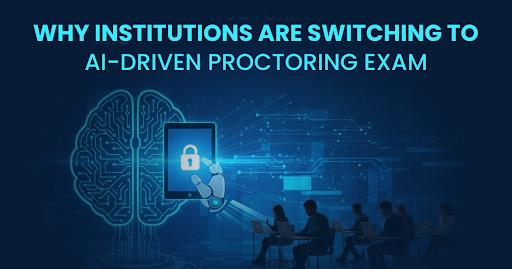
Online assessments are no longer a provisional option. The universities, certification bodies, and training centers’ evaluation ecosystem has now incorporated these assessments as an everlasting part of their assessments. The move has led to institutions facing a crucial question: how to keep the exams valid in a remote environment.
This is where the Proctoring Exam model has emerged. The traditional monitoring methods have been unable to cope with the modern threats and, therefore, pushed the institutions towards the adoption of smarter, AI-driven solutions. For institutions conducting large-scale evaluations, a structured Proctoring Exam approach has become unavoidable.
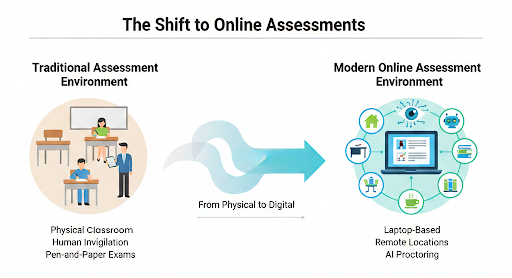
The Transformed Risk Landscape in Online Exams
1. Increased Exposure Beyond Physical Classrooms
With the exams moving to places other than the physical classrooms, the risk profile has grown remarkably.
Previously, the presence of invigilators controlled the situation. However, today, the candidates can take the exams from their homes, hostels, or even common places, and in most instances, they are not even monitored. This situation makes online proctoring a necessity, but on the other hand, it also complicates the matter for every Proctoring Exam conducted remotely.
The institutions have to deal with the following risks that have come up: impersonation, unauthorized cooperation, and exposure of digital content. The number of online examinations has increased the magnitude of these problems. An instance of a vulnerability can negatively affect the entire group of thousands of candidates appearing for a Proctoring Exam.
Without a dependable Proctoring Exam model, even the most-attended assessments can be perceived as untrustworthy.
Frequent Cheating Strategies Institutions Have to Deal With
2. Common Malpractice Patterns in Remote Exams
The scenario of remote exams has brought out the same cheating practices regardless of where and what kind of examination it is. They are no longer hypothetical risks but rather behaviors that have been seen repeatedly.
The following are some of the most common ones:
- Using fake identities or proxy test-takers for impersonation
- Candidates flipping through browser tabs to find answers
- Secondary devices like phones or tablets are being used
- Whispering or getting off-camera help
- Screen-sharing or recording the exam content
- Coordinated efforts in group assessments
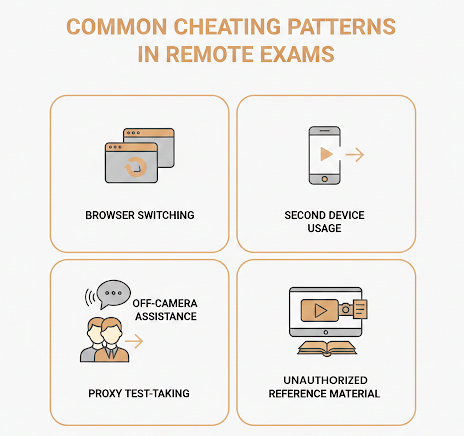
Basic online proctoring software can identify some of these actions, but others go undetected or are mistakenly labeled. Such a scenario undermines the honesty of the examination, especially in the case of high-stakes testing, where the reliability of a Proctoring Exam is vital.
The Downfall of Rule-Based Proctoring
3. Why Static Monitoring Rules Fail
The traditional proctoring systems are reliant upon fixed rules.
For instance:
- If the candidate’s eyes are not on the screen for more than 10 seconds, flag them
- Noise in the background should be monitored and flagged accordingly
- If more than one face is detected, then it is a flag
All these rules appear to be reasonable, but they do not provide the full context. A student peeking sideways does not necessarily indicate cheating. The sudden sound could be a natural one, not an intentional one.
Rule-based Proctoring Exam systems can’t keep up because the methods to cheat advance more quickly than the established rules. Hence, two main problems arise:
- Increase in false alarms that lead to an increased workload for the manual review process
- Not detecting sophisticated cheating methods, resulting in low confidence in the results
As the number of exams increases, these constraints become increasingly difficult to handle, considering the scale of a Proctoring Exam environment.
The Impact of AI Proctoring on the Examination Landscape
4. How AI Enhances Proctoring Accuracy
AI proctor exams work from a different direction; it does not depend on rigorous rules and regulations, but instead uses pattern recognition and behavioral analysis.
The AI monitors candidate activity over a long period of time and over several hundred sessions. It can tell the difference between what is normal and what is suspicious—this is based on statistics and not assumptions.
The major benefits are:
- Improvement in detection accuracy due to adaptive learning
- Context-aware flagging instead of blank alerts
- Sending a warning before raising risk
- Decreased reliance on manual intervention
This method greatly increases the integrity of exams while still providing a fair experience to the honest candidates taking a Proctoring Exam.
AI systems are not like the basic online proctoring systems; they focus on the substantial risk rather than every small deviation.
Quantifiable Results Institutions Are Experiencing
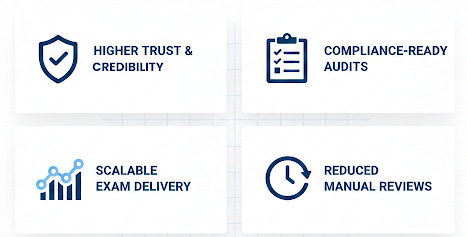
5. Measurable Outcomes of AI-Based Proctoring
Schools and universities that switch to AI-based Proctoring Exam solutions report distinct, quantifiable advantages.
- Increased Trust and Credibility
The value of certificates and scores received by stakeholders gets higher when they are aware of the intelligent monitoring of exams. It is especially important for universities, licensing bodies, and employers.
- Better Compliance
Ever more regulatory and accreditation institutions now require secure digital evaluation standards. AI-based online proctoring assists with audit trails, evidence logs, and compliance reporting.
- Uncomplicated Scalability
Taking care of this huge influx of candidates through manual monitoring is not feasible. However, the AI-driven Proctoring Exam models allow institutions to have thousands of exams going on at the same time without weakening the quality.
- Less Review Burden
AI lessens false positives and thereby reduces unnecessary human reviews, which in turn saves time and operational costs.
These results collectively form a sustainable assessment ecosystem rather than a temporary fix.
When Should Institutions Move to AI-Driven Proctoring?
6. Decision Factors for Institutions
Not every assessment requires high-level monitoring. Risk, scale, and the importance of the exam all play a role in the decision.
Institutions that are considering upgrading to AI Proctoring Exam solutions should take into account the following factors:
- Exams are critical for academic progression, hiring, or certification
- There is a large number of candidates or they are scattered over a wide area
- Manual review teams are overwhelmed
- Credibility issues are causing stakeholders to lose confidence
- Compliance and audit preparedness are essential
A trustworthy Proctoring Exam method is not about watching the candidates—it is about being fair, consistent, and trustworthy.
Use Case: How AI-Driven Proctoring Exam Works in Real-World Scenarios
University Semester Examinations
Universities that carry out end-of-term or semester exams generally have a situation where thousands of students, along with students from different locations, log in at the same time. Manual invigilation or simple rule-based monitoring fails to support the huge number of students and results in examination supervision discrepancies.
In this case, an AI-driven Proctoring Exam keeps track of every candidate’s actions throughout the examination period. The system detects weird behaviors—like switching screens too much, not showing one’s face consistently, or weird activities on the device—while disregarding harmless moves. This makes sure that large batches are treated fairly and, at the same time, human reviewers are not overwhelmed.
Outcome:
- Monitoring with the same consistency for all candidates
- Reduced manual supervision burden
- Increased trust in academic results
Competitive & Entrance Exams
Entrance exams and competitive exams are very prone to impersonation, collusion, and content leakage. Even one incident can ruin the whole examination cycle’s credibility.
An AI-based Proctoring Exam checks the identity of the candidate at several spots and keeps observing his/her behavior all through the test. Rather than reacting to random events, the system looks at the total risk build-up before marking a candidate for review.
Outcome:
- Very strong measures against test-taker by proxy
- Fewer wrongful accusations
- Reliable merit ranking based on test scores
Certification & Licensing Exams
The certification bodies are required to comply with strict regulations and audits. Conventional monitoring practices often do not provide structured evidence thus posing difficulties during post-exam audits.
When AI is used for proctoring, it is a Proctoring Exam that gives detailed audit logs, event timelines, and behavioral summaries. Such documentation allows the certifying authority to uphold the integrity of the exam during the audits or disputes.
Outcome:
- Unambiguous audit trails
- Better compliance with regulations
- Greater recognition of certificates
Corporate Hiring & Internal Assessments
Companies that are doing remote hiring tests or internal skill assessments need to have fast process but do not want to compromise on the integrity. Human proctoring makes it costly and also delays decision-making when applied on a large scale.
AI-driven Proctoring Exam systems allow organizations to simultaneously assess candidates across different regions without compromising the monitoring standards. Instead of raw alerts, recruiters get cleaner reports with meaningful risk indicators.
Outcome:
- Shorter hiring cycles
- Lower operational costs
- Equitable and standardized candidate evaluation
Why This Shift Is Important Now
Online testing has become a permanent element of the Education process. As new technologies roll out, so do ways of cheating. Institutions that stick to the traditional monitoring methods are not only risking losing operational efficiency; they are risking their reputations as well.
AI online proctoring is the next step in the secure digital evaluation process. It brings technology and human judgment together instead of just replacing one with the other.
Solutions such as Think Exam allow Educational Organizations to make this transition in a responsible way—by putting an emphasis on the accuracy, transparency, and learner experience rather than just on automation.
Final Thoughts
The switch to AI-driven Proctoring Exam systems is not a temporary measure but rather a necessary adaptation to the ever-growing challenge of modern education and assessment.
Institutions that take the necessary steps will be rewarded with the strengths of exam-integrity, scalability, and trust that lasts over time. On the contrary, those who postpone their decision risk lagging behind in a digital-first evaluation environment.
In the next generation of assessments, it will be intelligence—not any form of intensity—that decides credibility.
To understand secure proctored exams, read: AI Proctoring: How Artificial Intelligence is Enhancing Remote Proctoring.
FAQs
1. What is a Proctoring Exam?
A Proctoring Exam is an online exam that is monitored through technology to guarantee fair conduct and prevent cheating. It enables the institutions to conduct exams in a distant manner while still securing the integrity of the exam through live, recorded, or AI-based monitoring methods.
2. How is AI Proctoring Exam different from traditional online proctoring?
Traditional online proctoring works on the basis of fixed rules and human monitoring. An AI Proctoring Exam applies artificial intelligence to the process, analyzing the behavior of the candidates, recognizing patterns, and only then indicating a risk concern. This results in fewer false alerts and not only improves the accuracy but also the speed at which this accuracy is achieved.
3. Is AI-driven proctoring safe for candidates?
No doubt about it. AI-Powered Proctoring Exam programs are made in such a manner that they are privacy-conscious and just. They are concerned with conducting behavioral analysis linked to the integrity of exams and not personal data. Still, most systems permit establishments to set privacy and transparency standards up through their controls.
4. Can AI proctoring prevent impersonation in online exams?
AI-enhanced online proctoring has an immense effect on reducing impersonation risks with the use of identity confirmation, facial recognition, and behavior consistency checks. This process renders it nearly impossible for proxy test-takers to circumvent the system.
5. Does AI proctoring generate false positives?
When compared with rule-based systems, the AI Proctoring Exam produces a much lower number of false positives. The AI takes into account several different signs at the same time—for instance, eye movement, actions performed on the device, and the general setting—before marking an event.
6. Is AI proctoring feasible for large scale exam?
Absolutely. One of the key benefits of the AI-based Proctoring Exam is its scalability feature. Schools can host thousands of exams at the same time and without an increase in the manual supervision efforts, yet still the integrity of the examination will be preserved.
7. What types of exams benefit most from AI proctoring?
AI-powered online proctoring is highly suitable for:
- University semester exams
- Competitive entrance tests
- Certification and licensing exams
- Corporate hiring and internal assessments
Whichever exam requires credibility and compliance, it benefits from AI surveillance.