The shift toward online examination systems has transformed how organizations, universities, certification bodies, and employers evaluate candidates. What began as a necessity during remote learning and remote hiring has now become a long-term strategy for improving accessibility, scalability, and efficiency.
However, moving assessments online doesn’t automatically guarantee a seamless experience. Institutions and organizations often encounter challenges ranging from technical issues and security concerns to candidate engagement and administrative complexities.
The good news? Most of these challenges are preventable with the right technology, planning, and processes.
This article explores the most common online examination challenges and practical solutions to overcome them.
Why Online Examinations Are Becoming the New Standard
Before diving into the challenges, it’s important to understand why organizations continue investing in online examination systems.
Modern assessments offer:
- Greater flexibility for candidates
- Faster evaluation and result generation
- Reduced administrative workload
- Improved scalability
- Better access to data and analytics
As part of broader digital transformation initiatives, educational institutions and businesses are increasingly replacing traditional assessment methods with technology-driven alternatives.
Yet, like any digital system, success depends on implementation.
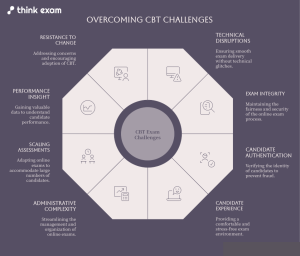
Challenge 1: Technical Disruptions During Exams
The Problem
Nothing creates anxiety faster than a technical issue during an exam.
Common disruptions include:
- Poor internet connectivity
- Browser crashes
- Device compatibility issues
- Unexpected power outages
- Platform slowdowns during peak usage
These issues can affect candidate performance and create concerns about fairness.
The Solution
Choose a Reliable Online Assessment Platform
A robust online assessment platform should be capable of handling large volumes of simultaneous users without performance degradation.
Look for features such as:
- Auto-save functionality
- Session recovery
- Low-bandwidth optimization
- Cross-device compatibility
Conduct Pre-Exam System Checks
Allow candidates to:
- Test their devices beforehand
- Verify internet stability
- Check browser compatibility
This simple step can eliminate many avoidable issues.
Have Backup Protocols
Institutions should establish clear procedures for:
- Reconnecting candidates
- Rescheduling interrupted exams
- Reviewing technical incident reports
Preparation minimizes disruption.
Challenge 2: Maintaining Exam Integrity
The Problem
One of the biggest concerns surrounding online examination systems is cheating.
Unlike traditional exam halls, candidates may be taking assessments from different locations with varying levels of supervision.
Common risks include:
- Unauthorized collaboration
- Use of external resources
- Impersonation
- Multiple device usage
The Solution
Implement AI-Based Monitoring
Modern proctoring solutions can:
- Monitor candidate behavior
- Detect suspicious activity
- Flag unusual movements
- Identify unauthorized applications
Use Secure Browser Technology
A secure testing environment can:
- Restrict access to other websites
- Disable screen sharing
- Block copy-paste functions
- Prevent switching between applications
Randomize Question Delivery
Randomized questions and answer choices reduce opportunities for answer sharing among candidates.
A quality online assessment platform should support dynamic question sequencing.
Challenge 3: Candidate Authentication Issues
The Problem
How can organizations be sure that the registered candidate is actually the person taking the exam?
Identity fraud remains a major concern for both academic institutions and employers.
The Solution
Multi-Layer Verification
Implement:
- Photo verification
- Government ID validation
- Facial recognition checks
- Live identity confirmation
Continuous Authentication
Rather than verifying identity only once, advanced systems perform periodic checks throughout the online examination process.
This significantly reduces impersonation risks.
Challenge 4: Poor Candidate Experience
The Problem
An overly complicated exam process can frustrate candidates.
Common complaints include:
- Confusing interfaces
- Difficult navigation
- Lengthy setup procedures
- Lack of clear instructions
When candidates struggle with the platform, their performance may not accurately reflect their actual abilities.
The Solution
Prioritize User-Friendly Design
A modern online assessment platform should provide:
- Simple navigation
- Clear instructions
- Intuitive workflows
- Mobile responsiveness
Offer Practice Assessments
Practice tests help candidates:
- Understand the interface
- Build confidence
- Resolve technical concerns before the actual exam
Better preparation leads to a better experience.
Challenge 5: Administrative Complexity
The Problem
Managing large-scale examinations manually can become overwhelming.
Administrators often struggle with:
- Scheduling
- Candidate communication
- Result processing
- Report generation
- Compliance tracking
As exam volumes grow, these tasks become increasingly difficult.
The Solution
Automate Processes
Automation can simplify:
- Exam scheduling
- Candidate invitations
- Reminder notifications
- Result distribution
Integrate Recruitment Software
For hiring-focused assessments, integrating recruitment software with the examination process creates a seamless workflow.
Recruiters can:
- Schedule assessments automatically
- Track candidate progress
- Access score reports instantly
- Move qualified candidates through the hiring funnel
This reduces administrative burden while improving efficiency.
Challenge 6: Scaling Assessments for Large Audiences
The Problem
Universities, certification bodies, and enterprises often need to conduct exams for thousands of candidates simultaneously.
Many systems struggle under heavy loads.
The result:
- Slow response times
- Login failures
- System crashes
- Negative candidate experiences
The Solution
Invest in Scalable Infrastructure
The right online assessment platform should support:
- High concurrent user volumes
- Cloud-based scalability
- Load balancing
- Automatic resource allocation
Conduct Stress Testing
Before major exams, organizations should test platform performance under realistic conditions.
This helps identify bottlenecks before they affect candidates.
Challenge 7: Limited Insight into Performance
The Problem
Traditional exam reports often provide only scores.
This makes it difficult to understand:
- Skill gaps
- Question effectiveness
- Candidate strengths
- Learning outcomes
Without deeper insights, organizations miss opportunities for improvement.
The Solution
Use Advanced Analytics
Modern online examination systems provide:
- Performance dashboards
- Section-wise analysis
- Difficulty-level reporting
- Candidate benchmarking
These insights support better academic and business decisions.
Support Continuous Improvement
Analytics help organizations:
- Refine assessments
- Improve curriculum design
- Optimize hiring strategies
This is where digital transformation delivers long-term value.
Challenge 8: Resistance to Change
The Problem
Even when technology offers clear benefits, adoption can be challenging.
Common concerns include:
- Fear of technology
- Preference for traditional methods
- Concerns about fairness
- Lack of training
Resistance often slows implementation efforts.
The Solution
Focus on Change Management
Organizations should:
- Train administrators thoroughly
- Educate stakeholders
- Communicate benefits clearly
- Provide ongoing support
Start with Pilot Programs
Running smaller assessment initiatives before full deployment helps build confidence and identify areas for improvement.
Successful pilots encourage wider adoption.
Online Examination as Part of Digital Transformation
The move toward online examination systems is about more than convenience.
It represents a broader shift toward digital transformation, where organizations use technology to improve efficiency, decision-making, and user experience.
Benefits include:
- Reduced operational costs
- Improved accessibility
- Faster processes
- Better data visibility
- Enhanced scalability
Whether in education, certification, or recruitment, digital assessment strategies are becoming essential for long-term success.
Conclusion
While online examination systems offer significant advantages, they also introduce new challenges that organizations must address proactively.
Technical disruptions, security concerns, candidate authentication issues, and administrative complexity can all impact assessment outcomes. However, these challenges are manageable with the right technology and processes.
A reliable online assessment platform, combined with intelligent automation, analytics, and integration with recruitment software, can help organizations create secure, scalable, and efficient assessment experiences.
As digital transformation continues to reshape education and workforce evaluation, organizations that solve these challenges effectively will be better positioned to deliver fair, reliable, and future-ready assessments.