Many organisations have already embraced online assessments to simplify hiring, training, certification, and employee development. They save time, reduce manual work, and make it easier to evaluate candidates at scale.
But adopting digital assessments is only the first step.
Many HR teams and recruiters discover new challenges once assessments become a regular part of their hiring or training process. These issues are not always obvious during the initial setup, but over time, they can affect candidate experience, hiring quality, and operational efficiency.
The good news is that most of these challenges can be solved with the right planning and the right technology.
Let’s look at some of the hidden challenges organisations face and how they can overcome them.
Challenge 1: Every Team Creates Assessments Differently
As organisations grow, different departments often create their own tests.
Marketing may use one format, sales another, and technical teams something completely different. This inconsistency makes it difficult to compare candidates fairly.
How to solve it
Create standardised assessment templates for common roles and skill levels.
A modern digital assessment platform allows organisations to manage question banks, assessment formats, and evaluation criteria from one central location. This creates consistency across departments while still allowing teams to customise assessments when needed.
Challenge 2: Assessments Become Outdated
Business needs to change quickly.
New technologies, changing job roles, and updated processes can make assessment questions outdated within months.
Candidates may end up being tested on skills that are no longer relevant.
How to solve it
Review assessments regularly.
Set a schedule to update question banks, remove outdated questions, and add new scenarios that reflect current job requirements.
Keeping assessments current helps organisations hire people with the skills they actually need.
Challenge 3: Reports Are Difficult to Understand
Many organisations receive detailed reports after every assessment.
The problem is that large amounts of data do not automatically create useful insights.
Recruiters often need answers to simple questions:
- Who is job-ready?
- Which skills need improvement?
- Which candidates should move to the next stage?
How to solve it
Choose a platform that presents information clearly.
A good online exam solution should provide dashboards, skill-based reports, and easy-to-understand analytics that support faster decision-making instead of overwhelming recruiters with raw data.
Challenge 4: Candidates Lose Interest During Long Assessments
Lengthy assessments often lead to lower completion rates.
Strong candidates may abandon a test if it feels unnecessarily long or repetitive.
This creates a poor candidate experience and reduces the quality of the hiring process.
How to solve it
Keep assessments focused.
Only evaluate the skills that matter for the role.
Shorter, well-designed assessments often provide better hiring insights than long tests with unnecessary questions.
Challenge 5: Hiring Teams Spend Too Much Time Managing Assessments
Even digital assessments can create administrative work if every invitation, reminder, and report is handled manually.
As hiring volumes increase, this quickly becomes difficult to manage.
How to solve it
Automation is essential.
Many organisations use recruitment software that works alongside assessment platforms to automate candidate invitations, scheduling, reminders, and result sharing.
This allows recruiters to spend more time evaluating talent instead of managing processes.
Challenge 6: Assessment Results Stay in One System
One common problem is that assessment data never reaches the people who need it.
Recruiters, hiring managers, and HR teams may all work in different systems.
This creates delays and duplicate work.
How to solve it
Look for solutions that integrate with existing HR technology.
When assessment results move automatically between systems, hiring becomes faster and collaboration improves.
Challenge 7: Organizations Focus Only on Scores
A high score does not always mean a candidate is the best fit.
Likewise, a slightly lower score does not necessarily mean someone lacks potential.
Many organisations miss valuable hiring insights by looking only at the final percentage.
How to solve it
Review the complete performance picture.
Modern online assessments can provide information about:
- Problem-solving ability
- Time management
- Topic-wise strengths
- Learning potential
- Skill gaps
These insights support better hiring decisions than scores alone.
Challenge 8: Candidate Experience Is Often Overlooked
Candidates judge employers throughout the hiring journey.
If assessments are difficult to access, confusing to complete, or technically unreliable, it can affect how candidates view the organisation.
How to solve it
Test the assessment experience regularly.
A reliable digital assessment platform should be easy to access, simple to navigate, and stable across different devices.
A smooth assessment process reflects positively on the employer brand.
Build a Better Assessment Strategy
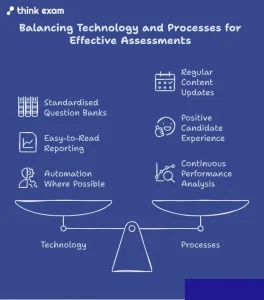
Technology alone cannot solve every assessment challenge.
Organisations also need clear processes, regular reviews, and continuous improvement.
An effective assessment strategy should include:
- Standardised question banks
- Regular content updates
- Easy-to-read reporting
- Automation where possible
- A positive candidate experience
- Continuous performance analysis
When these elements work together, assessments become more valuable for both recruiters and candidates.
Final Thoughts
Online assessments have transformed the way organisations evaluate talent, but success depends on more than moving tests online.
Standardisation, meaningful reporting, automation, and a strong candidate experience all play an important role in building an effective assessment process.
With the support of a reliable digital assessment platform, well-designed online exam assessment workflows, and integrated recruitment software, organisations can overcome common challenges and create assessments that are fair, efficient, and aligned with business goals.
The best assessments are not simply digital.
They are designed to deliver better hiring decisions and a better experience for everyone involved.