An examination used to involve a long chain of physical processes.
Question papers had to be printed and transported. Examination centres had to be arranged. Answer sheets had to be collected, transported, checked, and stored. Results then had to go through another round of processing.
The candidate experienced only a few hours of that process.
The organisation managed everything before and after it.
Online exams are changing this model.
By moving assessment delivery into a digital environment, organisations can reduce several manual steps while making examinations easier to deliver across locations. But the bigger change is not simply that candidates answer questions on a computer.
It is that the entire assessment process can become faster, more connected, and easier to manage.
Speed Starts Before the Exam
When people think about examination speed, they often think about how quickly results are released.
But speed starts much earlier.
A digital examination can streamline activities such as candidate registration, scheduling, test allocation, communication, and exam access.
Instead of managing several disconnected physical processes, administrators can coordinate much of the workflow through an online exam platform.
This can reduce repetitive administrative work and allow examination teams to spend more time on tasks that actually require human attention.
The result is not just a faster examination.
It is a faster assessment process.
Scale Without Replicating the Entire Operation
Conducting an examination for 100 candidates and conducting one for 100,000 candidates are very different operational challenges.
With physical examinations, increasing candidate numbers can mean increasing the number of centres, rooms, staff, printed materials, transportation arrangements, and administrative resources.
Digital delivery changes the equation.
An online exam system can allow organisations to manage large candidate groups through a centralised environment, depending on the platform’s infrastructure and capacity.
This can be useful for:
- Universities
- Certification bodies
- Recruitment teams
- Training organisations
- Coaching institutes
- Professional associations
The important point is that scale should not simply mean adding more people and processes.
It should mean being able to handle growth without creating the same amount of additional operational complexity.
Candidate Experience Starts With Simplicity
For candidates, an examination can already be stressful.
Complicated registration, unclear instructions, difficult navigation, or technical confusion can add unnecessary pressure.
A well-designed online exam website or testing interface should make the candidate journey straightforward.
Candidates should be able to understand:
- Where to access the examination
- What they need before starting
- How much time is available
- How to navigate questions
- How to review responses
- How to submit the examination
These details may seem small, but together they shape the candidate’s experience.
The best technology is often the technology that candidates don’t have to think about.
Digital Delivery Can Reduce Waiting Time
Traditional examination processes often involve waiting.
Waiting for question papers to arrive.
Waiting for answer sheets to be processed.
Waiting for manual evaluation.
Waiting for results to be compiled.
Not every examination can eliminate these stages completely, but digital delivery can reduce several of them.
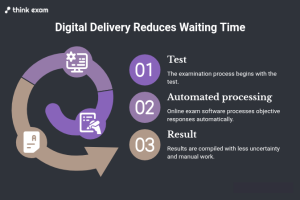
With online exam software, objective responses can be processed automatically, depending on the assessment design.
This can help organisations move from:
Test → Manual processing → Result
towards:
Test → Automated processing → Result
For candidates, that can mean less uncertainty about when their results will be available.
For administrators, it can mean less manual work.
An Online Exam Maker Changes How Tests Are Created
The shift to digital testing isn’t only about delivering examinations.
It also changes how assessment teams create them.
An online exam maker can help test creators build question banks, organise questions, assign marks, set time limits, and create different assessment versions.
This becomes particularly useful when organisations need to conduct multiple assessments for different groups.
For example, a university may need separate tests for different courses.
A recruitment team may need role-specific assessments.
A certification body may need different examination versions.
Instead of rebuilding each assessment from scratch, digital tools can make the process more structured.
One Platform Can Connect More of the Workflow
A fragmented examination process can create unnecessary work.
One system may manage candidate registrations.
Another may handle the test.
A separate spreadsheet may contain results.
Another tool may be used for reporting.
Connecting these stages through an online exam platform can simplify administration.
Depending on the platform, organisations may be able to manage:
Candidate Management → Test Creation → Delivery → Monitoring → Evaluation → Reporting
from a connected environment.
This doesn’t eliminate every operational challenge, but it can reduce the number of separate processes teams need to coordinate.
Scale Shouldn’t Come at the Cost of Security
Speed and scale are useful only when the examination remains credible.
As more assessments move online, organisations also need to consider identity verification, secure test environments, question security, monitoring, and result integrity.
An online exam system can incorporate security measures such as controlled access, authentication, secure browsers, question randomisation, and monitoring features depending on the examination’s requirements.
The exact combination should depend on the importance and risk level of the assessment.
A low-stakes practice test doesn’t need the same controls as a professional certification examination.
Personalisation Can Improve the Candidate Journey
Digital examinations can also create opportunities for more flexible assessment experiences.
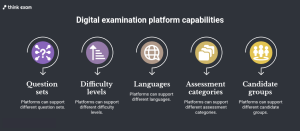
For example, platforms can support different question sets, difficulty levels, languages, assessment categories, and candidate groups.
This allows organisations to design assessments around their specific requirements instead of forcing every candidate through exactly the same operational workflow.
For large organisations, that flexibility can be particularly useful.
A single online exam platform may support assessments for different departments, courses, roles, or certification levels.
Data Makes the Assessment More Useful
A paper-based examination often produces one primary output:
The candidate’s score.
Digital examinations can produce much more information.
Depending on the system, administrators may be able to examine:
- Question-level performance
- Section-wise scores
- Time spent
- Attempt patterns
- Completion rates
- Candidate performance trends
This information can help organisations understand not only what candidates scored but also how they performed.
For educators, this can highlight topics where students need additional support.
For recruiters, it can provide additional evidence when evaluating candidates.
For certification bodies, it can support analysis of examination performance.
The Candidate Is No Longer Just a Test-Taker
The shift to digital assessment is also changing expectations.
Candidates increasingly expect digital processes to be clear and convenient because registration, communication, learning, recruitment, and other professional activities already happen online.
An online exam website that is difficult to navigate or poorly designed can therefore feel out of place.
Candidate experience is becoming part of assessment design.
Clear instructions, simple navigation, responsive interfaces, reliable access, and timely communication can all contribute to a smoother examination journey.
Speed Doesn’t Mean Rushing the Candidate
There is an important difference between making an examination process faster and making candidates rush.
The purpose of digital assessment is not necessarily to reduce examination time.
Instead, it can reduce operational waiting time around the examination.
Candidates can access tests remotely when the assessment model allows it. Results can be processed faster for objective assessments. Administrators can manage candidate information digitally.
This creates efficiency without necessarily changing the time candidates need to demonstrate their knowledge or skills.
Where Online Exams Are Making the Biggest Difference
Different sectors have different reasons for moving toward digital assessment.
Higher Education
Universities can conduct assessments across multiple courses and locations while managing results digitally.
Recruitment
Employers can assess large candidate pools before interviews and integrate assessment results into their wider hiring workflow.
Professional Certification
Certification bodies can deliver standardised assessments to candidates across different locations.
Corporate Training
Organisations can evaluate employee knowledge and skills after learning programmes.
Coaching and Education
Institutes can conduct regular mock tests and use performance data to understand student progress.
The technology may be similar, but the assessment objectives are different.
The Future Is About the Complete Assessment Experience
The biggest change brought by online exams is not the disappearance of paper.
It is the ability to connect different parts of assessment into one digital process.
From creating questions to registering candidates, delivering tests, monitoring sessions, processing responses, and generating reports, more of the journey can happen within a connected system.
That creates opportunities for organisations to improve efficiency while making the candidate journey simpler.
But technology alone isn’t enough.
A fast platform with a confusing interface is not a good candidate experience. A scalable system with weak security isn’t suitable for a high-stakes examination. And an attractive online exam website cannot compensate for poorly designed questions.
The strongest digital assessments bring all three areas together:
Speed for the organisation.
Scale for the operation.
Simplicity for the candidate.
From Taking Exams Online to Rethinking Assessment
The real transformation isn’t simply moving an examination from paper to a screen.
It is rethinking everything around the examination.
How quickly can candidates access it?
How easily can thousands of candidates be managed?
How much manual work can be removed?
How quickly can results be processed?
How much useful information can the organisation learn from the assessment?
And most importantly, how can candidates complete the process without unnecessary friction?
These are the questions that will shape the next generation of online exams.
Because the value of digital assessment isn’t just that the test happens online.
It’s that the entire experience can become faster to manage, easier to scale, and simpler to experience.