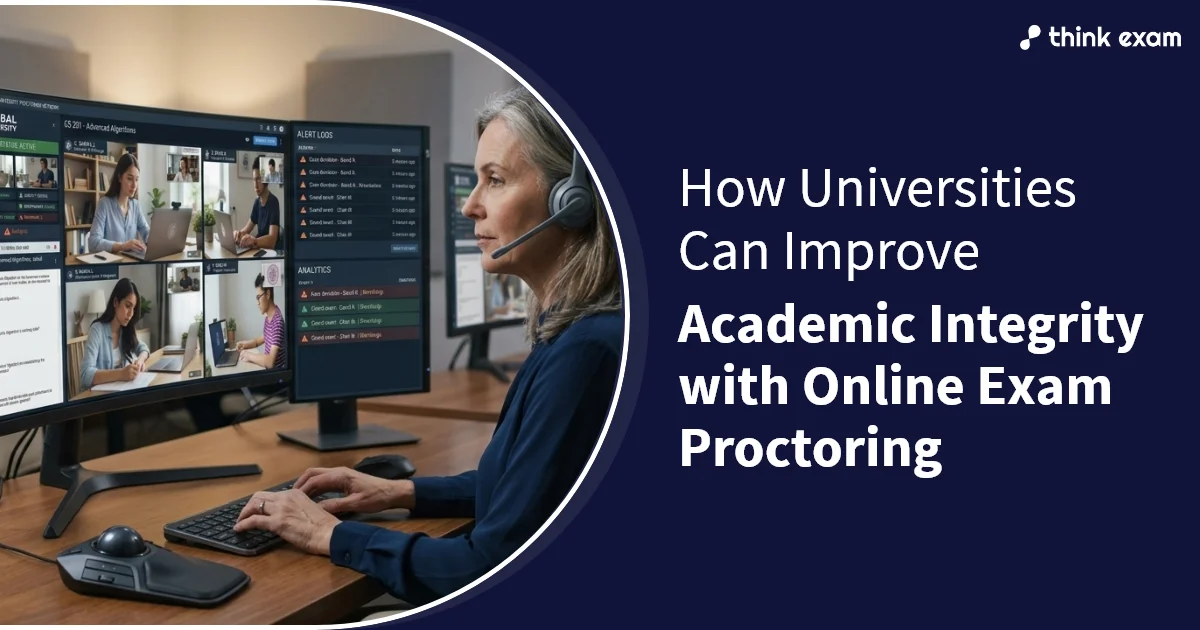
Academic integrity is easier to manage when an exam takes place in a classroom, with students sitting in the same room and an invigilator present. Universities today have a much more complicated assessment environment.
A single university may conduct hundreds of assessments across different departments, courses, campuses, and student groups. Some exams happen on campus, while others are taken remotely. This makes it difficult to maintain the same standards of academic integrity across every assessment.
Online exam proctoring can help universities create a more consistent approach to digital examinations. It can support candidate verification, secure exam delivery, monitoring, incident review, and record keeping, while allowing universities to decide how much control each assessment actually needs.
The aim is not to monitor students more aggressively. It is to create an examination process that is secure, fair, and practical for both universities and students.
Why Consistency Matters in University Exams
Most universities already have academic integrity policies. The bigger challenge is applying those policies consistently across different examinations.
One department may have a few hundred students taking an exam, while another may have several thousand. One course may use an on-campus examination, while another may rely on remote assessment. The people managing those exams may also follow different processes.
This raises an important question:
Can a university maintain the same standard of assessment integrity regardless of where an exam takes place?
A standardised online exam proctoring process can help answer that question. Instead of creating security procedures from scratch for every examination, universities can establish a common framework and adjust it according to the needs of each assessment.
Does Every Exam Need the Same Level of Security?
Not necessarily.
A weekly quiz does not carry the same risk as a final examination that contributes significantly to a student’s degree or professional qualification. Applying the same level of monitoring to both may not be practical.
Universities can consider factors such as:
- The importance of the assessment
- The number of students taking it
- The examination format
- The possibility of unauthorised assistance
- Whether the result affects the final grade
- Whether the qualification has professional or external significance
For a lower-stakes assessment, basic controls may be enough. A high-stakes examination may require stronger identity verification, a secure examination environment, monitoring, and additional review.
This risk-based approach allows universities to use stronger controls where they are actually needed.
How Can Universities Build a Consistent Proctoring Process?
The biggest benefit of online proctoring becomes clearer when an institution is managing a large number of examinations.
Rather than asking every faculty member to decide independently how a remote examination should be monitored, universities can create a repeatable process.
A typical workflow could look like this:
Assessment Setup → Candidate Verification → Secure Exam Delivery → Monitoring → Review → Record Keeping
Once this process is established, it can be adapted for different departments and courses.
Faculty members can concentrate on what students need to learn and demonstrate. The assessment infrastructure can handle the operational aspects of secure examination delivery.
That separation can make digital examinations easier to manage as the university grows.
What Role Does AI Proctoring Play?
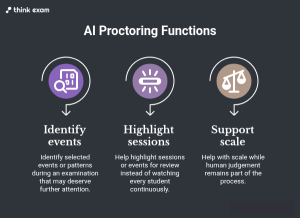
Large universities can have far more examination sessions than staff can realistically review manually.
This is where AI proctoring can be useful.
AI-assisted proctoring can identify selected events or patterns during an examination that may deserve further attention. Instead of asking staff to watch every student continuously, the system can help highlight sessions or events for review.
The important point is that an automated alert does not necessarily mean that a student has violated an examination rule.
For example, background noise, a temporary camera problem, or an unexpected movement may have a perfectly reasonable explanation. Human reviewers can look at the available evidence and consider the circumstances before reaching a decision.
In this way, AI can help with scale while human judgement remains part of the process.
Why Secure Browsers Matter in Online Exams
Monitoring is only one part of examination security.
A secure browser for exams can help control what students can access during an examination. Depending on how it is configured, it may restrict access to unauthorised websites, applications, browser functions, or other device activities.
This creates two different layers of protection.
Security controls help prevent certain activities.
Proctoring helps identify events that may need investigation.
Using both approaches can reduce the pressure on monitoring teams and create a more controlled digital examination environment.
Why an Evidence Trail Matters
An alert by itself does not always tell the full story.
When a university needs to investigate a possible examination issue, having an examination record can provide useful context. Depending on the platform and configuration, this may include:
- Candidate authentication information
- Examination activity
- Monitoring events
- Timestamps
- Session recordings
- Assessment responses
- Review outcomes
This allows authorised staff to look at what actually happened during a session rather than relying only on a notification that something appeared unusual.
The purpose is not to assume that every alert represents misconduct. It is to give the university enough information to review a particular situation properly.
Can Online Proctoring Replace Human Invigilators?
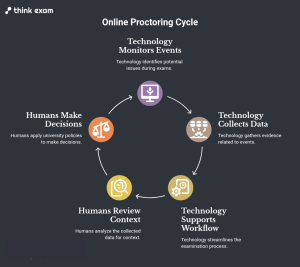
Online exam proctoring can reduce the amount of continuous manual monitoring required, but it does not necessarily remove the need for people.
Technology can identify events, collect information, and support the examination workflow. Human reviewers can then provide context and make decisions according to university policies.
This distinction matters because automated systems do not always understand why something happened.
A student may experience a connectivity problem. A camera may temporarily stop working. Background noise may occur. These situations should be reviewed rather than automatically treated as evidence of academic misconduct.
A practical approach is therefore:
Technology for monitoring and evidence + Human review for context and decisions.
How Can Universities Make Online Exams Fairer?
Academic integrity is not only about protecting the university. It is also about protecting students who follow the rules.
If one student takes an examination under controlled conditions while another has unrestricted access to external resources, the assessment may no longer measure the same thing for everyone.
Universities can support fairness by:
- Applying consistent examination procedures
- Explaining the rules before the exam
- Providing technical guidance
- Offering system-check or practice sessions
- Clearly defining permitted materials
- Providing technical support
- Reviewing unusual events in context
A secure examination should not become unnecessarily difficult simply because it is delivered online.
What Should Students Know Before an Online Proctored Exam?
Clear communication can make a significant difference to the student experience.
Before an online proctored exam, universities should explain what students need to do and what they can expect.
This can include:
- Required devices
- System requirements
- Identity verification steps
- Permitted materials
- Monitoring procedures
- Technical support options
- What happens if a technical problem occurs
- Relevant examination rules
A practice session or system check can also help students resolve basic technical problems before the real examination begins.
When students understand the process in advance, there is less uncertainty on examination day.
What Privacy Issues Should Universities Consider?
Online examinations can involve personal information, including identity details, video, audio, examination activity, and session records.
Universities therefore need clear policies around how this information is collected, accessed, stored, used, and retained.
The exact requirements can vary depending on the institution, jurisdiction, student population, and applicable regulations.
For that reason, privacy should be considered when designing the examination process, rather than treated as an issue to address after the technology has been implemented.
The objective should be to maintain examination integrity while also following responsible data-governance practices.
How Can Universities Learn From Their Examination Data?
Digital assessments can provide useful information beyond the examination itself.
Universities can look at patterns such as:
- Which assessments generate the most incidents
- Which types of problems occur repeatedly
- How long examination reviews take
- How many alerts require further investigation
- Where students experience technical difficulties
- Which processes create unnecessary administrative work
This information can help institutions improve future examinations.
For example, if students repeatedly experience technical problems during a particular examination, improving system preparation may be more useful than simply adding more monitoring.
The data can help universities understand whether the problem is related to examination security, technology, or the assessment process itself.
Building an Institutional Approach to Academic Integrity
Universities do not have to treat online exam proctoring as something added at the last minute.
It can become part of a broader assessment framework.
A university can establish common standards around:
Identity → Delivery → Security → Monitoring → Review → Record Keeping
Different examinations can then use different levels of control within that framework.
This approach gives universities a consistent foundation while still allowing individual departments and courses to adapt the process to their specific requirements.
How Think Exam Can Support University Assessments
Think Exam provides an online assessment environment that can support institutions in managing digital examinations and assessment workflows.
For universities, online assessment security can involve several connected elements rather than one standalone technology. Candidate verification, secure examination delivery, online proctoring, monitoring, and post-exam review can all play a role depending on the assessment.
The right combination will depend on the examination’s purpose, risk level, student requirements, institutional policies, and applicable privacy requirements.
The Real Goal: Confidence in Examination Results
A university degree represents more than the completion of coursework. It reflects the institution’s confidence that students have demonstrated the required knowledge and skills.
Maintaining that confidence becomes more challenging when assessments are conducted across different locations and at a large scale.
Online exam proctoring can help universities create more consistent examination processes, reduce repetitive monitoring work, identify sessions that need review, and maintain a clearer record of examination activity.
But technology alone cannot guarantee academic integrity.
A strong assessment process brings together:
Clear policies + Appropriate assessment design + Secure delivery + Responsible monitoring + Human judgement + Transparent communication
That is what allows universities to build an examination system that is not only more secure, but also understandable and fair for students.