Creating an online quiz takes only a few minutes. However, creating a practice test that genuinely helps learners improve requires more planning.
A useful practice test should do more than check answers. It should help learners understand concepts, identify weak areas, practise under realistic conditions, and track their progress over time. For educators, coaching institutes, universities, and corporate training teams, an online quiz generator can simplify this process by making it easier to create, organise, and manage digital assessments.
The key is to use the right questions, choose an appropriate test format, and turn the results into meaningful feedback.
In this guide, we will explore how to use an online quiz generator to build better practice tests, improve the learning experience, and make assessment more effective.
What Is an Online Quiz Generator?
An online quiz generator is a digital tool that helps users create quizzes and practice tests using different question types, scoring options, time limits, and assessment settings.
Depending on the platform, users may also be able to organise questions into a question bank, randomise questions across attempts, generate questions with AI assistance, and review learner performance through reports.
For example, a teacher preparing students for a science examination can create topic-based quizzes, while a corporate trainer can develop assessments to check employees’ understanding of a training module.
The purpose is not simply to create more tests. It is to make assessment easier to manage and more useful for the people taking it.
1. Define the Purpose Before Creating the Test
Before adding questions, decide what the practice test should measure.
A test designed for revision will have different requirements from one intended to simulate a final examination.
Common objectives include:
- Revising a particular subject or topic
- Checking understanding after a lesson
- Identifying knowledge gaps
- Preparing learners for a competitive examination
- Improving speed and time management
- Evaluating skills after a training programme
Once the objective is clear, it becomes easier to decide how many questions to include, how difficult they should be, and how much time learners will need.
Example: A short quiz on a single mathematics topic might contain 10 questions and allow learners to review their mistakes immediately. A full-length examination practice test may need multiple sections, different difficulty levels, a fixed duration, and a more detailed performance report.
A clear purpose helps ensure that every question serves a specific learning objective.
2. Create Questions That Test Understanding
One common mistake when building practice tests is focusing only on memorisation.
Remembering definitions and facts is important, but learners may also need to explain concepts, apply knowledge, interpret information, or solve problems.
A balanced practice test can include several types of questions:
- Recall-based questions: Check knowledge of facts, terms, and definitions.
- Conceptual questions: Test whether learners understand the underlying idea.
- Application-based questions: Ask learners to apply a concept to a practical problem.
- Scenario-based questions: Present a situation and ask learners to choose an appropriate response.
- Problem-solving questions: Evaluate reasoning and the ability to work through a challenge.
For example, a computer science quiz could include a question about the definition of an algorithm, followed by a scenario requiring the learner to select the correct algorithm for a particular problem.
This combination provides a broader view of understanding than a test containing only definition-based questions.
3. Choose the Right Question Types
An online quiz generator may support different question formats, depending on the platform.
The most suitable format depends on the subject, learning objective, and type of response you want to evaluate.
| Question type | Suitable use |
|---|---|
| Multiple-choice | Testing concepts and knowledge |
| Multiple-response | Checking whether learners can identify several correct answers |
| True or false | Assessing basic understanding of statements |
| Fill-in-the-blank | Testing recall of terms and missing information |
| Matching | Connecting related concepts, terms, or definitions |
| Scenario-based questions | Evaluating decision-making and practical application |
You do not need to use every available format in one test.
For instance, a vocabulary quiz may benefit from matching questions, while a technical assessment may need scenario-based problems. The goal is to select question types that reflect what learners are expected to know or do.
Before publishing a test, check that each question is clear, has an appropriate difficulty level, and includes the correct answer and explanation where needed.
4. Create Multiple Versions of the Same Practice Test
Repeated practice can help learners become more comfortable with a subject. However, when the same questions appear every time, learners may begin remembering answers instead of understanding the concepts.
A question bank can help solve this problem.
A question bank is a collection of questions organised by subject, topic, difficulty, question type, or learning objective. Assessment creators can use it to prepare different versions of a practice test.
For example:
- Attempt 1: Questions from algebra basics
- Attempt 2: Different questions covering the same algebra concepts
- Attempt 3: A mixed test covering algebra, geometry, and arithmetic
Question randomisation, where supported, can also vary the order of questions or answer options.
This approach is useful for coaching institutes, schools, universities, and training teams that need to provide repeated practice to multiple learners.
However, different versions should maintain a reasonably consistent level of difficulty. Randomly selecting questions without checking their quality can make one test much easier than another.
5. Set Appropriate Time Limits
Time management is an important part of examination preparation, particularly when learners are preparing for competitive exams or timed assessments.
A practice test can help learners become familiar with the pressure of completing questions within a limited period.
Depending on the purpose, useful settings may include:
- An overall test duration
- Section-wise time limits
- Question navigation
- Mark-for-review options
- Automatic submission when time expires
For example, a learner preparing for a timed aptitude examination can practise allocating time between numerical reasoning, logical reasoning, and verbal ability.
However, strict timing is not necessary for every activity. When learners are first studying a new topic, untimed practice with explanations may help them understand the material more effectively.
A useful approach is to begin with learning-focused quizzes and gradually introduce timed practice as learners become more confident.
6. Use Results to Identify Learning Gaps
A test score provides a quick overview of performance, but it does not explain everything a learner needs to improve.
Suppose a student scores 60% on a practice test. The next step should be to understand which topics caused difficulty and why.
Depending on the assessment platform, useful performance indicators may include:
- Overall score and accuracy
- Topic-wise performance
- Question-level results
- Correct and incorrect answers
- Unanswered questions
- Time spent on questions
- Performance across multiple attempts
Consider a student who performs well in algebra but struggles with geometry. Instead of repeating the entire mathematics syllabus, the student can focus revision on geometry and take another practice test afterwards.
Educators can use similar information to identify topics that need additional explanation or classroom practice.
The important point is that assessment results should guide the next learning activity, not simply record a score.
7. Organise Questions in a Reusable Question Bank
Creating every test from scratch can become time-consuming when an organisation manages several subjects, courses, or learner groups.
A structured question bank makes test creation more manageable by keeping questions organised and accessible for future use.
Questions can be categorised by:
- Subject and topic
- Difficulty level
- Question format
- Learning objective
- Course or examination
- Correct answer and explanation
For example, a coaching institute preparing students for several competitive examinations can maintain separate question collections for quantitative aptitude, reasoning, English, and general awareness.
Educators can then select relevant questions when preparing weekly quizzes, revision tests, or full-length mock examinations.
A well-maintained question bank also makes it easier to review outdated questions, correct errors, and improve the quality of future assessments.
8. Use AI to Support Question Creation
Artificial intelligence can help reduce the manual effort involved in preparing assessment questions, particularly when teams need to create questions from large amounts of learning material.
Depending on the platform, AI-assisted assessment tools may help with:
- Generating draft questions from source material
- Categorising questions by topic
- Creating variations of existing questions
- Suggesting different difficulty levels
- Organising questions for further review
For example, an educator working with a chapter on environmental science could use an AI question-generation tool to prepare draft questions covering the chapter’s main concepts.
The educator would then review the questions, correct any errors, verify the answers, and check that the questions match the learners’ level.
AI should support the question creation process, not replace subject expertise. Questions that are inaccurate, ambiguous, repetitive, or poorly matched to the learning objective can reduce the value of a practice test.
How Think Originate Can Support Question Generation
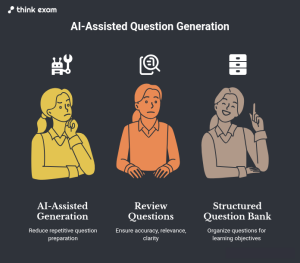
Think Exam’s Think Originate provides AI-assisted question-generation capabilities that can support the preparation of assessment content.
For educators and assessment teams, AI-assisted question generation can help reduce repetitive work when preparing questions from learning material. The resulting questions should still be reviewed for accuracy, relevance, clarity, and appropriate difficulty before being included in a practice test.
For organisations managing multiple assessments, combining question generation with a structured question bank can make it easier to organise questions and prepare tests for different learning objectives.
The practical value depends on the available platform features, the quality of the source material, and the review process followed by the assessment team.
9. Understand When Exam Security Is Necessary
Most low-stakes practice quizzes do not require extensive monitoring. Learners may benefit more from immediate feedback and the freedom to review their mistakes.
The requirements change when an assessment is used for certification, recruitment, formal evaluation, or another situation where exam integrity is important.
Depending on the assessment’s purpose, organisations may consider:
- Candidate identity verification
- Secure browser controls
- Remote exam proctoring
- Question and answer randomisation
- Attempt restrictions
- Activity records for review
Online exam proctoring software can help institutions monitor certain aspects of remote examinations. Secure browsers can also restrict specified device or browser activities during an assessment.
These measures have different capabilities and limitations. No single feature can guarantee that cheating will be prevented in every situation.
Organisations should choose security controls according to the assessment’s stakes, candidate requirements, privacy obligations, and operational needs.
For ordinary practice tests, the priority is usually learning and feedback. For higher-stakes examinations, assessment quality and security may need to work together.
10. Make Every Practice Attempt Useful
The value of a practice test does not end when a learner submits their answers.
The next steps determine whether the learner uses the experience to improve.
A practical practice-test cycle looks like this:
Create the test → Attempt the questions → Review the results → Identify weak topics → Practise again → Measure improvement
For example, a learner who repeatedly makes mistakes in logical reasoning can review the relevant concepts, solve additional questions, and take another test using a different set of questions.
The educator can then compare performance across attempts to see whether the learner has improved.
Training teams can apply the same approach after a learning module by identifying common mistakes and planning follow-up sessions.
The aim is to make each attempt contribute to better understanding rather than treating every quiz as an isolated activity.
11. Review the Test Before Sharing It
Even a well-structured assessment can produce misleading results if the questions contain errors or unclear instructions.
Before sharing a practice test, review the complete assessment.
Use this checklist:
- Confirm that every question matches the learning objective.
- Verify the correct answer and any explanation provided.
- Check for ambiguous wording and duplicate questions.
- Make sure the difficulty level is appropriate.
- Confirm the scoring rules and time limits.
- Test the assessment on the intended device or platform.
- Check that the results and feedback display correctly.
If several people are involved in creating the test, a second review can help identify mistakes that the original author may have missed.
This is particularly important when questions are generated with AI or reused from an existing question bank.
Conclusion
An online quiz generator can make practice test creation faster, but the quality of the assessment depends on how it is designed and used.
Start with a clear learning objective, create questions that test understanding, choose appropriate question types, and organise reusable questions in a structured question bank. Add time limits when they support the learning goal, and use performance reports to identify areas that need improvement.
AI-assisted question generation can further support the process, provided that generated content is reviewed before use. For higher-stakes assessments, organisations should also consider suitable exam security measures.
For educators, coaching institutes, universities, and training teams, the goal is not simply to create more quizzes. It is to make every practice attempt more useful.
When questions, feedback, and follow-up practice work together, an online quiz generator becomes a practical part of a more effective assessment and learning process.