Recruiters rarely receive a perfectly comparable set of candidates.
One applicant may have an impressive degree. Another may have more work experience. Someone else may have completed several certifications but have limited professional experience.
Resumes provide useful information, but they don’t always provide the same kind of evidence for every candidate.
This is where an online exam assessment can add another layer to recruitment.
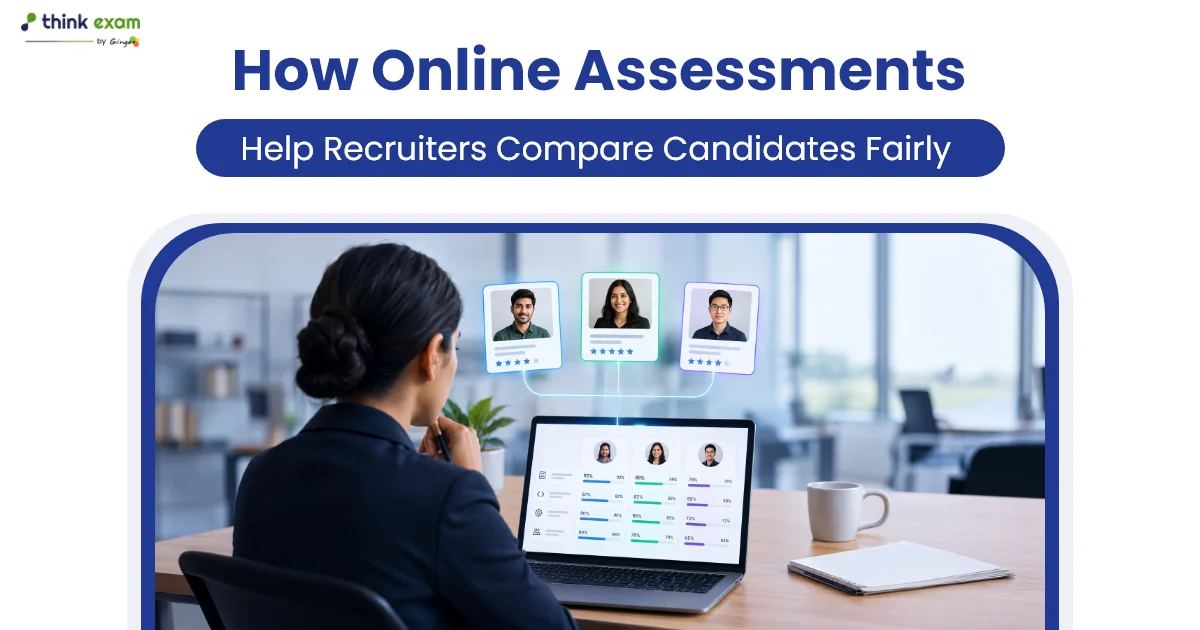
A structured assessment gives candidates a common set of questions, tasks, time limits, and evaluation criteria. Instead of comparing candidates only through information that appears differently on every resume, recruiters can also compare how candidates perform under the same assessment conditions.
That does not make hiring completely objective.
But it can give recruiters more consistent evidence to consider.
A Resume Doesn’t Always Give Recruiters the Same Information
Candidates present their experience differently.
Some resumes are detailed. Others are concise.
Some candidates have worked with well-known organizations. Others may have developed relevant skills through smaller companies, internships, academic projects, or independent work.
This makes direct comparison difficult.
An online assessment platform can introduce a common evaluation point.
Candidates can be asked to complete the same assessment, within the same broad conditions, against criteria that are relevant to the role.
The recruiter then has another source of evidence alongside the resume and interview.
Start With the Skills the Role Actually Needs
Fair comparison begins before the assessment is created.
If a company is hiring for a business development role, for example, the assessment might need to examine numerical reasoning, communication, situational judgement, or basic business understanding.
A technical role may require logical reasoning, technical knowledge, or practical problem-solving.
A finance role may require numerical analysis and interpretation.
The important question is not:
“What questions can we put into the test?”
It is:
“What skills should this candidate demonstrate for this role?”
That distinction can make an online exam assessment much more relevant to hiring.
Give Candidates a Common Starting Point
Imagine 500 candidates applying for the same position.
Their educational backgrounds may vary considerably.
Their resumes may use different terminology.
Their previous employers may have different standards.
An online aptitude exam can provide a common starting point.
Every candidate can be assessed against the same broad skill areas and evaluation criteria.
For example, an organization might evaluate:
- Numerical reasoning
- Logical reasoning
- Verbal ability
- Data interpretation
- Situational judgement
- Role-specific knowledge
This does not mean every candidate becomes identical.
It simply gives recruiters a shared reference point when reviewing a large candidate pool.
Aptitude Tests Can Help With Early-Stage Screening
Recruiters often need to manage large applicant volumes.
Reviewing every application in the same depth may not be practical.
An online aptitude test can be used as one stage of the recruitment process to understand whether candidates demonstrate the foundational skills required for a role.
For example, an organization hiring graduate trainees may use an aptitude assessment to evaluate reasoning, numerical ability, and verbal skills before moving selected candidates to interviews.
This can make the early stages of recruitment more structured.
However, the assessment should complement—not completely replace—the rest of the hiring process.
Standardized Conditions Make Comparison Easier
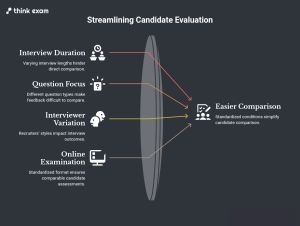
Suppose two candidates are interviewed by different recruiters.
One interview lasts 30 minutes.
Another lasts 50 minutes.
One interviewer asks mostly technical questions. Another focuses on communication.
The resulting feedback can be difficult to compare directly.
A structured online examination can reduce some of this variation by giving candidates a defined assessment format.
They receive the same instructions, comparable time constraints, and a predetermined evaluation framework.
This can make the resulting data easier to compare.
But a Higher Score Doesn’t Automatically Mean a Better Candidate
This is an important distinction.
An online aptitude assessment test can measure the skills it was designed to measure.
It cannot automatically determine whether someone will become the best employee.
A candidate’s final suitability may also depend on:
- Role-specific experience
- Communication
- Motivation
- Teamwork
- Cultural and organizational fit
- Practical skills
- Interview performance
- Career goals
The assessment should therefore be treated as one evidence point, not the entire hiring decision.
Use the Same Assessment Logic for Everyone
Fair comparison also depends on consistency.
If one candidate receives a completely different assessment without a valid reason, the results may become difficult to interpret.
Recruitment teams can create clearer processes by defining in advance:
- Which candidates take the assessment
- Which skills are being measured
- How much time candidates receive
- How responses are scored
- Which score or performance indicators matter
- What happens after the assessment
A consistent process helps recruiters compare results more meaningfully.
Recruitment Software Can Connect Assessment With the Hiring Process
Assessment shouldn’t have to sit separately from recruitment.
Modern recruitment software can connect different stages of the candidate journey, depending on the system being used.
For example:
Application → Screening → Assessment → Interview → Selection
When assessment information can be connected with candidate records, recruiters can review results alongside other relevant information.
This reduces the need to manually move scores between spreadsheets or separate systems.
More importantly, it gives recruiters a clearer view of where assessment fits into the overall hiring process.
Digital Transformation Is Changing Recruitment Workflows
Recruitment has gradually moved from paper applications and manual records toward digital platforms.
This broader digital transformation is also changing how organizations evaluate candidates.
Candidates can apply online, complete assessments remotely, attend interviews digitally, and receive communication through connected systems.
The important change isn’t simply that recruitment is now digital.
It is that more stages of the candidate journey can generate structured information.
Recruiters can use that information to make comparisons based on evidence rather than relying entirely on first impressions.
An Online Assessment Platform Can Make Results Easier to Understand
A useful online assessment platform should not stop at producing a final score.
Depending on the assessment, recruiters may be able to review:
- Overall performance
- Section-wise scores
- Accuracy
- Time taken
- Skill-area performance
- Question-level results
This can reveal differences that a single score may hide.
For example, two candidates might both achieve 75%.
One may perform strongly in numerical reasoning but struggle with verbal ability.
The other may show the opposite pattern.
If the role requires stronger numerical skills, the section-level information may be more useful than the overall score alone.
Assessment Design Matters More Than the Technology
Putting an assessment online does not automatically make recruitment fairer.
A poorly designed test can still produce poor comparisons.
Recruiters should consider whether the assessment:
- Measures skills relevant to the role
- Uses clear questions
- Avoids unnecessary complexity
- Has appropriate difficulty
- Uses consistent scoring
- Gives candidates reasonable instructions
- Reflects the actual requirements of the position
Technology can deliver the assessment.
It cannot decide whether the assessment itself is appropriate.
Use Assessments to Support, Not Replace, Human Judgement
Recruitment involves decisions about people, so context matters.
A candidate may perform poorly because of unfamiliarity with a testing format. Another may have excellent test performance but limited practical experience.
Recruiters should therefore look at assessment results alongside other evidence.
The purpose of an online exam in recruitment should be to improve the information available to the hiring team.
Not to turn hiring into a single-number exercise.
The Value of Comparability
The biggest advantage of structured assessments may not be that they identify a perfect candidate.
It is that they give recruiters a common basis for comparison.
Candidates from different educational institutions can attempt the same assessment.
Applicants with different amounts of experience can demonstrate specific skills.
Large applicant pools can be evaluated using consistent criteria.
Recruiters can then combine those results with resumes, interviews, portfolios, references, and other relevant information.
That creates a broader picture of each candidate.
A More Structured Way to Compare Candidates
Fair recruitment does not mean treating every candidate as exactly the same in every situation.
It means being clear about what is being evaluated and applying relevant criteria consistently.
An online exam assessment can support that process by giving candidates a shared opportunity to demonstrate specific skills.
An online aptitude test can help evaluate foundational abilities.
An online assessment platform can organize and report the results.
Recruitment software can connect those results with the wider hiring workflow.
But the final value comes from how recruiters use the information.
The goal is not to find a number that decides who gets hired.
It is to give recruiters better evidence for comparing candidates on skills that actually matter to the role.