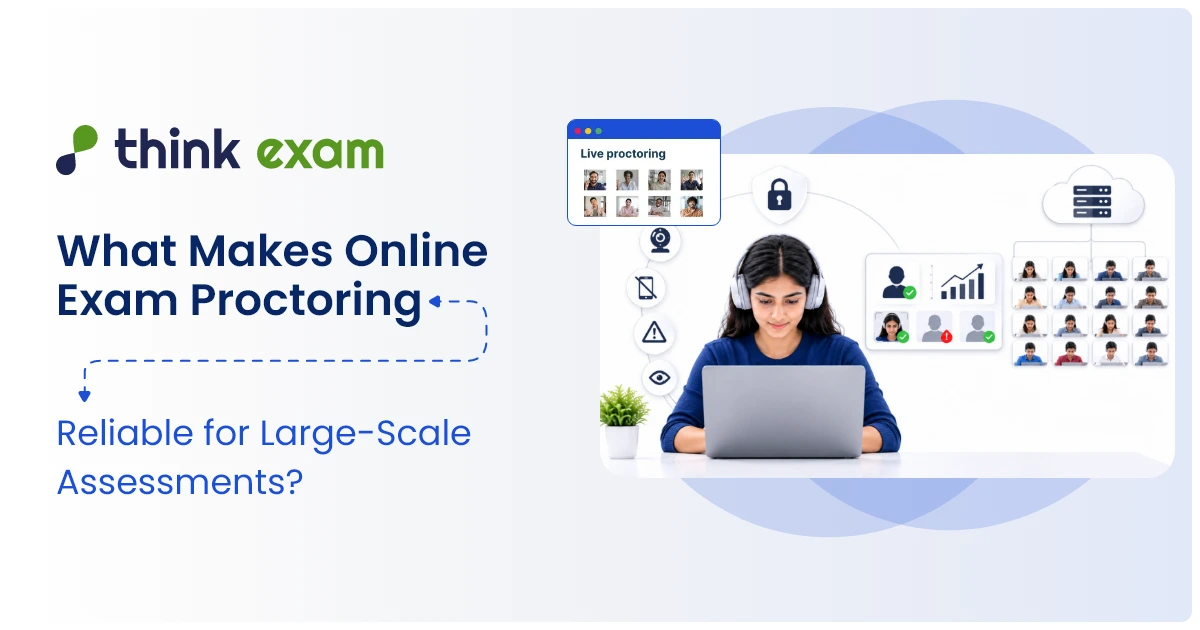
Monitoring 100 candidates is one thing. Monitoring 10,000 candidates taking an exam across different locations, devices, and time zones is a different challenge.
At that size, even a small technical issue or inconsistent review process can create problems for the entire examination.
Online exam proctoring helps institutions monitor remote examinations, but reliability depends on much more than surveillance. The system must work consistently, handle unexpected issues, and give exam teams a clear way to review potential violations.
Here are the factors that matter when assessments grow.
1. Consistency Matters More Than the Number of Cameras
In a large examination, candidates may be monitored by different people or automated systems. Without clear rules, similar incidents could receive different responses.
A reliable proctoring process needs:
- Standardised exam rules: Candidates should know what is permitted before the test begins.
- Consistent monitoring settings: Security checks should match the exam’s requirements.
- Clear escalation procedures: Proctors need to know which incidents require immediate attention and which can be reviewed later.
This helps institutions maintain a consistent approach across candidate groups without assuming that every unusual action indicates misconduct.
2. AI Should Help Proctors Focus, Not Replace Judgement
When thousands of candidates take an online proctored exam simultaneously, reviewing every moment manually can be difficult.
AI proctoring can help identify events that may need attention, such as a candidate leaving the camera view or another person appearing in the frame.
Its role is to help manage the volume of monitoring activity.
- Automated alerts: Highlight events that may need review.
- Prioritised investigation: Help proctors focus on flagged sessions.
- Human review: Provides context before decisions are made about potential violations.
An alert is not proof of cheating. Reliable systems need a review process that accounts for technical interruptions, accessibility needs, and ordinary candidate behaviour.
3. Secure Browsers Close a Different Gap
A candidate may remain visible on camera while still accessing unauthorised digital resources. Camera monitoring alone cannot reliably prevent this.
Secure Browsers help address the problem by restricting specified websites, applications, and computer functions during an examination.
For large-scale online assessments, this adds another layer of control:
- Limits certain unauthorised actions on supported devices.
- Helps protect the exam environment.
- Works alongside identity checks and proctoring.
Browser restrictions depend on the device, operating system, and configuration. Institutions should test compatibility before exam day to avoid preventable access issues.
4. The System Must Handle Problems Without Losing Control
A proctoring solution may perform well in a small trial but face different challenges when thousands of candidates log in at once.
Reliability means preparing for the unexpected, not just planning for a smooth session.
Before a large examination, institutions should check:
- Concurrent candidate capacity: Can the platform support the expected number of simultaneous sessions?
- Device compatibility: Does it work with the devices and operating systems candidates use?
- Connectivity interruptions: Are there clear procedures for reconnecting and resuming where permitted?
- Technical support: Can candidates and administrators get help when problems occur?
- System monitoring: Can the exam team identify widespread technical issues quickly?
A successful launch is important, but the ability to respond to problems during the examination matters just as much.
5. Every Flag Needs a Clear Record
Large examinations can generate thousands of monitoring alerts. Without organised records, investigating incidents becomes time-consuming.
A reliable online exam proctoring workflow should help authorised teams:
- Review relevant session recordings and flagged events, where available.
- See timestamps and supporting evidence.
- Document decisions and follow-up actions.
- Apply consistent review procedures across candidates.
This becomes particularly important when a candidate challenges an incident or an institution needs to explain its decision.
Recording an event is only the first step. The evidence must be reviewed fairly, stored securely, and accessed only by authorised people.
6. Candidate Experience Is Part of Reliability
Security controls should protect an exam without making it unnecessarily difficult for genuine candidates to participate.
Before the assessment, institutions should provide:
- Clear instructions on installation, permissions, and identity verification.
- A practice session or system compatibility check.
- Information about camera, microphone, and browser requirements.
- A support channel for technical difficulties.
- Clear guidance on privacy and monitoring.
These steps can reduce avoidable delays and help candidates begin their assessments with fewer surprises.
A Quick Reliability Checklist
Before selecting a solution for large-scale examinations, ask:
| Area | What to check |
| Monitoring | Can it support the required live, automated, or recorded proctoring model? |
| Security | Does it offer suitable identity checks and Secure Browsers? |
| Capacity | Has it been tested for the expected concurrent candidate volume? |
| Review | Can teams investigate alerts using relevant evidence? |
| Support | Are technical issues handled through a defined process? |
| Privacy | Are access permissions and data-retention rules clearly defined? |
Think Exam offers configurable proctoring capabilities that can combine AI-based monitoring, human review, and security controls according to assessment requirements. The right setup depends on the exam format, risk level, candidate volume, and operational needs.
Large-Scale Exams Need More Than Large-Scale Monitoring
Reliable proctoring comes from several parts working together: consistent rules, appropriate technology, stable delivery, organised evidence, and fair review.
AI can help teams manage monitoring at volume. Secure Browsers can restrict specified digital activities. Technical support and clear procedures help keep the examination running when problems arise.
The real measure of reliable online exam proctoring isn’t how much activity a system flags. It’s whether the institution can run the exam consistently and make informed, defensible decisions when something goes wrong.
Frequently Asked Questions
What is online exam proctoring?
It is the supervision of an online examination through live human monitoring, automated tools, recorded sessions, or a combination of these methods.
How does AI proctoring help with large-scale exams?
It can flag events that may need attention, helping review teams prioritise sessions rather than manually monitoring every moment.
Why are Secure Browsers important?
They restrict specified applications, websites, and computer functions, adding a layer of protection beyond camera monitoring.
Can online proctoring handle thousands of candidates?
It can, provided the platform has sufficient capacity, appropriate configuration, tested infrastructure, and reliable technical support.
Does a proctoring alert prove that a candidate cheated?
No. Alerts indicate activity that may require investigation. Decisions should consider the available evidence and relevant exam rules.