Putting a question paper on a screen doesn’t automatically make an exam smarter. It changes the format, but the real opportunity lies in what happens around the questions: how they are created, delivered, evaluated, and used to understand performance.
The online exam has evolved from a digital version of a traditional test into a more connected assessment process. Today, institutions can build question banks, automate evaluation, manage exam security, and use performance data to improve future tests.
Here’s how that shift is changing the way organisations assess people.
It Started With Moving the Question Paper to a Screen
The early shift to digital testing was largely about replacing paper-based processes.
Instead of printing question papers and manually checking answer sheets, institutions could deliver questions digitally and evaluate objective responses automatically.
That brought practical improvements:
- Less paperwork and manual data entry.
- Faster scoring for supported question types.
- Easier storage and organisation of exam records.
- More convenient access for candidates taking exams remotely or at designated centres.
But the first generation of digital testing had a limitation: a digital question paper could still be just as rigid as a printed one.
The next step was to rethink how assessments were created and managed, not simply where candidates answered them.
The Question Bank Became More Important Than the Question Paper
When every exam is built from scratch, updating questions and maintaining consistency can become difficult.
Modern online exam software helps institutions move towards reusable, organised question banks.
Instead of managing separate documents for every test, exam administrators can:
- Group questions by subject, topic, difficulty, or competency.
- Reuse approved questions across different assessments.
- Create multiple test versions where appropriate.
- Update questions while maintaining better control over changes.
This also makes it easier to improve an assessment over time. If a question repeatedly confuses candidates or fails to measure the intended skill, administrators can review and revise it.
The focus shifts from creating another question paper to maintaining a reliable collection of questions that supports better testing.
Exams Are Becoming More Flexible
Not every assessment needs the same format.
A university entrance test, a recruitment aptitude test, and an employee skills assessment have different requirements. A modern online exam platform should make it possible to configure the assessment around its purpose.
That may include:
- Different question formats, including multiple-choice, descriptive, and other supported types.
- Timers, navigation settings, and marking rules suited to the exam.
- Randomised questions or answer options where appropriate.
- Different assessment formats for different candidate groups.
This flexibility allows institutions to design tests around what they need to measure rather than forcing every assessment into the same template.
Security Is No Longer an Afterthought
As digital exams become more accessible, protecting the assessment becomes just as important as delivering it.
A secure online exam platform can combine several safeguards, depending on the exam’s risk level:
- Identity verification: Helps confirm that the registered candidate is taking the test.
- Secure browser controls: Restrict specified applications, websites, or computer functions.
- Online proctoring: Helps monitor activity and flag incidents that may need review.
- Access permissions: Limit who can view or modify confidential exam content.
- Audit records: Help administrators investigate changes or disputed incidents.
No single feature can eliminate every security risk. The aim is to combine appropriate controls and give exam teams a reliable process for reviewing potential problems.
The Bigger Shift: From Scores to Insights
An exam traditionally ended when the marks were calculated. But a score alone rarely explains the full picture.
A well-designed online assessment platform can help institutions examine performance beyond the final result.
For example:
- Educators can identify topics where students consistently struggle.
- Recruiters can compare performance across job-related competencies.
- Training teams can identify areas that may need further development.
- Exam administrators can review question performance and improve future assessments.
These insights are useful only when the questions measure the right things and the results are interpreted in context. Still, they create opportunities to make assessments more informative than a simple pass-or-fail decision.
Where AI Fits Into the Next Stage
Artificial intelligence is adding new possibilities to assessment design and analysis, but its value depends on how it is used.
Within a digital examination platform, AI-supported capabilities may help with:
- Generating draft questions from approved learning material.
- Supporting question classification and organisation.
- Analysing patterns in candidate responses.
- Flagging activity that may require further review during a proctored exam.
Human oversight remains important. Generated questions need validation, unusual behaviour should not automatically be treated as misconduct, and high-stakes decisions require appropriate review.
The goal is not to automate every part of an exam. It is to reduce repetitive work and give assessment teams more time to focus on quality and decision-making.
What Should a Modern Examination Platform Bring Together?
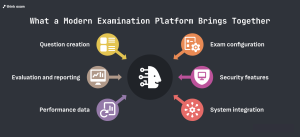
The evolution of online exams points towards a connected process rather than a collection of disconnected tools.
When evaluating a digital examination platform, institutions should look for:
- Question creation and question-bank management.
- Flexible exam configuration and delivery.
- Reliable evaluation and reporting.
- Security features suited to the assessment.
- Useful performance data and audit records.
- Integration with existing systems, where required.
Think Exam brings assessment creation, exam delivery, evaluation, and security capabilities together to support different examination needs. The specific configuration depends on the institution, assessment format, and level of risk involved.
The Next Exam Should Do More Than Go Digital
The real progress in online testing isn’t just that candidates no longer need paper. It’s that institutions have more ways to design assessments, manage security, understand results, and improve the next test.
As technology develops, the most useful online exam solutions will be those that connect these parts of the process without making testing unnecessarily complicated.
A smarter exam isn’t defined by the technology behind it. It’s defined by how well that technology helps people measure what matters.