A low score doesn’t always mean a candidate lacks the required skills. A high score doesn’t automatically mean they’re the right fit, either.
The challenge is knowing what the results actually tell you.
Online assessments help organisations move beyond simply conducting tests. When designed well, they provide useful information that supports decisions in hiring, education, and employee development.
1. Turning Scores Into Useful Information
A final score tells you how someone performed, but it doesn’t always explain where they did well or struggled.
Online assessments can provide more detailed insights through:
- Topic-wise performance: Identify areas where candidates perform well or need improvement.
- Question-level analysis: Spot questions that are too easy, too difficult, or potentially unclear.
- Skill-based results: Understand performance across specific competencies instead of relying only on a total score.
These insights help institutions improve future tests and make more informed decisions about individual performance.
2. Making Candidate Evaluation More Relevant
Hiring teams often receive applications from candidates with different qualifications and work experiences. Comparing them using resumes alone can make it difficult to judge their actual abilities.
An online assessment for hiring adds another source of evidence.
- Online aptitude assessment: Helps evaluate logical reasoning, numerical ability, and problem-solving.
- Online skills assessment: Tests job-related knowledge or practical capabilities.
- Role-specific questions: Focus on the skills required for a particular position.
Recruiters can use these results alongside interviews, experience, and other selection criteria. The aim isn’t to let a test make the final decision, but to help hiring teams ask better questions and assess candidates more meaningfully.
3. Finding Gaps Before They Become Bigger Problems
In education and employee training, assessments can reveal gaps that might otherwise go unnoticed.
For example, a training team may discover that employees understand a process in theory but struggle to apply it in practical situations.
Online assessments help teams:
- Identify recurring knowledge gaps.
- Compare performance across groups or departments.
- Decide which topics need additional training.
- Track progress through follow-up assessments.
Instead of giving everyone the same training again, organisations can focus their efforts where they are most needed.
4. Improving the Tests Themselves
Sometimes, the problem isn’t the candidate. It is the test.
Poorly worded questions, incorrect answer keys, or questions that don’t measure the intended skill can lead to misleading results.
A digital assessment platform can help test administrators manage and review assessments more systematically.
Useful capabilities include:
- Question banks: Reuse and organise questions by topic, difficulty, or skill.
- Test maker tools: Create assessments with defined question types, timings, and marking rules.
- Question analysis: Identify items that consistently produce unexpected results.
- Version management: Track revisions and keep test content organised.
Reviewing performance data helps administrators improve question quality and make future assessments more useful.
5. Reducing Delays Between Testing and Action
When results take too long to process, decisions get delayed. Candidates wait for updates, recruiters struggle to move hiring forward, and educators may miss opportunities to address learning gaps.
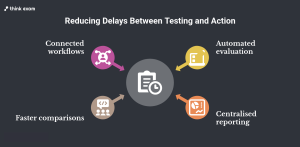
A well-designed online exam assessment process can reduce unnecessary delays through:
- Automated evaluation: Scores objective questions without routine manual checking.
- Centralised reporting: Gives authorised teams access to results in one place.
- Faster comparisons: Helps reviewers identify patterns across candidates or groups.
- Connected workflows: Recruitment software and assessment tools can work together to reduce repeated data entry, depending on available integrations.
Faster results are useful only when they remain accurate and are interpreted properly. Speed should support better decisions, not replace careful judgement.
6. Choosing a Platform That Supports Better Decisions
The value of online assessments depends on the quality of the test and the information available after candidates complete it.
When choosing a platform, look for:
- Flexible test creation: Support for different subjects, roles, question types, and difficulty levels.
- Useful reporting: Results that go beyond a single overall score.
- Reliable evaluation: Clear marking rules and appropriate review options.
- Security controls: Access permissions and suitable monitoring for the assessment’s risk level.
- Integration options: Compatibility with existing learning or recruitment systems.
- Scalability: The ability to manage your expected number of candidates without making administration more difficult.
Think Exam brings assessment creation, delivery, evaluation, and reporting together, helping organisations manage different testing requirements through a connected platform.
Better Questions Lead to Better Decisions
Online assessments are most useful when they help answer a specific question: Does this candidate have the skills required? Which topic needs more attention? Is this test measuring what it was designed to measure?
The score is only the starting point. The real value comes from understanding what sits behind it and using that information to decide what happens next.