An online exam can have a strong password, a timed question paper, and a reliable platform, yet still leave room for security risks. A candidate could receive outside help, use an unauthorised resource, or have someone else attempt the test on their behalf. These gaps are not always obvious when an exam is being planned, but they can affect the credibility of the final result.
This is where proctoring becomes an important part of online assessment security. It helps institutions verify who is taking the exam, monitor activity during the session, and review events that may require attention. More importantly, it works best when combined with other security measures rather than treated as a complete solution on its own.
For universities, certification bodies, recruitment teams, and assessment providers, the goal is not simply to monitor candidates. It is to make sure that exam results remain trustworthy.
The Security Gaps That Often Go Unnoticed
Online exams create flexibility, but they also change how institutions manage exam security. In a physical examination centre, invigilators can observe candidates, check identification, and respond to suspicious activity. In a remote setting, these responsibilities need to be handled through a combination of technology, clear rules, and human oversight.
Some common gaps include:
- Identity gaps: The system needs to establish that the registered candidate is the person taking the exam.
- Device and browser gaps: Candidates may be able to access unauthorised websites, applications, or communication tools if the exam environment is not restricted.
- Monitoring gaps: Without suitable supervision, certain activities may go unnoticed during an assessment.
- Evidence gaps: If a result is challenged, the institution may struggle to establish what happened during the exam.
- Response gaps: Even when suspicious activity is detected, unclear review procedures can lead to inconsistent decisions.
These are connected problems. Verifying identity does not prevent access to outside resources, and restricting a browser does not establish who is sitting in front of the screen. Effective security requires controls that address different risks.
1. Confirming That the Right Person Takes the Exam
One of the first security checks happens before the candidate answers a single question.
Without proper identity verification, there is a risk that someone other than the registered candidate could attempt the assessment. This matters particularly in recruitment tests, professional certifications, entrance examinations, and other assessments where results influence important decisions.
Online exam proctoring can help address this gap through identity checks, such as comparing a candidate’s identification with their live image or using supported authentication methods.
Depending on the platform and exam requirements, additional checks may help identify a change in the person appearing on camera or a candidate’s prolonged absence.
However, identity verification should not rely on an automated match alone. Institutions need a defined process for handling mismatches, technical issues, and cases that require manual review.
The objective is straightforward: establish a reasonable basis for confirming who took the assessment, while giving genuine candidates a clear way to resolve verification problems.
2. Controlling What Candidates Can Access During an Exam
A candidate may be correctly identified and still have access to resources that are not permitted during the assessment.
For example, a closed-book exam could be compromised if candidates can switch to a search engine, open messaging applications, or copy questions into another document. Webcam monitoring alone cannot reliably prevent every such activity.
A lockdown browser helps address this specific gap by restricting access to unauthorised websites, applications, and certain computer functions during an exam, depending on its configuration and technical capabilities.
When combined with proctoring, it creates two complementary layers of protection:
- The browser restricts certain actions within the testing environment.
- Proctoring helps monitor candidate activity and identify events that may need further investigation.
This distinction is important. A secure browser is not a replacement for supervision, and supervision is not a substitute for technical restrictions.
Institutions should also check which devices, operating systems, and exam formats are supported before selecting a solution. Security controls must work reliably for the candidates who are expected to use them.
3. Identifying Activity That Needs a Closer Look
Not every unusual movement or interruption indicates misconduct. A candidate might look away while thinking, adjust their seating, or experience a temporary internet problem.
The challenge is distinguishing ordinary behaviour from activity that may violate exam rules.
Remote proctoring can use webcam monitoring, audio signals, screen activity, and other configured checks to identify events that warrant attention. Depending on the solution, these events may be flagged in real time or recorded for later review.
For example, a prolonged absence from the camera, the appearance of another person, or an attempt to access a restricted resource may trigger an alert.
But an alert is not the same as proof.
A reliable process considers the context of the event, the exam’s rules, and the available evidence before deciding whether action is necessary. Human review is particularly important when an automated flag could affect a candidate’s result.
This approach helps institutions focus attention on relevant incidents without treating every unusual action as evidence of cheating.
4. Keeping Evidence When Results Are Challenged
Exam security does not end when a candidate clicks Submit.
A candidate may question a result, an institution may need to investigate a reported incident, or an assessment provider may need to explain how a security decision was made.
Without a reliable record, reviewing such cases can become difficult. Staff may have to rely on incomplete notes or recollections rather than evidence from the exam session.
Depending on the platform and its settings, proctoring systems can maintain session recordings, timestamped alerts, incident logs, and review records. These can help authorised reviewers understand what happened and document the reasoning behind their decisions.
A useful audit trail should make it easier to answer three questions:
- What activity was flagged?
- What evidence was available for review?
- What action was taken, and why?
This is especially valuable for high-stakes assessments, where decisions may need to be explained consistently.
Institutions should also establish who can access recordings, how long data is retained, and how candidates are informed about monitoring. Security evidence is useful only when it is managed responsibly.
5. Making Security Decisions More Consistent
When different teams supervise exams independently, the way incidents are handled can vary. One reviewer might escalate a particular event, while another might dismiss a similar case without a clear reason.
Proctoring can support a more consistent process by bringing monitoring events, review workflows, and session evidence into a structured system.
For example, an institution could define which incidents require immediate attention, which can be reviewed after the exam, and which do not warrant action without additional evidence.
This becomes particularly useful when several departments, examination centres, or recruitment teams conduct assessments under the same organisation.
A consistent process does not mean every incident receives the same outcome. It means similar cases are assessed against clear rules, with room for context and human judgement.
The result is a more organised approach to security, rather than a collection of isolated monitoring activities.
Proctoring Works Best as Part of a Wider Security Framework
No single technology can address every possible threat to an online exam. Proctoring can help detect and document suspicious activity, but it cannot guarantee that all misconduct will be prevented or identified.
A stronger assessment security framework combines multiple measures:
| Security measure | What it helps address |
| Identity verification | Confirms the candidate’s identity before access is granted |
| Lockdown browser | Restricts specified unauthorised digital activities |
| Proctoring | Monitors the session and flags events for review |
| Question randomisation | Reduces the benefit of sharing identical questions or answer sequences |
| Access controls | Limits access to exam content and administrative functions |
| Audit trails | Supports investigation and documented decisions |
| Clear exam policies | Helps candidates understand permitted and prohibited behaviour |
The right combination depends on the assessment’s purpose and risk level. A routine practice quiz may need fewer controls than a professional licensing examination or a high-stakes recruitment test.
Institutions should also consider accessibility, candidate privacy, technical support, and the consequences of false alerts when designing their security approach.
Choosing the Best Online Proctoring Software for Your Needs
The best online proctoring software is not necessarily the platform with the longest feature list. It is the one that addresses the organisation’s actual security requirements and fits its assessment process.
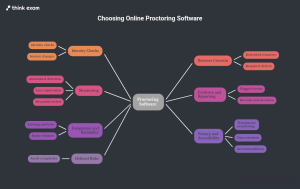
Before making a decision, consider the following:
- Identity and session verification: Does the platform support appropriate identity checks and help identify relevant changes during an exam?
- Browser and device controls: Can it restrict the resources candidates are not permitted to use, and does it support the devices required for the assessment?
- Monitoring and review: Does it offer the right combination of automated detection, live supervision, or recorded review for your exam?
- Evidence and reporting: Can authorised staff review flagged events, access relevant records, and document their decisions?
- Integration and reliability: Will the solution work with your existing assessment platform and expected exam volumes?
- Privacy and accessibility: Are monitoring practices transparent, data retention clearly defined, and reasonable accommodations supported?
A feature should not be selected simply because it sounds advanced. Every control should address a defined risk without creating unnecessary complexity for candidates or administrators.
Building More Trustworthy Online Assessments
The real value of proctoring lies in how it fits into the complete examination process. Identity checks address impersonation risks. Browser restrictions limit certain unauthorised activities. Monitoring helps identify events that need attention, while evidence and review workflows support consistent decisions.
Together, these measures help institutions make more informed decisions about exam integrity.
For organisations conducting assessments across locations, departments, or candidate groups, platforms such as Think Exam bring examination delivery and configurable security measures into a connected workflow. The specific controls should be selected according to the assessment’s requirements, rather than assuming that one configuration suits every exam.
Ultimately, secure online exams depend on more than watching candidates. They require clear rules, appropriate technology, reliable evidence, and a fair process for reviewing incidents. When these elements work together, institutions can protect the credibility of their assessments while maintaining a practical experience for genuine candidates.