Running a large examination is not just about delivering questions to thousands of candidates.
There is candidate registration, scheduling, centre allocation, question delivery, attendance, technical support, answer capture, evaluation, result processing, and reporting. When these activities are managed across disconnected systems or manual processes, even a well-planned examination can become difficult to coordinate.
A computer based examination changes how these stages are connected.
Instead of treating the exam as a single event, institutions can build a more structured digital workflow around it. This can make large assessments easier to manage, while also giving examination teams more visibility into what is happening at every stage.
The Real Challenge Is Managing the Entire Exam Lifecycle
For a small assessment, manual processes may be manageable.
At large scale, the number of moving parts increases quickly.
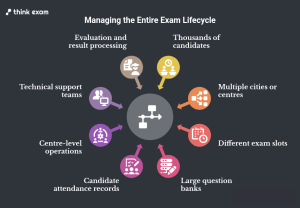
An examination may involve:
- Thousands of candidates
- Multiple cities or test centres
- Different exam slots
- Large question banks
- Candidate attendance records
- Centre-level operations
- Technical support teams
- Evaluation and result processing
A computer based examination can bring many of these activities into a connected workflow.
The benefit is not simply that candidates answer questions on a screen. It is that information generated during one stage can support the next stage of the examination process.
Candidate Management Becomes More Structured
Large examinations often begin long before candidates enter the test room.
Candidate information may need to be collected, verified, scheduled, and assigned to appropriate centres or sessions.
A digital examination system can help manage these activities through a central workflow.
For example:
Candidate registration → Verification → Slot allocation → Centre allocation → Admit card → Examination → Result
This reduces the need to move information manually between different processes.
It also gives examination administrators a clearer view of candidate status before the exam begins.
CBT Can Simplify Question Delivery
In traditional paper-based assessments, producing, transporting, distributing, collecting, and securely storing question papers and answer sheets can add several operational steps.
With CBT, questions can be delivered digitally according to predefined examination settings.
Depending on the system, administrators can configure:
- Question sequence
- Sections
- Time limits
- Navigation rules
- Question randomisation
- Mark-for-review options
- Attempt settings
This can give institutions greater control over how an examination is delivered across different sessions.
It also makes it easier to manage large candidate groups without physically handling an individual paper question set for every candidate.
Multiple Exam Centres Can Work From One System
Large examinations rarely happen in a single location.
Universities, government bodies, certification organisations, and other institutions may conduct assessments across many centres.
A connected computer based examination platform can allow administrators to manage centre-level information from a central system while candidates take the assessment at designated locations.
This can support:
- Centre allocation
- Candidate attendance
- Session management
- Exam activation
- Centre-level monitoring
- Candidate issue tracking
- Examination reporting
The exact workflow depends on the examination model, but centralised management can reduce the amount of coordination required between separate teams.
Evaluation Can Move Faster After the Exam
One of the biggest operational differences between digital and paper-based assessments comes after candidates submit their answers.
With digitally delivered objective questions, responses can be captured directly by the system.
This can reduce several manual steps associated with collecting and processing answer sheets.
For suitable question types, the workflow can move from:
Candidate submission → Automated evaluation → Result processing
rather than requiring every response to be manually transferred before evaluation begins.
This does not mean every type of assessment can or should be fully automated. Subjective questions and specialised evaluation requirements may still require human review.
Online Assessments Generate More Operational Data
A large examination creates a considerable amount of information.
With digital delivery, institutions can potentially track information such as:
- Candidate attendance
- Test completion
- Question attempts
- Time information
- Centre performance
- Technical events
- Evaluation status
- Results
This makes online assessments more than a way to replace paper.
The data generated throughout the process can help examination teams understand where delays occurred, which centres experienced issues, and how candidates progressed through the examination.
Security Can Be Built Into the Examination Workflow
Large-scale examinations also require strong controls around candidate identity, question security, and examination access.
Depending on the assessment, a computer based examination can incorporate controls such as:
- Candidate authentication
- Secure browser environments
- Restricted system access
- Question randomisation
- Access controls
- Activity monitoring
- Audit trails
The right combination depends on the examination’s risk level and delivery model.
For high-stakes assessments, security should be considered throughout the examination lifecycle rather than added only at the point where candidates start answering questions.
Technical Support Becomes Part of Exam Planning
Digital examinations introduce a different operational consideration: technology.
A large examination may involve thousands of devices, network connections, test centres, and candidate sessions.
That makes technical readiness an important part of the examination plan.
Institutions can prepare through:
- Pre-exam system checks
- Device compatibility testing
- Centre readiness checks
- Clear troubleshooting processes
- Technical support teams
- Backup procedures
The objective is not to assume that technical issues will never occur. It is to ensure that the examination process has a defined response when they do.
Scaling Does Not Mean Using One Process for Every Exam
A university entrance examination, a professional certification, and an internal assessment may have very different requirements.
A useful CBT system should therefore be configurable.
One examination may require:
Multiple centres + strict timing + secure browser + large candidate volume
Another may require:
Smaller candidate groups + flexible scheduling + detailed reporting
The underlying digital infrastructure can remain consistent while examination settings change according to the assessment.
This flexibility becomes increasingly important as organisations conduct different types of computer based exams throughout the year.
The Result Is More Than a Faster Exam
Speed is one benefit of digital examination, but it is not the only one.
A well-designed computer based examination can connect candidate management, exam delivery, evaluation, reporting, and operational oversight into one process.
That can help institutions reduce repetitive manual work, gain better visibility, and manage large assessments in a more structured way.
The real shift is therefore not simply:
Paper → Computer
It is:
Disconnected exam processes → Connected digital examination workflow
When the technology, people, processes, and security controls are designed together, large-scale assessments become easier to coordinate from the first candidate registration to the final result.