Online examinations have changed significantly with the growth of remote learning, digital assessments, recruitment tests, and large-scale entrance examinations. As more exams move online, maintaining exam integrity while protecting candidate information has become equally important.
AI proctoring helps organizations monitor online exams, verify candidates, detect unusual activity, and identify events that may require further review. But secure online proctoring is not only about preventing cheating. It also involves protecting personal information, controlling access to exam data, defining retention periods, and being transparent about how candidate data is handled.
In simple terms, responsible AI proctoring should follow four principles: collect necessary data, protect it properly, explain how it is used, and give authorized people control over access and retention.
This guide explains how AI proctoring works, what data it may collect, important data privacy practices, compliance considerations, and what organizations should look for when choosing AI proctoring software.
What Is AI Proctoring?
AI proctoring is a technology that uses artificial intelligence to monitor candidates during online examinations and assessments. It can help verify candidate identity, monitor exam sessions, identify predefined unusual events, and generate alerts for review.
Depending on the examination setup, AI proctoring may analyze webcam video, microphone input, screen activity, candidate identity information, browser or device activity, and other behavioral signals.
The purpose is not simply to record everything a candidate does. A properly configured system should focus on the information and events that are relevant to maintaining the integrity of the examination.
AI can also support human reviewers rather than completely replacing them. For example, an AI system can identify and flag an event, while an authorized reviewer examines the evidence and applies the examination rules before a final decision is made.
How Does AI Proctoring Work?
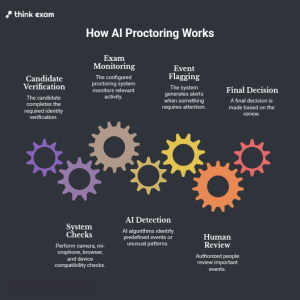
AI-proctored examinations generally follow a series of steps.
First, the candidate completes the required identity verification and system checks. Depending on the examination, this may involve identity authentication, camera and microphone checks, browser verification, or device compatibility checks.
Once the examination begins, the configured proctoring system monitors relevant activity. AI algorithms can identify predefined events or unusual patterns and generate alerts when something requires attention.
The important distinction is between detection and decision-making.
The typical workflow can be represented as:
Candidate Verification → System Checks → Exam Monitoring → AI Detection → Event Flagging → Human Review → Final Decision
This approach allows technology to handle large volumes of monitoring while giving authorized people an opportunity to review important events.
What Data Does AI Proctoring Collect?
The exact information collected depends on the proctoring platform, examination requirements, configuration, and applicable privacy rules.
Common categories of data may include webcam video, audio, screen activity, identity information, ID documents where verification is required, technical information, examination records, and behavioral signals.
For example, webcam video may be used to monitor the candidate and examination environment, while screen activity can help identify activity that is not permitted during the exam.
However, organizations should not collect information simply because the technology allows them to collect it.
The objective should be data minimization: collect only the information needed for the specific examination purpose.
Why Does Data Privacy Matter in AI Proctoring?
AI proctoring can involve personal and potentially sensitive candidate information. This makes data privacy an important part of online examination security.
If candidate information is collected or stored without appropriate controls, organizations may face risks involving unauthorized access, excessive data collection, unclear retention periods, inappropriate data sharing, or security incidents.
Privacy should therefore be considered when designing the examination process rather than treated as an additional requirement after the technology has already been deployed.
A secure AI proctoring strategy should consider both sides of the problem:
Exam Integrity + Candidate Privacy
Organizations need to protect examination content and prevent unauthorized activity while also handling candidate information responsibly.
Best Practices for AI Proctoring and Data Privacy
1. Collect Only Necessary Candidate Data
Data collection should have a clear purpose.
If an examination does not require audio monitoring, for example, there may be no reason to collect microphone data. Similarly, organizations should determine whether full recordings are necessary or whether other monitoring approaches can meet their examination requirements.
Limiting data collection reduces the amount of information that needs to be protected.
2. Protect Data During Transmission and Storage
Candidate and examination information should be protected using appropriate security measures.
Encryption can help protect information while it is transmitted between systems and while it is stored. Organizations should also understand where their data is stored, how it moves between systems, and which parties have access to it.
Security should cover the complete data lifecycle rather than focusing only on the examination session.
3. Control Who Can Access Proctoring Data
Not every person involved in an examination needs access to candidate recordings or identity information.
Role-based access controls can help ensure that employees and administrators can access only the information required for their responsibilities.
For example, an administrator may need access to exam configuration, while a reviewer may need access to specific flagged events. Restricting unnecessary access can reduce privacy and security risks.
4. Establish Clear Data Retention Policies
Organizations should determine how long proctoring information needs to be retained.
The appropriate period may depend on the examination type, institutional policies, contractual requirements, applicable laws, and the period required for reviews or disputes.
Once information is no longer needed, organizations should follow appropriate deletion or disposal procedures.
5. Explain Monitoring to Candidates
Candidates should know what monitoring technologies are being used before they begin an examination.
Clear privacy information can explain what data is collected, why it is collected, how it is used, who may access it, and how long it may be retained.
Transparent communication helps candidates understand what to expect from an AI-proctored examination.
6. Protect Identity Verification Information
Identity verification can involve sensitive personal information, particularly when an examination requires an identity document or other authentication method.
Organizations should carefully evaluate what information is required, how it is transmitted, where it is stored, who can access it, and when it should be deleted.
Identity verification should be proportionate to the security requirements of the examination.
7. Keep AI Flags Separate From Final Decisions
An AI-generated alert should not automatically be treated as proof of misconduct.
AI systems identify patterns or events based on their configuration. Context can be important when evaluating those events.
A responsible workflow can therefore use:
AI Detection → Flagged Event → Evidence Review → Human Assessment → Institutional Decision
Human review can provide additional context before an institution takes action based on a flagged event.
8. Maintain Appropriate Audit Trails
Organizations should be able to understand important actions involving examination information.
Audit trails can help identify who accessed information, when it was accessed, and what action was performed.
This can support accountability and help organizations investigate potential security incidents.
9. Understand Third-Party Data Processing
Online proctoring platforms may involve cloud infrastructure, integrations, or other service providers. Organizations should understand how candidate information moves between these systems.
Before selecting a provider, organizations should ask:
- Who processes the candidate data?
- Where is the data stored?
- Is information transferred across countries?
- What security controls are available?
- How is information deleted?
- What contractual protections apply?
Understanding these data flows is important for both privacy management and vendor evaluation.
10. Review Privacy and Security Practices Regularly
AI technology, examination requirements, and privacy expectations can change over time.
Organizations should periodically review their data collection practices, retention policies, access permissions, security controls, vendor relationships, and candidate-facing privacy information.
Privacy should be treated as an ongoing process rather than a one-time implementation task.
AI Proctoring and Regulatory Compliance
Privacy regulations can affect how organizations collect, process, store, and share candidate information.
AI proctoring itself is not automatically compliant with every privacy regulation. Compliance depends on factors such as the organization’s role, location, processing activities, data types, configuration, legal requirements, and applicable jurisdiction.
Organizations should therefore assess their own obligations before deploying an AI proctoring solution.
GDPR and AI Proctoring
Where GDPR applies, organizations may need to consider areas such as transparency, data minimization, purpose limitation, security, retention, data-subject rights, processing arrangements, and international data transfers.
Using a proctoring platform with privacy and security features does not by itself guarantee GDPR compliance.
India’s DPDP Framework
Organizations handling digital personal data in India should assess the requirements applicable to their specific processing activities.
This includes understanding what personal data is collected, why it is processed, how it is protected, and how applicable rights and obligations are handled.
CCPA/CPRA
Organizations subject to California privacy requirements should evaluate their responsibilities concerning personal information collected through online examinations and proctoring systems.
FERPA
Educational institutions subject to FERPA should consider how student education records and related information are collected, accessed, maintained, and disclosed.
Because legal requirements can vary by organization and situation, institutions should obtain appropriate legal guidance when determining their specific compliance obligations.
AI Proctoring and Human Review: Why Both Matter
One of the important developments in online examination technology is the combination of automated monitoring and human review.
AI can help monitor large numbers of candidates simultaneously and identify events that may require attention. This can make large-scale examination monitoring more manageable.
However, automated detection does not always provide complete context.
A candidate looking away from the screen, for example, may have several possible explanations. A human reviewer can examine the relevant evidence and consider the examination rules before an institution makes a decision.
This creates a more structured workflow:
AI monitors → AI identifies an event → Evidence is generated → Human reviews → Institution applies its rules
The role of AI is therefore to support examination security and review processes, not necessarily to replace human judgment.
How to Choose Secure AI Proctoring Software
Organizations evaluating AI proctoring software should look beyond the number of monitoring features available.
Security and privacy should be part of the evaluation from the beginning.
Security
Check whether the platform provides appropriate encryption, access controls, authentication, and other security measures.
Privacy
Understand what information is collected, why it is collected, where it is stored, and how long it can be retained.
AI Transparency
Understand what the AI monitors, what events it can flag, and how flagged events are reviewed.
Compliance Support
Ask what privacy and security documentation the provider can provide and understand which responsibilities remain with the organization using the platform.
Scalability
Large universities, examination bodies, recruitment organizations, and coaching institutions may need to monitor thousands of candidates. The platform should be able to support the expected examination volume.
Integration
Consider whether the proctoring platform can work with existing examination systems, LMS platforms, identity systems, or other technology already used by the organization.
Candidate Experience
The examination process should clearly communicate system requirements, monitoring requirements, and relevant privacy information to candidates.
How Think Exam Supports Secure Online Proctoring
Think Exam provides AI-enabled proctoring capabilities for online examinations and assessments.
Its proctoring solution is designed to support automated monitoring, event detection, examination workflows, and human review. The platform also describes controls related to data handling, access, retention, and candidate consent.
For organizations conducting online assessments at scale, the combination of automated monitoring and configurable examination workflows can help manage exam security while keeping data privacy considerations within the overall assessment process.
Organizations should still evaluate the specific configuration, contractual terms, security controls, and applicable legal requirements for their individual use case.
AI Proctoring Privacy Checklist
Before launching an AI-proctored examination, organizations can review the following:
- Define why candidate data is being collected.
- Collect only information required for the examination.
- Explain monitoring practices clearly to candidates.
- Use appropriate security controls.
- Restrict access to authorized personnel.
- Define data retention and deletion procedures.
- Review third-party data processing.
- Understand how AI-generated events are reviewed.
- Check applicable privacy requirements.
- Regularly review security and privacy practices.
Is AI Proctoring Safe for Online Exams?
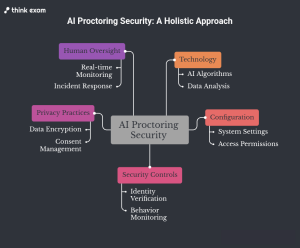
AI proctoring can be used securely when appropriate privacy, security, transparency, access-control, and retention practices are implemented.
The security of an AI-proctored examination does not depend on artificial intelligence alone.
It depends on the complete system:
Technology + Configuration + Security Controls + Privacy Practices + Human Oversight
This is why organizations should evaluate both the proctoring technology and the processes surrounding it.
Conclusion
AI proctoring can help organizations conduct secure and scalable online examinations while reducing the manual effort involved in monitoring candidates. However, exam security should not come at the expense of responsible data handling.
Organizations should consider data minimization, encryption, access control, transparent candidate communication, retention policies, AI oversight, human review, and applicable privacy requirements when implementing an online proctoring solution.
The goal is straightforward: protect examination integrity while treating candidate privacy as an essential part of the examination process.
Think Exam’s AI-enabled proctoring capabilities can support organizations in managing online examinations and assessments through automated monitoring, event detection, and configurable examination workflows.