Hiring teams need more than resumes and interviews to evaluate candidates effectively. Modern recruitment often involves aptitude tests, technical assessments, coding challenges, psychometric evaluations, behavioral assessments, and role-specific tests.
Think Exam provides online assessment solutions that support customized assessments, AI-enabled proctoring, skill and psychometric assessments, analytics, and scalable test delivery. Its platform also supports open API integration for connecting assessment workflows with existing technology environments.
What Is an Online Assessment Platform for Hiring?
An online assessment platform for hiring is a digital system that helps organizations create, deliver, monitor, evaluate, and analyze candidate assessments during recruitment.
Depending on the role, recruiters can use different assessment formats to evaluate areas such as:
- Aptitude and cognitive skills
- Technical knowledge
- Coding and programming
- Job-specific skills
- Communication skills
- Psychometric traits
- Behavioral characteristics
- Situational judgment
- Domain knowledge
Instead of managing separate tools for every stage, an assessment platform can bring candidate testing, scoring, reporting, and monitoring into one workflow.
Quick answer
An online assessment platform for hiring helps recruiters evaluate candidates digitally through customized tests, automated scoring, analytics, and secure assessment features. When integrated with HRTech systems, it can connect assessment results with the broader recruitment workflow.
How Does an Online Assessment Platform Improve Hiring?
Traditional recruitment can involve several disconnected steps. Recruiters may collect applications, send assessments through another system, download results, compare candidates manually, and then update recruitment records.
An integrated assessment workflow can reduce these disconnected steps.
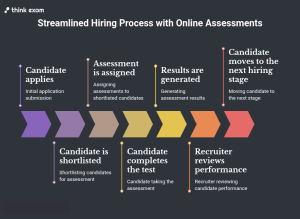
A typical process looks like this:
Candidate applies → Candidate is shortlisted → Assessment is assigned → Candidate completes the test → Results are generated → Recruiter reviews performance → Candidate moves to the next hiring stage
This approach can help recruitment teams organize candidate evaluation while keeping assessment data connected to the hiring process.
The exact workflow depends on how the assessment platform and HRTech systems are configured.
How HRTech Integration Works With Online Assessments
HRTech integration connects an assessment platform with the systems recruiters already use.
For example, an organization may use an ATS to manage candidate applications and an assessment platform to evaluate candidates. Through an integration or API, information can move between the systems instead of requiring recruiters to repeatedly enter the same information manually.
A simplified workflow can look like this:
ATS / HRMS
↓
Candidate Information
↓
Online Assessment Platform
↓
Test Assignment
↓
Candidate Assessment
↓
Scoring + Proctoring + Analytics
↓
Assessment Results
↓
Recruiter / Hiring Team
This type of architecture can help organizations create a more connected recruitment workflow.
Think Exam states that its assessment platform provides open APIs and integration capabilities designed to connect assessment workflows with other systems.
What Are the Benefits of HRTech Integration for Recruitment?
Integrating an online assessment platform with HRTech can support several parts of the hiring process.
1. Less Manual Data Entry
Recruiters often work with large amounts of candidate information.
When systems are connected, candidate and assessment information can move between platforms according to the configured integration. This can reduce repetitive data entry and help maintain consistency.
2. Faster Assessment Workflows
Recruiters can assign tests as part of the candidate journey instead of managing every assessment manually.
This can be particularly useful when organizations evaluate large candidate pools.
3. Centralized Candidate Information
Integration can help connect application information, assessment results, and recruitment activity.
Recruiters can then review candidate information from connected systems rather than maintaining multiple disconnected records.
4. Easier Candidate Shortlisting
Assessment results can provide additional information alongside resumes and interviews.
Recruiters can use scores, skill results, reports, and other assessment data as part of their candidate evaluation process.
5. Better Recruitment Visibility
Assessment analytics can help hiring teams understand candidate performance across different tests, skills, and stages.
Think Exam provides detailed analytics and reporting as part of its assessment platform capabilities.
What Types of Hiring Assessments Can Be Conducted Online?
Different jobs require different evaluation methods. A good hiring assessment platform should therefore support multiple assessment formats.
Common examples include:
Aptitude Assessments
Aptitude tests can evaluate areas such as numerical reasoning, logical reasoning, verbal ability, and problem-solving.
Coding Assessments
Technical hiring teams can use coding assessments to evaluate programming and problem-solving skills.
Psychometric Assessments
Psychometric assessments can be used to evaluate specific behavioral or psychological attributes when designed and administered appropriately.
Think Exam lists psychometric assessments among its assessment capabilities.
Skill-Based Assessments
These assessments focus on the practical skills required for a particular job role.
Domain Assessments
Organizations can create assessments around industry-specific or role-specific knowledge.
Job-Specific Assessments
Recruiters can customize assessments according to the competencies and skills required for a particular position.
Think Exam supports customized assessments and job-oriented assessment capabilities.
How AI Proctoring Supports Online Hiring Assessments
Remote assessments create an important question: how can organizations maintain assessment integrity when candidates are taking tests outside a physical test center?
AI-enabled remote proctoring can provide automated monitoring during online assessments.
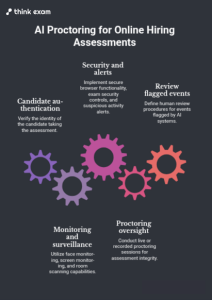
Depending on the assessment configuration, proctoring may involve:
- Candidate authentication
- Face monitoring
- Screen monitoring
- Suspicious activity alerts
- Live proctoring
- Recorded proctoring
- Secure browser functionality
- Additional exam security controls
Think Exam’s Think Proctor solution includes AI-based automated remote proctoring, live and recorded monitoring, candidate authentication, lockdown browser functionality, and room scanning capabilities.
Important point
AI proctoring should not be treated as a replacement for every form of human review. Organizations should define appropriate review procedures for flagged events and consider privacy, consent, accessibility, and applicable data protection requirements when deploying remote monitoring.
Why Secure Assessments Matter in Online Hiring
Candidate assessments can contain sensitive information and confidential test content.
A secure online assessment environment can help organizations protect the integrity of the test and reduce opportunities for unauthorized activity.
Security measures can include:
- Candidate authentication
- Secure browsers
- Question randomization
- Time controls
- Proctoring
- Activity monitoring
- Access controls
- Result reporting
Think Exam describes secure browser and anti-cheating capabilities as part of its assessment and proctoring solutions.
Security requirements should always be selected according to the assessment’s risk level and the organization’s data protection requirements.
What Should Companies Look for in an Online Assessment Platform?
Choosing an online assessment platform should start with the organization’s recruitment requirements rather than the number of features listed on a product page.
Here are important factors to consider.
1. Assessment Types
Check whether the platform supports the assessments required for your roles, such as aptitude, coding, technical, psychometric, behavioral, or job-specific tests.
2. Customization
Recruiters may need assessments designed around specific job roles, departments, industries, or competency frameworks.
3. HRTech Integration
Check whether the platform can integrate with your existing ATS, HRMS, LMS, or other recruitment technology through APIs or available connectors.
4. Proctoring and Security
For remote or high-stakes assessments, evaluate authentication, monitoring, secure browser capabilities, and review workflows.
5. Analytics and Reporting
Look for reports that help recruiters understand candidate performance rather than simply providing a final score.
6. Scalability
The platform should be able to support the expected number of candidates during normal and peak recruitment periods.
Think Exam states that its infrastructure supports simultaneous testing for thousands of candidates and scaling based on demand.
7. Candidate Experience
A technically powerful assessment platform still needs to be easy for candidates to use.
Consider:
- Test accessibility
- Device compatibility
- Navigation
- Instructions
- Technical support
- Submission experience
8. Data and Privacy Controls
Before implementation, organizations should review data handling, access controls, retention practices, security certifications, and applicable privacy requirements.
How Think Exam Supports Hiring Assessments
Think Exam provides a range of assessment and testing capabilities for organizations that need to evaluate candidates and skills digitally.
Its current platform offering includes:
- Online assessments
- Customized assessments
- Skill assessments
- Coding assessments
- Psychometric assessments
- AI-powered insights
- Remote proctoring
- Analytics and reporting
- Open API integrations
- Scalable assessment infrastructure
Think Exam also offers Think Talent for talent assessment, including competency mapping, targeted skill assessments, and AI-generated reports.
This makes the platform relevant to recruitment workflows where organizations need to evaluate candidates based on skills, aptitude, behavior, or role-specific competencies.
Online Assessment Platform for Different Hiring Use Cases
Campus Hiring
Organizations and educational institutions can use online assessments to evaluate large groups of candidates during campus recruitment.
A standardized assessment can help recruiters apply consistent evaluation criteria across a candidate pool.
Lateral Hiring
For experienced professionals, organizations can create assessments around job-specific technical and functional skills.
IT and Technical Recruitment
Coding, technical, aptitude, and domain assessments can be combined to evaluate candidates for technology-related roles.
High-Volume Recruitment
When hundreds or thousands of candidates need to be assessed, scalability becomes an important consideration.
Think Exam states that its platform supports high-volume assessment delivery and concurrent testing.
Remote Hiring
Organizations hiring candidates across different locations can use online assessments and remote proctoring to conduct parts of the evaluation process without requiring candidates to visit a physical location.
Online Assessment Platform vs Traditional Hiring Tests
| Factor | Traditional Test | Online Assessment Platform |
|---|---|---|
| Test delivery | Physical or manual | Digital |
| Candidate location | Usually fixed | Can support remote delivery |
| Evaluation | Often manual or semi-automated | Can include automated scoring |
| Reporting | Manual reports | Digital analytics and reports |
| Candidate volume | Operationally demanding at scale | Designed for scalable delivery |
| Proctoring | Physical invigilation | Can include AI or live remote monitoring |
| Integration | Limited or manual | APIs/integrations can connect systems |
| Customization | Depends on process | Digital tests can be configured for specific roles |
The exact capabilities vary between platforms and implementation models.
How to Build a Better Online Hiring Assessment Workflow
A strong assessment process starts before the test is created.
Step 1: Define the Job Requirements
Identify the knowledge, skills, and competencies required for the role.
Step 2: Select the Assessment Type
Choose aptitude, technical, coding, psychometric, behavioral, or job-specific assessments based on the hiring objective.
Step 3: Configure the Test
Set questions, time limits, scoring rules, difficulty levels, and other requirements.
Step 4: Connect the HRTech Workflow
Integrate the assessment platform with the organization’s ATS, HRMS, or other relevant systems where supported.
Step 5: Configure Security
Set candidate authentication, proctoring, secure browser, and other controls according to the assessment’s requirements.
Step 6: Evaluate Results
Review scores, reports, skill-level performance, and relevant proctoring information.
Step 7: Move Candidates to the Next Stage
Use assessment results alongside other recruitment information to determine the next step in the hiring process.
How AI and Analytics Are Changing Candidate Assessment
AI is increasingly being used across assessment workflows for monitoring, analysis, personalization, and reporting.
For example, AI-enabled assessment systems can support:
- Automated proctoring
- Candidate authentication
- Performance analysis
- AI-generated insights
- Adaptive assessments
- Automated evaluation
Think Exam currently describes AI-powered insights, adaptive assessments, automated grading, and AI-enabled proctoring within its broader platform offering.
However, AI-generated results should be interpreted within the context of the assessment design. Organizations should also maintain appropriate human oversight for important hiring decisions.
Final Thoughts
An online assessment platform for hiring can become an important part of a modern recruitment workflow, particularly when organizations need to evaluate candidates at scale or conduct assessments remotely.
The value goes beyond simply putting a test online. The platform should support the complete assessment lifecycle, including test creation, candidate management, secure delivery, proctoring, scoring, analytics, and reporting.
HRTech integration adds another layer by connecting assessment activities with existing recruitment systems. With the right implementation, organizations can create a more structured and connected candidate evaluation process.
Think Exam brings together online assessments, customized testing, skill and psychometric assessments, AI-enabled proctoring, analytics, and integration capabilities within its broader assessment ecosystem.
For organizations evaluating assessment platforms, the most important step is to match the platform’s capabilities with their hiring workflow, candidate volume, assessment requirements, security needs, and existing HR technology.