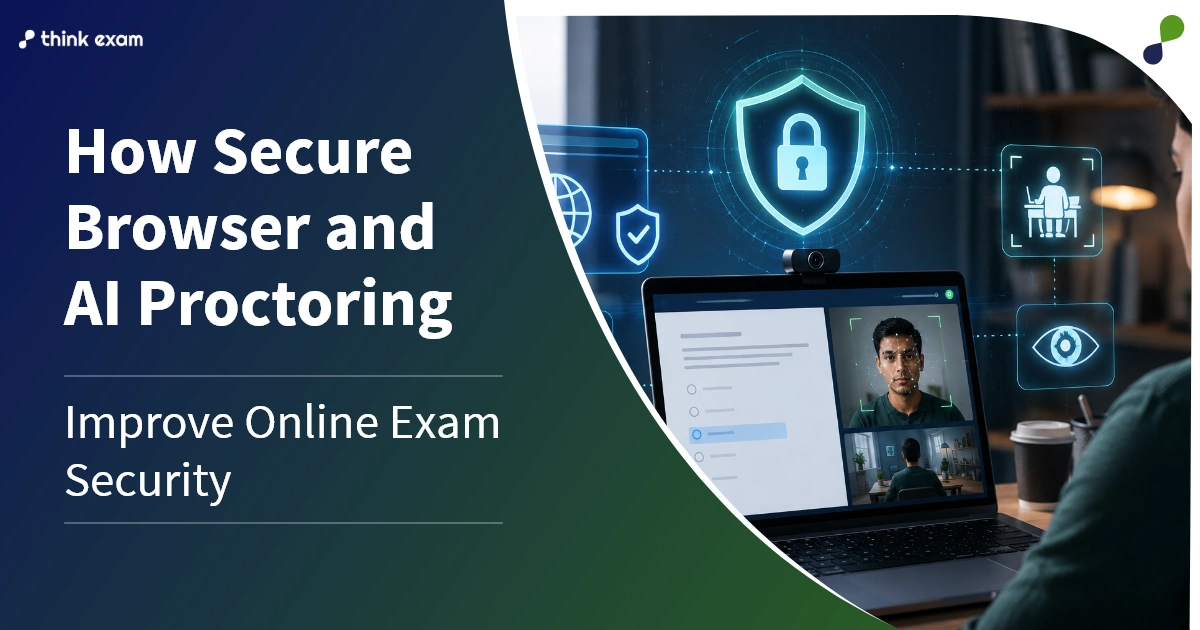
Online assessments have made it easier for universities, businesses, certification bodies, and government organisations to test candidates across locations. But as testing moves away from controlled exam centres, security becomes a bigger concern.
A candidate may be taking an online exam from a bedroom, office, or another remote location. How can an organisation know that the candidate is working independently? How can it prevent access to unauthorised websites or applications?
This is where online exam proctoring becomes important.
However, simply watching a candidate through a webcam is not enough. Strong exam security needs to cover both the candidate and the device they are using. Combining AI proctoring with secure browsers creates a stronger approach to protecting the integrity of digital assessments.
Why Online Exam Security Needs Multiple Layers
An online assessment can be exposed to different types of risks.
A candidate might open another browser tab, switch to an application, use an unauthorised device, or receive help from someone outside the camera’s view.
This means organisations need to look at two different areas:
The candidate environment: Is the candidate behaving as expected?
The digital environment: Is the candidate accessing anything they shouldn’t?
A reliable online exam proctoring strategy should address both.
Secure browsers help control the digital environment, while AI-powered monitoring helps identify unusual behaviour. Together, they create multiple layers of protection instead of relying on one security feature.
What Secure Browsers Add to an Online Exam
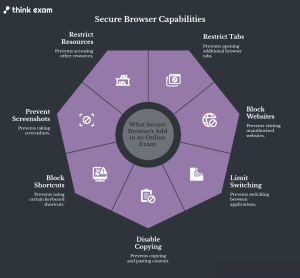
A secure browser creates a controlled environment on the candidate’s computer during the test.
Depending on its configuration, it can restrict activities such as:
- Opening additional browser tabs
- Visiting unauthorised websites
- Switching between applications
- Copying and pasting content
- Using certain keyboard shortcuts
- Taking screenshots
- Accessing other resources
This becomes particularly useful during a high-stakes online exam, where access to external information could compromise the fairness of the assessment.
Instead of only monitoring what the candidate is doing, the platform can also control what the candidate is able to access.
That makes Secure Browsers an important part of a wider online exam proctoring strategy.
How AI Proctoring Adds Another Layer
A secure browser protects the candidate’s digital environment, but it cannot tell the complete story.
For example, a candidate may have another person in the room or repeatedly move away from the screen. This is where AI proctoring can help.
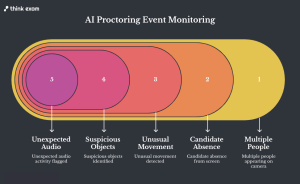
During an online proctored exam, AI can monitor different aspects of the session and flag events that may need further review.
Depending on the solution, these can include:
- Multiple people appearing on camera
- Candidate absence
- Unusual movement
- Suspicious objects
- Unexpected audio activity
- Camera obstruction
- Other unusual behaviour patterns
The important point is that an alert does not automatically mean misconduct. It gives the reviewer something to investigate.
This makes online exam proctoring more useful when AI is used to support human decision-making rather than replace it completely.
Why Secure Browsers and AI Work Better Together
Think of exam security as protecting two doors.
The first door controls what the candidate can access.
The second monitors what the candidate is doing.
A secure browser strengthens the first layer. AI proctoring strengthens the second.
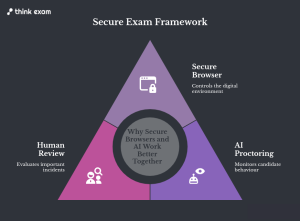
Together, they can create a more complete security framework:
Secure Browser → Controls the digital environment
AI Proctoring → Monitors candidate behaviour
Human Review → Evaluates important incidents
This layered approach makes online exam proctoring more effective because it does not depend on a single method of detection.
Reducing the Pressure on Human Invigilators
Monitoring a large number of candidates manually can be difficult. An invigilator cannot realistically give the same level of attention to every candidate throughout a long examination.
AI can help by continuously analysing sessions and highlighting events that may require attention.
Instead of manually reviewing every minute of every online proctored exam, administrators can focus their time on flagged incidents and supporting evidence.
This becomes particularly valuable when organisations conduct assessments for hundreds or thousands of candidates.
The technology doesn’t remove human oversight. It makes that oversight more focused.
Security Should Not Make the Exam Difficult
A highly secure exam is not successful if candidates struggle to access it.
The best online exam proctoring experience should make security requirements clear before the assessment begins.
Candidates should know:
- Which devices are supported
- Whether a secure browser is required
- How to check their camera and microphone
- What identity verification involves
- Which activities are restricted
- What they should do if a technical issue occurs
A pre-exam system check can identify many problems before the assessment starts.
This is especially important for remote candidates who may not have technical support available at home.
Protecting the Assessment Content
Candidate monitoring is only one part of exam security.
The assessment itself also needs protection.
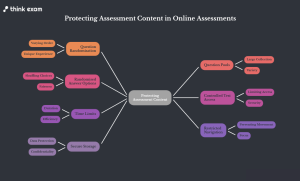
Organisations conducting online assessments should consider features such as:
- Question randomisation
- Question pools
- Randomised answer options
- Controlled test access
- Time limits
- Restricted navigation
- Secure storage of assessment data
These measures make it harder for candidates to share questions or access test content outside the intended examination environment.
When content protection is combined with online exam proctoring, organisations can protect the assessment from multiple angles.
Why This Matters for High-Stakes Assessments
Not every digital test carries the same level of risk.
A short internal quiz may not require the same controls as a university examination, recruitment assessment, professional certification, or government test.
For high-stakes assessments, the result can directly affect someone’s admission, career, certification, or eligibility.
If the organisation cannot trust the assessment process, it becomes difficult to trust the result.
This is why online exam proctoring has become an important part of digital assessment strategies for organisations where exam integrity matters.
Choosing the Right Security Approach
Organisations should not evaluate assessment platforms by looking at individual features alone.
Instead, consider whether the platform can provide a complete security framework that includes:
- Candidate authentication
- Secure browser capabilities
- AI-based monitoring
- Assessment content protection
- Incident reporting
- Human review
- Data security
- Scalable infrastructure
- A simple candidate experience
The goal is not to create an unnecessarily restrictive examination.
The goal is to create an environment where genuine candidates can perform fairly while organisations have enough evidence to investigate suspicious activity.
Building Greater Trust in Digital Testing
As more organisations move assessments online, security will become an even bigger part of the testing experience.
Online exam proctoring helps organisations monitor candidate sessions, while Secure Browsers help control what happens on the candidate’s device. AI proctoring adds another layer by identifying behaviour that may require attention.
Used together, these technologies can make an online proctored exam more secure without removing the flexibility that makes remote testing valuable.
For universities, certification providers, recruitment teams, government bodies, and other organisations conducting high-stakes online assessments, the future is not simply about monitoring candidates more closely.
It is about creating a smarter testing environment where security works quietly in the background and trust remains at the centre of the assessment.