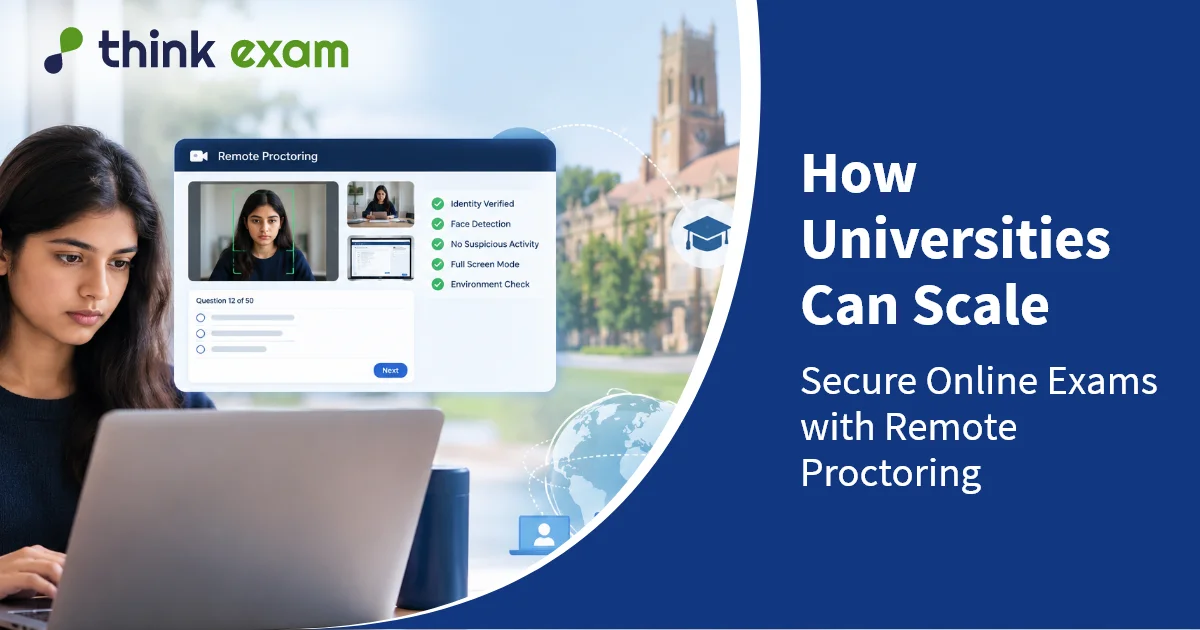
Running a secure exam for 50 students is one thing. Running the same examination for 5,000 students across multiple courses, locations, and time slots is a very different operational challenge.
Universities are increasingly using online exam proctoring to conduct assessments remotely without requiring every candidate to appear at a physical test centre. But scaling online examinations is not simply about adding more candidates to a platform.
As exam volumes grow, universities need to manage candidate authentication, device readiness, secure exam delivery, monitoring, technical support, incident review, and reporting without creating unnecessary friction for students or examination teams.
Universities can scale secure online exams by combining remote proctoring, identity verification, secure exam delivery, AI-supported monitoring, human review, technical support, and reporting into one repeatable examination workflow.
This makes remote proctoring for universities more than a monitoring feature. It becomes part of the wider examination process.
What Makes Large-Scale University Exams Difficult to Manage?
A university may conduct several types of assessments during an academic year, including:
- Semester examinations
- Entrance assessments
- Internal assessments
- Professional certifications
- Make-up examinations
- Recruitment or placement tests
Each assessment can have different rules, durations, candidate groups, security requirements, and delivery methods.
When hundreds or thousands of students take an examination within the same period, small operational problems can quickly become large ones. A camera permission issue, browser problem, identity verification failure, or connectivity problem can affect many candidates at once.
This is why universities need an examination workflow that can be repeated and managed across different departments, courses, and examination periods.
Build a Scalable Online Exam Workflow
A scalable online assessment platform should allow universities to configure assessments according to their requirements instead of forcing every examination into one fixed process.
A typical workflow can include:
Assessment creation → Candidate registration → System readiness check → Identity verification → Secure exam access → AI or live monitoring → Event review → Reporting
Universities can configure elements such as:
- Candidate access
- Exam scheduling
- Identity verification
- Exam duration
- Permitted devices
- Monitoring requirements
- Browser restrictions
- Reporting and review processes
Standardising these steps can make it easier for examination teams to repeat the process across departments, courses, and examination periods.
Use AI Proctoring to Support Large Candidate Volumes
Human proctors can monitor candidates, but scaling continuous live supervision directly with candidate numbers can become operationally demanding.
This is where AI-powered remote proctoring can support larger examination volumes.
Depending on the system and its configuration, AI-based monitoring may analyse predefined signals and flag events that require further attention. These can include:
- Face not present
- Multiple faces detected
- Face mismatch
- Looking away
- Voice or audio activity
- Screen focus changes
- Unauthorised objects or activity
Instead of requiring a human reviewer to watch every candidate continuously, AI can help identify sessions or events that may require additional review.
The purpose is not to make an automated flag the final decision. A flagged event is an observation that may require context and human evaluation.
This can create a more scalable model:
AI monitoring → Event detection → Human review → Institutional decision
Combine Automated Monitoring With Human Review
Scaling an examination does not necessarily mean removing people from the process.
For assessments where additional oversight is required, universities can combine automated monitoring with human review.
For example:
Candidate takes the exam → AI monitors predefined signals → Events are flagged → Reviewer examines relevant evidence → Institution makes the final decision
This approach allows technology to handle repetitive monitoring tasks while authorised reviewers focus on events that require attention.
Human review is particularly important because a system-generated event does not automatically establish misconduct. A candidate looking away from the screen, for example, may have a legitimate explanation.
The final interpretation should therefore remain part of the institution’s examination and academic-integrity process.
Verify Candidate Identity Before the Exam
Identity verification is an important part of a secure online examination.
Before a candidate starts an assessment, the institution may need to confirm that the person taking the examination matches the registered candidate.
A candidate authentication process can be used alongside other examination controls depending on the assessment requirements.
The process may include:
- Candidate identification
- Authentication checks
- Face verification
- Examination access controls
- Session monitoring
The exact approach should depend on the institution’s policies, assessment risk, and applicable requirements.
Use a Secure Browser for Controlled Exam Delivery
Monitoring the candidate is only one part of examination security.
Universities may also need to control what candidates can access while the examination is running. A secure browser for exams can help restrict access to unauthorised websites, applications, or system functions when such controls are required.
This can be particularly relevant for high-stakes examinations where institutions want greater control over the digital examination environment.
A layered approach can therefore combine:
- Candidate authentication
- Secure browser controls
- AI monitoring
- Human review
- Examination recording or evidence
- Reporting
The appropriate combination will depend on the type and risk level of the assessment.
Prepare Candidates Before the Exam Starts
A significant part of online examination management happens before the first question appears.
If candidates cannot access their cameras, microphones, browsers, or network properly, technical problems can quickly become an examination-management issue.
Universities can reduce avoidable disruption through a pre-exam readiness process that checks:
- Device compatibility
- Camera and microphone permissions
- Browser requirements
- Internet connectivity
- System access
- Identity verification requirements
A short system check before the actual online exam can help candidates resolve common technical problems before the examination begins.
This becomes especially important when hundreds or thousands of candidates are expected to start within a similar period.
Make Different Exams Configurable
Universities do not necessarily need the same level of monitoring for every assessment.
A low-stakes internal quiz may require basic access and assessment controls. A final examination or professional certification may require identity verification, a secure browser, recording, and additional monitoring.
A scalable platform should allow institutions to configure these requirements without creating an entirely new examination process every time.
This flexibility allows universities to create different security levels for different examinations while maintaining a consistent overall workflow.
Ensure the Platform Can Handle Peak Exam Volumes
Scaling an examination also requires more than increasing the number of registered candidates.
Universities should consider how the platform performs when large numbers of candidates begin an assessment within the same examination window.
Important areas include:
- Concurrent candidate sessions
- Examination scheduling
- Platform availability
- Monitoring capacity
- Reporting
- Data handling
- Administrator access
- Technical support
A scalable online assessment platform should be designed to support the operational requirements of both regular and high-volume examination periods.
The objective is to maintain a consistent candidate and administrator experience even when examination activity increases significantly.
Build Security Into the Candidate Journey
Security controls work best when they are part of the examination workflow rather than isolated features.
For example, a university may combine:
Identity Verification
Confirm that the registered candidate is the person taking the assessment.
Secure Browser
Restrict access to unauthorised websites, applications, or system functions where required.
AI Monitoring
Identify predefined behavioural or environmental signals during the assessment.
Recording and Evidence
Maintain relevant session information for later review, subject to institutional policies and applicable requirements.
Human Review
Allow authorised reviewers to investigate flagged events and consider the surrounding context.
This layered approach allows universities to adjust examination controls according to the requirements of each assessment.
Don’t Let Exam-Day Support Become the Bottleneck
When candidate numbers increase, technical support can become just as important as the examination platform itself.
Imagine 3,000 students starting an examination within the same window. Even if only a small percentage experience access or device issues, the resulting support requests can quickly become difficult to manage.
Universities can prepare for this by establishing:
- Pre-exam system checks
- Clear candidate instructions
- Defined escalation processes
- Technical support channels
- Troubleshooting guidance
- Exam-day monitoring dashboards
The objective is not to assume that every candidate will have a perfect technical experience. It is to establish a clear process for identifying and resolving problems when they occur.
Protect Exam Data and Candidate Information
Remote examinations can involve candidate identity information, video or audio recordings, examination activity, technical events, and other session data.
Universities should therefore establish appropriate policies around:
- Data access
- Data retention
- Secure storage
- Authorised reviewers
- Candidate communication
- Institutional privacy requirements
- Applicable regulatory requirements
The exact requirements can differ between institutions and jurisdictions, so examination teams should align their processes with their own policies and legal obligations.
Use Examination Data Beyond the Final Score
An online examination can generate more information than simply a candidate’s final marks.
Depending on the platform and institutional policies, administrators may be able to review:
- Candidate participation
- Attempt status
- Time information
- Technical events
- Proctoring alerts
- Review outcomes
- Examination completion
These records can help examination teams understand what happened during an assessment and investigate issues when necessary.
For universities running repeated examination cycles, this information can also reveal recurring operational problems and help teams improve future assessments.
How Think Exam Supports University Online Exams
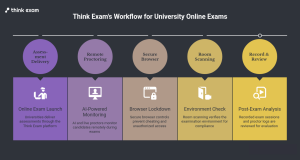
For universities looking to bring assessment delivery, monitoring, and review into a connected workflow, Think Exam provides solutions for higher education assessments.
Its higher-education offering includes AI-powered remote proctoring, live monitoring, and record-and-review capabilities. Think Proctor also supports capabilities such as candidate authentication, secure browser controls, and room scanning for examination environments where these controls are required.
The platform can support different examination requirements rather than treating every assessment as the same type of test.
Universities can explore relevant assessment and proctoring capabilities based on their examination requirements.
Key Components of a Scalable Remote Proctoring Workflow
| Component | Purpose |
|---|---|
| Candidate authentication | Helps verify candidate identity |
| Secure browser | Helps control the examination environment |
| AI proctoring | Flags predefined events for review |
| Live proctoring | Enables real-time human monitoring |
| Record and review | Supports post-examination investigation |
| System checks | Helps identify technical issues before the exam |
| Technical support | Helps manage exam-day problems |
| Analytics and reporting | Helps administrators review examination activity |
The key is not to use every feature for every assessment. Universities can configure the workflow according to the examination’s security, operational, and candidate requirements.
Scale the Process, Not Just the Candidate Count
The biggest challenge in remote examination is not necessarily putting more students online.
It is maintaining a consistent process as the number of candidates, courses, assessments, and examination windows increases.
A scalable remote proctoring for universities model should therefore bring several components together:
- Candidate readiness
- Identity verification
- Secure exam delivery
- AI-supported monitoring
- Human review
- Technical support
- Evidence and reporting
- Scalable examination infrastructure
When these elements work together, universities can manage larger remote assessments through a repeatable process rather than relying entirely on manual supervision.
Conclusion
Universities can scale secure online examinations by treating remote proctoring as part of the complete assessment workflow rather than as a standalone monitoring feature.
A combination of online exam proctoring, candidate authentication, secure browser controls, AI-supported monitoring, human review, technical readiness, support, and reporting can help institutions manage different examination formats and candidate volumes.
The right approach will depend on the type of assessment, security requirements, candidate experience, institutional policies, and operational needs.