Most institutions regard assessments as just another mechanical activity to be done. Every candidate requires a screening test, while students have their own final exams. In the past, these responsibilities were delegated to admin units or junior human resources teams. However, the digital economy has fundamentally changed how organizations evaluate human potential.
There is now a strong need to incorporate a well-defined assessment strategy because it is vital to the functioning of any institution. Whether one is responsible for scaling an internet company or supervising a renowned higher education institution, leaders ultimately determine the tools used to evaluate knowledge, skills, and capabilities through talent assessments.
When referring to assessment design as a leader’s task, it does not imply that the leaders directly conduct the tests. Rather, they protect the organization’s middleman and make sure that the current decisions have sustainable benefits in the coming years through a long-term assessment plan.
1. Assessments Are Strategic Decisions, Not Admin Tasks
An assessment strategy is fundamentally about talent and quality management. Every organization that deploys hiring and academic tests is making a significant investment in training and development. Talent assessments that are poorly designed have a negative effect on this foundation and consequently influence the reporting of the organization.
An organized assessment method can be one of the ways to close this gap. The CEO is thus enabled to know that the staff members have the required digital transformation skills. For a Dean, it guarantees that graduating students meet certified professional competency standards through reliable talent assessments.
When assessments are strategically designed, leaders move away from convenience-based testing and prioritize validity and relevance. A critical leadership question becomes: Will this assessment strategy help us evaluate the skills we will need five years from now?
2. The Price Tag of a Bad Assessment Strategy
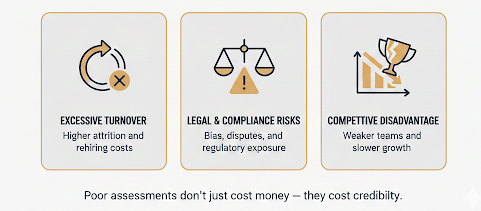
While hiring or admission costs are easy to quantify, the cost of poor judgment caused by weak talent assessments is far more damaging. Studies indicate that a wrong hire can cost up to 30% of an employee’s annual salary in the first year alone. In education, ineffective assessment strategies result in certifications that employers distrust, ultimately damaging institutional brand value.
A fragmented or outdated assessment strategy creates multiple risks:
Key Risks of Poor Talent Assessments
- Excessive Turnover: Inadequate talent assessments cause mismatches and, hence, increase attrition rates.
- Non-compliance and Legal Risks: Unfair or biased assessment strategy frameworks at the organization lead to lawsuits and fines.
- Competitive Disadvantage: A weak assessment strategy can’t reveal skill gaps early, thus the organization has to go through the expensive process of corrective training later on, and at the same time, the reduction of workforce readiness happens.
A solid assessment strategy empowers the leaders to lessen these risks by making sure that talent assessments are equitable, safe, and dependable.
3. Integrating Assessment Strategy with Long-Term Objectives
Many organizations default to short-term convenience by choosing generic tests. These kinds of tests hardly ever coincide with the long-term goals of the business or the university, thereby undermining the overall evaluation procedure.
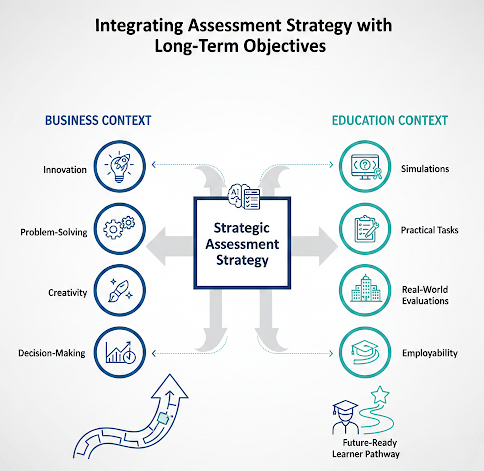
The management monitoring gives a guarantee that the identification of talents is done for the purpose of the company and is connected with the results rather than being just a matter of formality.
-
In the Business Context
The assessment strategy should focus on the attributes of creativity, problem-solving, and ideation rather than on rote knowledge if the innovation is a strategic priority.
-
In the Education Context
If employability is the goal, talent assessments should shift toward simulations, practical tasks, and real-world performance evaluation.
Strategic alignment is not about testing for its own sake. It is about building a theory of change where assessment strategy informs curriculum development, workforce planning, and capability building.
4. Why Leadership Must Own Assessment Strategy Design
Consistency is central to a strong brand. When online assessment design is left to multiple departments without leadership governance, user experience becomes fragmented. Absence of a unified assessment strategy leads to candidates facing inconsistent expectations and students being evaluated unevenly.
Leadership Role in Talent Assessment:
- Quality assurance: Setting specific performance indicators and criteria for passing.
- Reliance on tech: Persuading the use of AI-based monitoring for the sake of maintaining integrity in talent assessments.
- Responsibility: Assigning accountability when assessment results do not reflect actual performance.
The presence of leadership indicates that the assessment strategy is firm and that accuracy and justice are part of the organizational values.
5. KPIs to Measure the Effectiveness of Assessment Strategy
What cannot be measured cannot be controlled. Leaders must move beyond basic pass–fail metrics and evaluate the true effectiveness of their assessment strategy.
Common Parameters for Talent Assessment
- Forecast Validity: Relationship between the evaluation result and the forthcoming performance.
- On-the-Job Performance: Candidates selected through talent assessments.
- Assessment Quality: Reliability and consistency of assessment tools.
- Policy Effectiveness: Impact of existing assessment strategy frameworks.
- Candidate Experience: The rate of completions and the trend of drop-offs in talent assessments.
- Cost vs Benefit: The comparison of turnover and training expenses reductions after the execution of structured talent assessments.
Related Blog: Boosting Candidate Selection with Behavioural Assessment Test
Think Exam: Enabling the Future of Assessment Strategy
Think Exam offers advanced technology and strong platforms to support executives in the creation of adaptable and future-oriented assessment strategy frameworks. Organizations are enabled to create talent assessments through AI-based proctoring, sophisticated analytics, and a secure digital infrastructure that will provide them with a measurable competitive edge.
FAQs
1. What is a modern assessment strategy?
An assessment strategy that balances the evaluative purposes with the strategic objectives of a business and thereby informs the decisions. After a while, there is an impending need to go beyond assessment to more predictive analytics, candidate satisfaction, and in-depth talent assessments for forecasting capabilities of the skills over a longer period of time.
2. How do talent assessments reduce employee turnover?
The major benefit of validated talent assessments is that they provide the first accurate scan of technically and culturally appropriate candidates. This helps to prevent premature attrition, which is a function of poor job fit.
3. Can talent assessments support leadership development?
Of course. Talent assessments make it easier to make a judgment about the employees with predictive potential without any biases and allow for planning the replacement of the leader and developing leadership on the basis of evidence.
4. Is AI proctoring essential in a modern assessment strategy?
Assessment Strategy and management includes prevention of cheating in exams, maintenance of the honesty of students, and assurance of the results in talent assessments that are fair and can be depended on, especially in a competitive business environment that is overly remote.
Talent assessments are used in a variety of industries and provide clean and reliable information for decision makers who need to make objective decisions, since the positions in question take the focus off who is qualified and who is not.