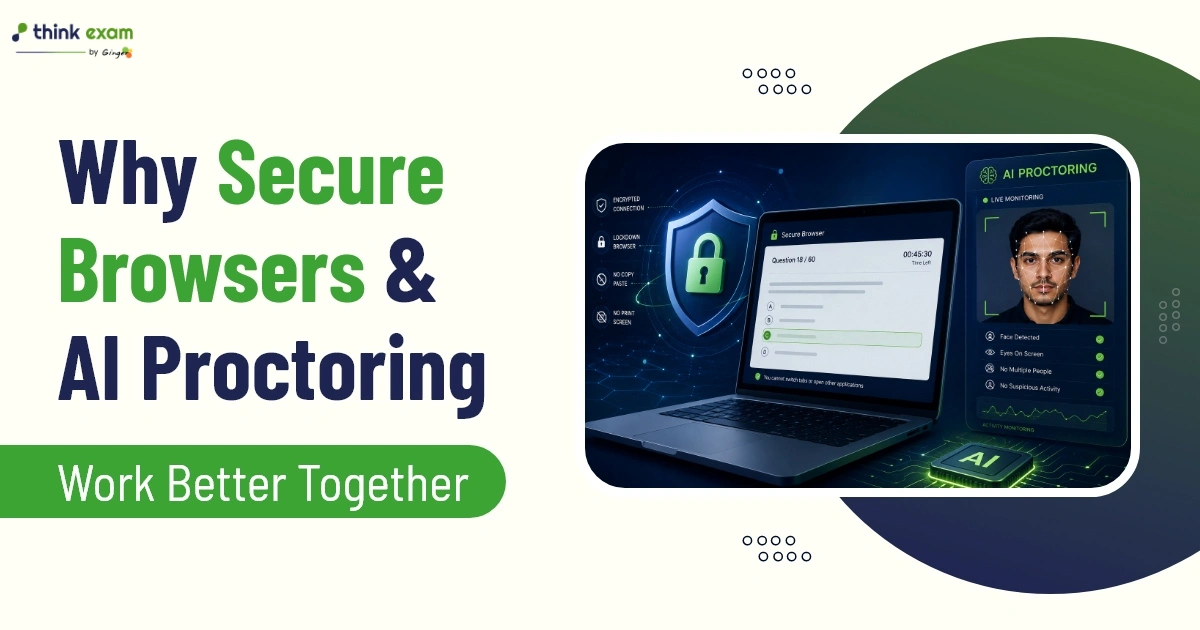
Conducting a secure online exam has become more challenging than ever.
Educational institutions, certification bodies, coaching centres, and organisations are all looking for ways to protect the integrity of their assessments while providing a smooth experience for candidates.
Many believe that one security solution is enough. In reality, no single technology can secure every part of an online assessment.
This is why more institutions are combining online exam proctoring with secure browsers. One protects the testing environment, while the other protects the candidate’s device. Together, they create a stronger and more reliable assessment process.
Let’s explore why this combination is becoming the preferred approach for secure online examinations.
Exam Security Needs More Than One Layer
Online assessments face different types of risks.
Some involve the candidate’s device, while others involve the testing environment.
For example:
- Opening unauthorised websites
- Switching between applications
- Using external software
- Receiving outside assistance
- Accessing unauthorised study material
Trying to address all these risks with a single tool often leaves security gaps.
A layered approach helps institutions protect multiple parts of the assessment process at the same time.
How Secure Browsers Protect Online Exams
A secure browser creates a controlled environment on the candidate’s computer.
Instead of allowing unrestricted access, it helps limit activities that are not permitted during the exam.
Depending on the institution’s settings, a secure browser may help prevent candidates from:
- Opening additional browser tabs
- Accessing unauthorised websites
- Switching between applications
- Copying or printing exam content
- Using certain keyboard shortcuts
These controls help candidates stay focused on the assessment while reducing opportunities for unauthorised activity.
How AI Proctoring Monitors Online Exam Environments
While the browser focuses on the device, online exam proctoring focuses on what happens around the candidate during the assessment.
Instead of simply recording the session, modern systems help institutions monitor the testing environment and identify events that may require review.
Examples include:
- Multiple faces appearing on screen
- Candidates leaving the camera view
- Identity verification concerns
- Unexpected movement during the assessment
- Activities that do not match the institution’s exam policies
This gives administrators better visibility into the assessment process without manually observing every session.
How AI Proctoring Simplifies Large-Scale Online Exams
Monitoring hundreds or thousands of candidates manually can be difficult.
This is where AI proctoring supports the assessment process.
Rather than replacing human reviewers, AI helps identify sessions that may require attention.
This allows institutions to:
- Conduct assessments at scale
- Reduce manual monitoring effort
- Review flagged events more efficiently
- Maintain consistent monitoring standards
The result is a more manageable assessment process, especially for large examinations.
Device Security and Environment Monitoring Solve Different Problems
A common misunderstanding is that a secure browser and proctoring perform the same function.
They do not.
A secure browser focuses on controlling the candidate’s computer.
Online exam proctoring focuses on monitoring the assessment environment.
When combined, these technologies provide broader protection than either solution alone.
This layered strategy reduces security gaps and strengthens confidence in assessment outcomes.
How Secure Browsers and AI Proctoring Improve Candidate Experience
Security should support the assessment, not make it stressful.
When institutions provide clear instructions before the exam, candidates know:
- Which devices they can use
- What actions are restricted
- How monitoring works
- What technical requirements must be met
This clarity helps candidates prepare properly and complete the assessment with confidence.
Online Test Monitoring Supports Fair Evaluations
Fairness is one of the most important goals of any assessment.
Every candidate should be evaluated under similar conditions.
Through structured online test monitoring, institutions can maintain greater consistency across multiple locations, batches, and examination sessions.
This helps create an assessment environment where results are based on performance rather than differences in testing conditions.
A Better Approach for Large-Scale Online Exams
Large assessments require more than strong security.
They also require efficient administration.
By combining secure browsers with exam online proctoring, institutions can simplify:
- Candidate management
- Assessment delivery
- Session monitoring
- Review workflows
- Performance reporting
This allows administrators to focus on managing the assessment rather than handling multiple disconnected processes.
Planning for the Future of Digital Assessments
As more institutions adopt digital examinations, expectations around assessment security continue to grow.
Students, candidates, employers, and certification bodies all expect assessments to be:
- Fair
- Consistent
- Secure
- Scalable
- Easy to manage
A layered security strategy helps institutions meet these expectations while supporting future growth.
Best Practices for Secure Online Exam Delivery
Security should not begin only after the exam starts.
Institutions should review every stage of the assessment journey, including:
- Candidate registration
- Identity verification
- Device preparation
- Assessment delivery
- Session monitoring
- Result review
Combining secure browsers with online exam proctoring creates a more complete security strategy from beginning to end.
Final Thoughts
No single technology can protect every aspect of an online assessment.
A secure browser helps control the candidate’s device, while online exam proctoring helps monitor the testing environment. Together, they provide stronger protection, improve consistency, and help institutions conduct assessments with greater confidence.
As digital examinations continue to expand, combining AI proctoring, structured online test monitoring, and a reliable online proctored exam process will help organisations build secure, scalable, and trustworthy assessment experiences.