Online examinations have become an important part of digital education. Universities, colleges, training institutions, and certification bodies are increasingly using digital platforms to assess students remotely and manage examinations at scale.
However, moving an exam online does not automatically make it secure. Institutions still need to verify candidate identities, protect examination content, control the testing environment, monitor relevant activity, and maintain reliable assessment records.
This is where secure online exam platforms play an important role. By combining exam management with security controls such as identity verification, secure browsers, online proctoring, question randomization, and analytics, these platforms help institutions conduct reliable digital assessments while supporting students across different locations.
What Makes an Online Exam Platform Secure?
A secure online exam platform uses multiple layers of protection throughout the examination process. Instead of relying on one security feature, institutions can combine different controls based on the type and risk level of the assessment.
Key security capabilities may include:
- Candidate identity verification
- Secure examination environments
- Question randomization
- Browser restrictions
- AI-assisted or human proctoring
- Activity monitoring
- Access controls
- Examination logs and audit trails
- Data protection
- Post-exam review and reporting
The exact features vary between platforms, so institutions should select a solution based on their examination requirements, candidate volume, security policies, and student experience goals.
Why Is Exam Security Important in Digital Education?
Academic integrity remains important whether an examination takes place in a physical classroom or online.
Remote examinations can introduce challenges such as unauthorized access to resources, impersonation, collaboration between candidates, and the use of restricted applications or websites.
A secure online examination environment can help institutions address these risks while allowing students to take assessments from approved locations.
Effective exam security can help institutions:
- Verify that the correct candidate is taking the exam
- Protect examination content
- Reduce opportunities for unauthorized assistance
- Maintain consistent examination rules
- Monitor relevant assessment activity
- Identify events that may require review
- Maintain examination records
- Support fair and reliable evaluation
The objective is not simply to monitor students. It is to create a controlled and trustworthy environment in which assessments can be conducted fairly.
5 Key Security Layers of Online Exam Platforms
A strong digital examination strategy typically combines several security layers.
1. Candidate Identity Verification
Identity verification helps confirm that the registered candidate is the person taking the examination.
Depending on the platform and assessment requirements, institutions may use candidate credentials, identity documents, facial authentication, or other verification methods.
For high-stakes examinations, identity verification can be combined with additional monitoring and security measures to strengthen the overall assessment process.
2. Secure Exam Environment
A secure examination environment helps limit unauthorized activity while a test is in progress.
Depending on the platform, security controls may include:
- Restricted navigation
- Full-screen examination environments
- Secure browser capabilities
- Application restrictions
- Controlled access to exam content
- Session monitoring
These controls can reduce opportunities for candidates to access unauthorized resources during an assessment.
3. AI-Powered Online Proctoring
AI proctoring can help monitor predefined events or activities during an online examination and flag situations that may require further review.
Depending on the implementation, a proctoring system may monitor factors such as:
- Candidate presence
- Multiple faces
- Unexpected activity
- Screen activity
- Audio events
- Browser activity
- Other predefined examination events
An automated alert should not automatically be treated as proof of misconduct. Human review can provide additional context before an institution makes a decision.
This combination of automated monitoring and human oversight can help institutions manage remote assessments more efficiently while maintaining appropriate review processes.
4. Question Randomization
Question randomization can reduce the possibility of candidates receiving exactly the same questions in the same sequence.
Institutions can use question banks to create different combinations of questions while maintaining the required learning objectives and difficulty level.
This approach can be especially useful when large numbers of students are taking an examination at the same time.
5. Examination Data Protection
Online examination systems may handle sensitive information, including:
- Candidate details
- Examination responses
- Scores
- Assessment records
- Proctoring information
Institutions should therefore evaluate how a platform manages authentication, permissions, access controls, encryption, data storage, retention, and other applicable security requirements.
Data protection should be considered alongside examination security rather than treated as a separate concern.
How Do Secure Online Exam Platforms Help Prevent Cheating?
No technology can guarantee that cheating will never happen.
Instead, secure online exam platforms use multiple controls to reduce opportunities for unauthorized activity and identify events that may require investigation.
A layered approach can include:
Identity verification + secure browser + question randomization + proctoring + activity monitoring + examination records
Using these controls together can provide stronger protection than depending on a single security feature.
Institutions can also establish clear examination policies explaining what candidates can and cannot do during an assessment. Technology works best when it is supported by transparent policies and appropriate human review.
How Does AI Proctoring Support Secure Online Exams?
AI proctoring can help institutions monitor online examinations at scale by identifying predefined events that may require attention.
Instead of requiring a human proctor to continuously watch every candidate, AI-assisted systems can help prioritize events for review.
A simplified workflow can look like this:
Candidate takes exam → AI monitors predefined events → Potential event is flagged → Reviewer examines the event → Institution makes a decision
This approach can help universities manage larger remote examinations while keeping human oversight involved in important decisions.
Why Do Secure Browsers Matter in Online Examinations?
A secure browser can help create a controlled digital testing environment by restricting certain activities while an examination is active.
Depending on the implementation, it may limit:
- Access to other websites
- Application switching
- Copy and paste
- Unauthorized navigation
- Other restricted actions
A secure browser should not be viewed as a complete examination security solution. It works best when combined with appropriate authentication, monitoring, proctoring, and examination policies.
How Secure Online Exams Support Universities
Universities can use secure online examination platforms for a range of assessments, including:
- Semester examinations
- Internal assessments
- Entrance examinations
- Certification examinations
- Remote examinations
- Skill assessments
- High-stakes examinations
A centralized platform can also help examination teams manage candidate registration, assessment delivery, monitoring, evaluation, and reporting within a common environment.
This can be particularly useful for institutions that conduct examinations across multiple courses, departments, campuses, or locations.
Can Secure Online Exam Platforms Handle Large-Scale Examinations?
Yes. Platforms designed for scalable online examination delivery can support large candidate volumes across different sessions and locations.
However, scalability depends on the platform architecture, infrastructure, configuration, and capacity planning.
For large examinations, institutions should evaluate:
- Concurrent candidate capacity
- Cloud infrastructure
- Exam scheduling
- Monitoring capabilities
- Technical support
- Candidate communication
- Contingency processes
- Result processing
- Reporting capabilities
Testing the platform under realistic conditions before a high-volume examination can also help institutions identify technical issues before candidates begin their assessments.
How to Choose a Secure Online Exam Platform
Choosing an examination platform should involve more than comparing the number of features available.
Institutions should consider whether the platform can support their specific examination model and security requirements.
| Requirement | What to evaluate |
|---|---|
| Identity | Candidate verification options |
| Security | Access controls and examination restrictions |
| Proctoring | AI-assisted and/or human review capabilities |
| Browser | Secure examination environment |
| Question security | Question banks and randomization |
| Scalability | Concurrent candidate capacity |
| Analytics | Results and assessment reporting |
| Data | Protection, permissions, and retention |
| Support | Technical assistance and incident handling |
| Usability | Candidate and administrator experience |
The best platform is not necessarily the one with the most features. It is the one that provides the right combination of security, scalability, usability, and assessment management for the institution’s needs.
How Think Exam Supports Secure Online Assessments
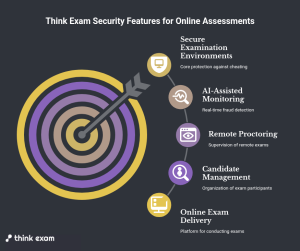
Think Exam provides online assessment and examination capabilities for organizations and educational institutions.
Depending on the assessment requirements, institutions can use a combination of capabilities such as:
- Online exam delivery
- Candidate management
- Remote proctoring
- AI-assisted monitoring
- Secure examination environments
- Assessment analytics
- Results and reporting
The appropriate combination depends on factors such as the examination type, candidate volume, security requirements, and institutional policies.
For organizations planning digital assessments, Think Exam can provide a centralized environment for managing different stages of the online assessment process.
What Is the Future of Secure Online Examinations?
The future of online examination security is likely to focus on layered protection rather than a single technology.
AI-assisted monitoring, stronger identity verification, secure browsers, scalable cloud infrastructure, examination analytics, audit trails, and human review can work together to create more reliable digital assessment environments.
At the same time, institutions will need to balance security with student privacy, accessibility, usability, and transparency.
The goal is not to make online examinations unnecessarily restrictive. It is to create an assessment environment that is secure enough to protect academic integrity while remaining practical and accessible for legitimate candidates.
Conclusion
Secure online exam platforms are becoming an important part of digital education because institutions need more than simple online test delivery. They need ways to verify candidates, protect examination content, control the testing environment, monitor relevant activity, and manage assessment records.
A layered approach that combines identity verification, secure browsers, AI proctoring, question security, data protection, and human review can help institutions conduct more reliable digital examinations.
As universities and educational organizations continue expanding remote and online assessments, choosing the right examination platform will be an important part of maintaining both academic integrity and a positive student experience.