1. The Reality Check: Why Traditional Exams Are Losing Relevance
University exams were designed for a time when student volumes were lower, courses were less dynamic, and evaluation did not need to be instant. Today, that model feels outdated. Institutions are expected to operate faster, provide better student experiences, and align with industry expectations, but their examination systems often remain unchanged.
This gap creates friction across the entire academic lifecycle. From delayed results affecting placements to outdated testing formats failing to measure real skills, traditional exams are no longer meeting the needs of modern education. This is why many institutions are gradually shifting toward online exams as a more efficient and relevant solution.
2. Operational Inefficiencies That Slow Everything Down
2.1 Time-Heavy Exam Cycles
Traditional exams involve multiple layers of coordination:
- Paper setting and approvals
- Printing and distribution logistics
- Physical exam conduction
- Manual evaluation and result compilation
Each stage adds time, often stretching the process across weeks or even months. This delay impacts academic calendars, admissions cycles, and placement timelines. In contrast, online exams significantly reduce this turnaround time, enabling faster execution and quicker results.
2.2 Resource Drain on Institutions
Conducting exams offline requires substantial resources:
- Examination halls and infrastructure
- Invigilators and administrative staff
- Printing, storage, and transportation of papers
These are recurring costs that grow with the number of students. An online exam platform eliminates most of these dependencies, allowing institutions to optimise both cost and effort while maintaining efficiency.
2.3 Limited Scalability
Traditional exams struggle when student numbers increase:
- Limited seating capacity
- Difficulty in managing multiple locations
- Challenges in scheduling large batches
Scaling such systems becomes complex and error-prone. With online exams, institutions can handle large volumes seamlessly without worrying about physical constraints.
3. The Evaluation Problem: Measuring Memory, Not Ability
3.1 One-Dimensional Testing
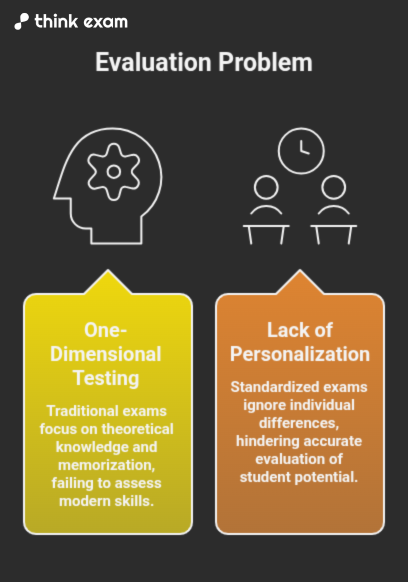
Most traditional exams are designed to test:
- Theoretical knowledge
- Memorisation
- Repetition of learned concepts
However, modern education requires much more:
- Analytical thinking
- Problem-solving skills
- Application-based knowledge
This mismatch results in graduates who may score well in exams but struggle in real-world scenarios. Online exams allow institutions to move beyond theory and incorporate practical, skill-based assessments.
3.2 Lack of Personalization
Every student receives the same question paper regardless of:
- Skill level
- Learning pace
- Strengths and weaknesses
This “one-size-fits-all” approach fails to capture true potential. A modern online exam platform can support adaptive assessments, where question difficulty adjusts based on student performance, providing a more accurate evaluation.
4. Academic Integrity: More Fragile Than It Appears
4.1 Limitations of Manual Invigilation
Human invigilation has inherent challenges:
- Inconsistent monitoring across exam centers
- Difficulty in tracking every student simultaneously
- Dependence on individual vigilance
Even with strict supervision, maintaining uniform standards is difficult.
4.2 Offline Malpractice Still Exists
Despite traditional controls, issues like:
- Question paper leaks
- Proxy test-taking
- Unfair collaboration
continue to surface. These incidents impact the credibility of institutions and question the reliability of results.
5. Student Experience: A Missing Priority
5.1 High Pressure, Low Flexibility
Traditional exams often:
- Follow rigid schedules
- Allow little room for rescheduling
- Depend on one-time performance
This creates unnecessary stress for students, especially when external factors affect their performance.
5.2 Accessibility Challenges
Students face multiple barriers:
- Travel to exam centers
- Physical presence requirements
- Limited accommodations for special needs
Online exams address these challenges by offering flexibility and inclusivity, allowing students to take assessments from their preferred environment.
6. The Shift: Why Change Is No Longer Optional
Institutions are recognising that traditional systems cannot support:
- Large-scale education models
- Remote and hybrid learning
- Skill-based evaluation needs
The demand is clear: faster, smarter, and more scalable solutions. This is driving the adoption of online exams across universities globally.
7. What an Online Exam Platform Brings to the Table
7.1 Speed and Efficiency
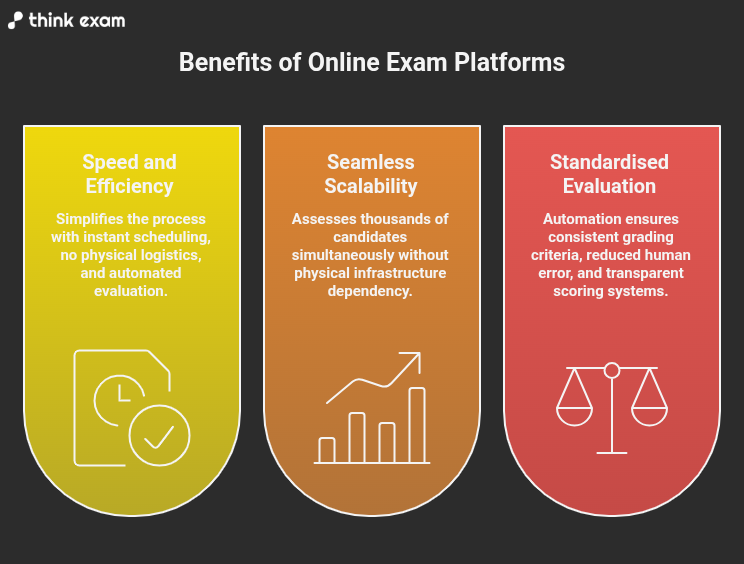
An online exam platform simplifies the entire process:
- Instant scheduling
- No physical logistics
- Automated evaluation
What once took weeks can now be completed within hours, improving institutional efficiency.
7.2 Seamless Scalability
With online exams:
- Thousands of candidates can be assessed simultaneously
- No dependency on physical infrastructure
- Easy expansion across geographies
This makes it ideal for universities handling large student populations.
7.3 Standardised Evaluation
Automation ensures:
- Consistent grading criteria
- Reduced human error
- Transparent scoring systems
This improves fairness and reliability in assessments.
8. Moving Beyond Traditional Testing Models
8.1 Skill-Based Assessments
Modern online exams enable:
- Case-study based questions
- Real-life simulations
- Interactive problem-solving tasks
This ensures students are evaluated on skills that matter beyond the classroom.
8.2 Adaptive Testing
An advanced online exam platform can:
- Adjust question difficulty in real-time
- Provide personalised test experiences
- Deliver deeper insights into student capabilities
This creates a more accurate and meaningful evaluation process.
9. Security Reinvented with AI Proctoring
9.1 Real-Time Monitoring
AI proctoring uses technology to:
- Track candidate behavior
- Monitor eye movement and activity
- Flag suspicious actions instantly
9.2 Scalable and Consistent Security
Unlike human invigilation, AI proctoring offers:
- Uniform monitoring for all candidates
- No fatigue or oversight issues
- Ability to manage large-scale exams
9.3 Strengthening Exam Credibility
With AI proctoring, institutions can:
- Minimize cheating risks
- Maintain exam integrity
- Build trust in online exams
10. Better Outcomes for Everyone Involved
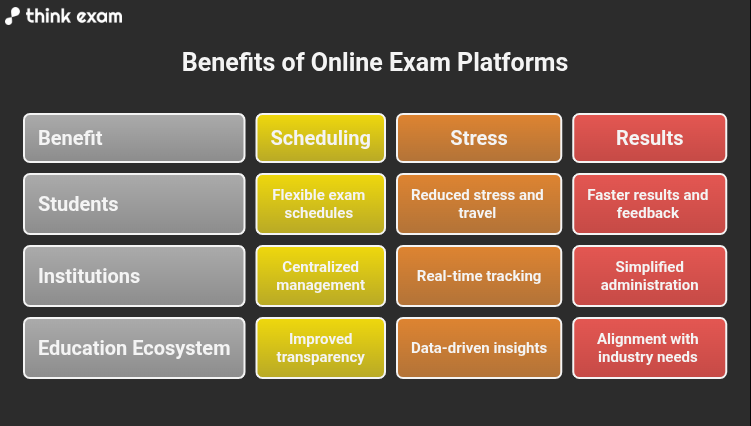
10.1 For Students
- Flexible exam schedules
- Reduced stress and travel
- Faster results and feedback
10.2 For Institutions
An online exam platform enables:
- Centralized management
- Real-time tracking
- Simplified administration
10.3 For the Education Ecosystem
- Improved transparency
- Data-driven insights
- Alignment with industry needs
11. Strategic Advantages for Universities
11.1 Staying Competitive
Universities adopting online exams:
- Attract more students
- Enhance their reputation
- Align with global standards
11.2 Data-Driven Improvements
A modern online exam platform provides:
- Performance analytics
- Exam pattern insights
- Continuous improvement opportunities
11.3 Future-Ready Infrastructure
With AI proctoring and scalable systems, institutions are better prepared for:
- Remote learning environments
- Hybrid education models
- Evolving academic needs
12. The Bottom Line
Traditional university exams are no longer sufficient for today’s fast-paced, digital-first world. They are slow, resource-intensive, and limited in their ability to measure real skills.
On the other hand, online exams, powered by a robust online exam platform and enhanced with AI proctoring, offer a smarter, faster, and more secure alternative.
The transition is not just about adopting technology—it’s about redefining how learning is evaluated. Institutions that embrace this shift will not only improve efficiency but also deliver more meaningful and credible assessments.
The real question is no longer whether to adopt online exams, but how quickly universities can move toward a more modern and effective system.