For organisations running high-stakes assessments, government certifications, professional licencing, and corporate hiring, the shift to online delivery has created a real problem: how do you maintain invigilation standards without a physical room? That is the gap that well-implemented AI remote proctoring is designed to fill.
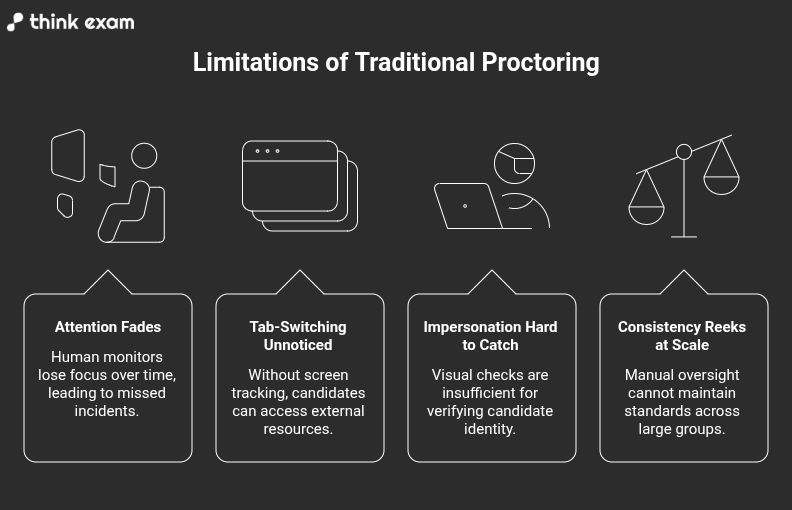
Why Traditional Proctoring Does Not Scale Online
Human monitoring was built for physical rooms. Online exams expose their limits quickly:
- Attention fades: One person cannot watch dozens of live feeds at the same level of focus for two hours straight, and incidents get missed.
- Tab-switching goes unnoticed: Without automated screen tracking, candidates can consult external resources without appearing suspicious on camera.
- Impersonation is hard to catch: A quick visual check is not enough. Without structured identity verification, someone else can sit the exam entirely.
- Consistency reeks at scale: When thousands of candidates sit simultaneously, manual oversight cannot maintain the same standard across all sessions.
These are not rare edge cases. They happen routinely in large online assessments. The credibility of results suffers, and institutions are right to be concerned.
What AI Remote Proctoring Actually Does
It is worth being specific because there is a lot of noise around what the technology does and does not do.
- Behavioural monitoring: The system watches for eye gaze patterns, head movement, and physical absence, flagging anomalies with a timestamp and confidence score for human review.
- Audio detection: Background voices or prompted answers are picked up automatically, one of the harder things for a human reviewer to catch from a webcam feed alone.
- Screen and device tracking: Tab changes, copy-paste events, and app switching are logged throughout the session, creating a clear activity record.
- Identity verification at the start: A live face match against a government ID with liveness detection confirms the right person is sitting before the exam begins.
- Human review at every step: The AI flags; a trained human decides. No candidate faces consequences from an algorithm alone. That is both good practice and a legal requirement in most places.
Compliance cannot be an Afterthought.
Exam sessions capture biometric data like faces, voices, and ID documents. That places them firmly within the scope of data protection law. Getting this right from the start matters:
- Explicit candidate consent: Candidates must know what is being recorded, why, and for how long before the session starts, not buried in a T&C page.
- Clear retention limits: Data should be kept only as long as necessary for appeals and compliance, then deleted on a defined schedule.
- Full audit trails: Every flag, review decision, and outcome must be logged and retrievable for appeals, audits, or regulatory inspection.
- Vendor accountability: If your provider cannot answer compliance questions in writing, with specifics, that tells you something important about how they operate.
Fairness Is Not Optional
Early AI proctoring systems flagged candidates inconsistently based on skin tone, lighting, or environment. That is not a neutral outcome; it is a discriminatory one. What responsible platforms need to demonstrate:
- Diverse training data: The model must perform consistently across demographics and lighting conditions, not just in ideal environments.
- Regular bias audits: Not a one-time exercise ongoing testing with published results is the standard worth holding vendors to.
- Accessibility built in: Candidates using assistive devices or adapted environments should not be flagged as anomalies. This needs to be a configurable feature, not a workaround.
How to Evaluate AI Remote Proctoring Software
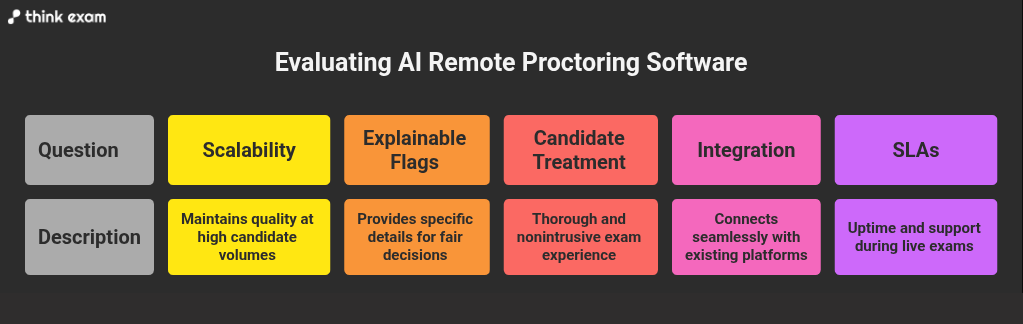
Before choosing a platform, these are the questions worth asking:
- Does it scale without dropping quality: Detection accuracy should hold at 500 candidates or 500,000. If it degrades under load, that is a product problem.
- Are flags explainable: “Secondary face at 14:23 for 9 seconds” is useful. “Suspicious behaviour detected” is not. You need specifics to make fair decisions.
- How does it treat the candidate: A clunky onboarding process creates stress before the exam starts. Proctoring should be thorough and nonintrusive — not a hurdle.
- Does it integrate cleanly? Whether you use a government portal, an LMS, or a custom platform, the proctoring layer should connect via API without heavy lifting on your side.
- What do the SLAs actually say: Uptime and support commitments need to hold during live exam windows, the most critical time is when most things go wrong.
The Bottom Line
The credibility of a qualification comes from the rigour behind it. As more exams move online, maintaining that rigour requires tools that are consistent, fair, and built for scale. AI proctoring, if done right, is what makes that possible. It is not about surveillance. It is about giving every candidate the same standard, wherever they sit.