Hiring has never been a simple task. But in today’s high-volume, high-speed talent market, it has become even more complex. Organisations are no longer dealing with dozens of applications; they’re handling thousands. In this environment, traditional hiring methods are starting to show their limitations. Manual resume screening, inconsistent evaluations, and delayed decision-making are no longer sustainable.
This is where online assessments and modern hiring tools step in—not as a trend, but as a necessity.
The Problem with Manual Screening
For years, recruiters have relied on resumes to shortlist candidates. While resumes provide a snapshot of experience, they often fail to capture actual skills, problem-solving ability, or job readiness. This leads to two major challenges:
- Bias and inconsistency in evaluation
- Time-consuming shortlisting processes
Manual screening also struggles to scale. When hundreds of candidates apply for a single role, even the most efficient HR teams can get overwhelmed. This often results in missed talent or rushed decisions.
The Shift Toward Smart Hiring
To overcome these challenges, organisations are increasingly adopting online assessments as a core part of their hiring strategy. Instead of relying solely on resumes, companies now evaluate candidates based on real skills, cognitive ability, and job-specific competencies.
A well-designed digital assessment platform allows recruiters to automate the initial stages of hiring while improving accuracy. Candidates are assessed through structured tests, simulations, or scenario-based evaluations that reflect real-world job requirements.
This shift is not just about efficiency—it’s about better decision-making.
How Online Assessment Platforms Transform Hiring
1. Faster Screening Without Compromising Quality
One of the biggest advantages of a digital assessment platform is speed. What used to take days or weeks can now be done in hours.
Instead of manually reviewing resumes, recruiters can filter candidates based on performance in online exam. This ensures that only qualified candidates move forward in the hiring process.
2. Data-Driven Decision Making
Traditional hiring often relies on intuition. But with online assessments, decisions are backed by data.
Recruiters can analyze:
- Test scores
- Skill benchmarks
- Behavioral insights
This data-driven approach reduces guesswork and improves hiring accuracy. When combined with recruitment software, these insights can be seamlessly integrated into the overall hiring workflow.
3. Improved Candidate Quality
When candidates are evaluated through online exam assessment, companies get a clearer picture of their actual capabilities.
This leads to:
- Better job-role alignment
- Reduced hiring mistakes
- Improved employee performance post-hiring
Instead of hiring based on what candidates say they can do, organizations hire based on what they can demonstrate.
4. Scalability for High-Volume Hiring
Campus hiring, bulk recruitment drives, and large-scale talent acquisition require systems that can handle volume.
This is where online assessments prove invaluable. A single digital assessment platform can evaluate thousands of candidates simultaneously without compromising on consistency or fairness.
This scalability is especially useful for industries like IT, BPO, and education, where hiring needs are often large and time-sensitive.
5. Enhanced Candidate Experience
Hiring is not just about evaluating candidates—it’s also about creating a positive experience.
A streamlined online exam assessment process allows candidates to:
- Take tests remotely
- Complete assessments at their convenience
- Receive faster updates
Modern recruitment software ensures that communication, scheduling, and feedback are handled efficiently, improving the overall candidate journey.
The Business Impact
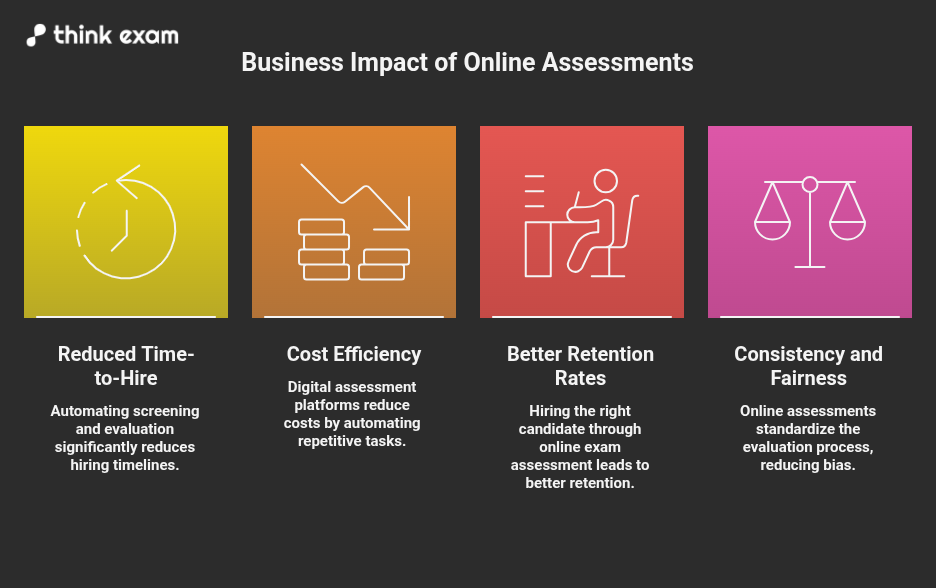
The adoption of online assessments goes beyond operational efficiency—it has a direct impact on business outcomes.
Reduced Time-to-Hire
By automating screening and evaluation, companies significantly reduce hiring timelines. Faster hiring means roles are filled quickly, minimizing productivity loss.
Cost Efficiency
Manual hiring processes involve significant costs—HR hours, administrative overhead, and logistical expenses. A digital assessment platform reduces these costs by automating repetitive tasks and minimizing dependency on physical resources.
Better Retention Rates
Hiring the right candidate from the start leads to better retention. When employees are well-matched to their roles through online exam assessment, they are more likely to perform well and stay longer.
Consistency and Fairness
One of the biggest challenges in hiring is maintaining fairness. Online assessments standardize the evaluation process, ensuring every candidate is assessed on the same parameters.
This reduces bias and strengthens employer credibility.
Integration with Recruitment Software
A standalone assessment tool is useful—but the real power lies in integration.
When a digital assessment platform is combined with advanced recruitment software, organizations get an end-to-end hiring solution. From candidate sourcing to onboarding, everything is connected.
This integration allows:
- Automated shortlisting
- Real-time tracking of candidates
- Seamless communication between teams
It also ensures that insights from online assessments are directly linked to hiring decisions, making the process more efficient and transparent.
Adapting to Remote and Hybrid Hiring
The shift to remote work has further accelerated the adoption of online assessments. Organizations are no longer limited by geography when hiring talent.
A robust online exam assessment system enables companies to evaluate candidates from anywhere in the world. This expands the talent pool and increases the chances of finding the right fit.
At the same time, recruitment software ensures that remote hiring processes remain structured and organized.
Overcoming Challenges
While the benefits are clear, implementing a digital assessment platform requires careful planning.
Some common challenges include:
- Designing relevant and role-specific assessments
- Ensuring test security and integrity
- Integrating with existing recruitment software
However, with the right strategy and tools, these challenges can be effectively managed.
The Future of Hiring
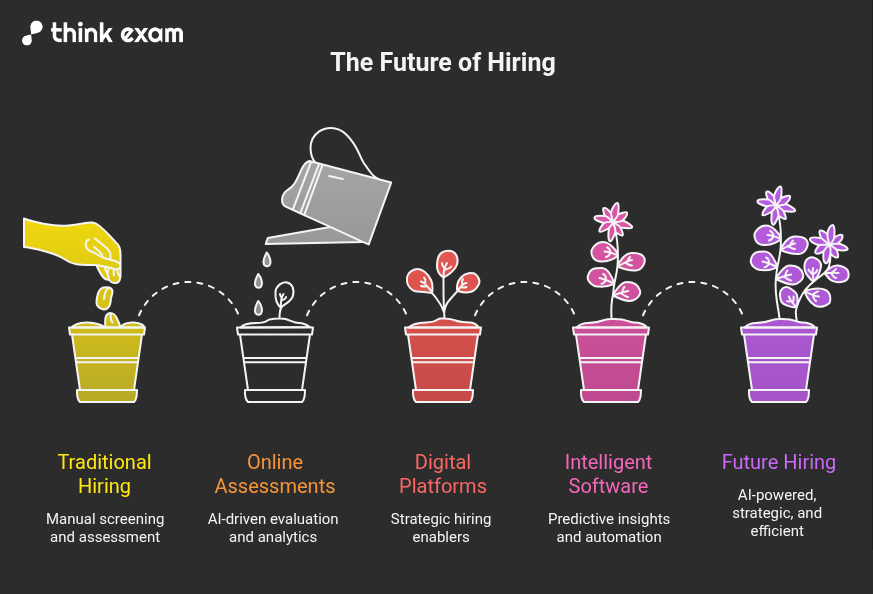
Hiring is evolving—and fast. As technology continues to advance, online assessments will become even more sophisticated.
We can expect:
- AI-driven evaluation models
- Behavioral and cognitive analytics
- Adaptive testing mechanisms
The role of digital assessment platforms will expand from screening tools to strategic hiring enablers.
At the same time, recruitment software will become more intelligent, offering predictive insights and automation across the hiring lifecycle.
Conclusion
The shift from manual screening to smart hiring is not just a technological upgrade—it’s a strategic transformation.
Organizations that embrace online assessments and invest in a robust digital assessment platform are better equipped to handle modern hiring challenges. They gain speed, accuracy, scalability, and a competitive edge in attracting top talent.
When combined with powerful recruitment software, these platforms create a seamless, data-driven hiring ecosystem.
In a world where talent is the biggest differentiator, smarter hiring is no longer optional—it’s essential.