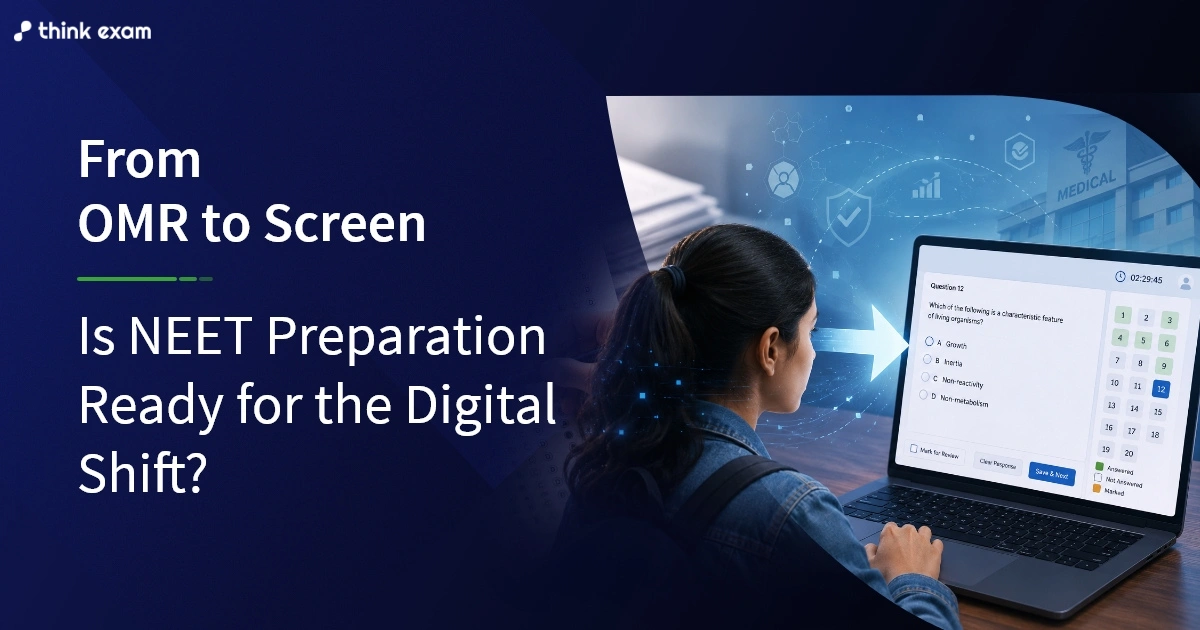
For years, NEET preparation has followed a familiar routine: study from books, solve questions on paper, take mock tests, and practise filling OMR sheets under time pressure.
But what happens if the examination experience moves from paper to a screen?
That question is becoming increasingly relevant as computer-based testing continues to expand across competitive and entrance examinations in India. NTA itself conducts several examinations in CBT mode, and its broader testing framework recognises computer-based testing as a way to handle high-volume examinations efficiently.
At present, NEET (UG) 2026 was conducted using OMR-based testing, with NTA providing candidates access to scanned OMR answer sheets and recorded responses.
So, there is no reason for students or coaching institutes to treat a CBT transition as the current NEET format. But there is a useful question to ask ahead of any future change:
Is NEET preparation ready for a digital exam environment?
NEET Preparation Is More Than Knowing the Syllabus
Students preparing for NEET spend years building subject knowledge. Physics, Chemistry, and Biology require extensive practice, revision, and repeated testing.
But performing well in an examination also depends on how comfortably a student can handle the testing environment.
In a CBT mode, students would have to read questions on a screen, select answers digitally, navigate between questions, manage an on-screen timer, and review responses through the test interface.
The syllabus may not change simply because the delivery method changes. The exam-taking experience would.
That is why preparation for a potential NEET CBT shift should not be limited to academic preparation.
OMR Practice and CBT Practice Build Different Habits
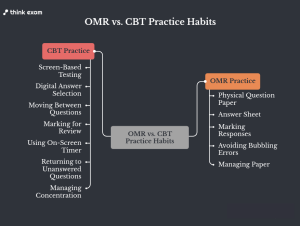
OMR-based tests train students to work with a physical question paper and answer sheet. They learn how to mark responses carefully, avoid bubbling errors, and manage their paper while solving questions.
A CBT NEET practice environment would require a different set of habits.
Students would need to become comfortable with:
- Reading lengthy questions on a screen
- Selecting answers digitally
- Moving between questions
- Marking questions for review
- Using the on-screen timer
- Returning to unanswered questions
- Managing concentration during screen-based testing
Neither approach makes the other useless.
OMR practice remains valuable while the official examination uses OMR. But if the CBT mode of exam becomes part of NEET in the future, students would benefit from having experience with that environment before the actual examination.
What Could Change for Students in CBT Mode?
The biggest adjustment may not be technology itself. It could be time management.
On paper, students can quickly scan multiple pages, underline information, circle something for later, or physically move between sections.
On a screen, navigation works differently.
A student taking a NEET CBT test for the first time may spend extra time figuring out the interface instead of solving questions.
That may seem like a small issue, but competitive examinations are often decided by seconds.
Regular digital practice can make actions such as opening the next question, reviewing an answer, or moving between sections feel routine.
The aim isn’t to make students “tech-savvy.”
It is to make the technology invisible to the student on exam day.
Coaching Institutes Have a Bigger Role to Play
A potential shift to NEET CBT would not affect students alone.
Coaching institutes would also need to rethink how they conduct mock examinations.
Instead of introducing a digital test only when an official announcement is made, institutes could gradually introduce optional online assessments alongside their existing paper-based tests.
For example:
- Chapter-wise digital quizzes
- Weekly CBT practice
- Full-length digital mock exams
- Timed computer-based tests
- Mixed OMR and digital practice
- Performance comparison across multiple tests
This would allow students to build familiarity without suddenly replacing the preparation methods they already know.
The First Digital Mock Shouldn’t Be the Last
One digital mock test cannot create digital exam readiness.
A student may initially struggle with something as simple as finding the question palette or understanding how to revisit a marked question.
That is normal.
Repeated exposure can help students become more comfortable with the interface and focus more of their attention on the questions themselves.
This is where a CBT mode practice strategy can be useful.
The goal is not to conduct one impressive mock examination. It is to make the digital environment familiar enough that it no longer becomes a source of stress.
What Should a NEET CBT Mock Test Include?
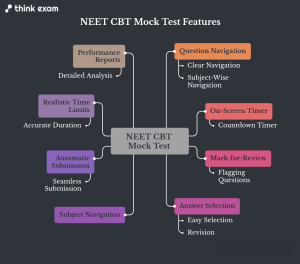
If coaching institutes begin preparing students for a possible digital format, the mock test should feel like a real examination rather than a basic online quiz.
A useful NEET CBT test should include features such as:
- Clear question navigation
- On-screen countdown timer
- Mark-for-review functionality
- Easy answer selection and revision
- Subject-wise navigation
- Automatic submission
- Realistic time limits
- Detailed performance reports
The exact interface should, of course, be aligned with the official examination pattern if and when NTA announces a CBT format for NEET.
The objective is simple: the closer practice is to the expected exam experience, the more useful it becomes.
Don’t Stop at the Final Score
A mock test becomes much more valuable when students can understand what happened during the test.
Instead of showing only:
Score: 620/720
A digital assessment can provide additional insights.
For example:
- Which subject took the most time?
- Which topics had the lowest accuracy?
- How many questions were left unanswered?
- How often did the student change answers?
- How did performance change as the test progressed?
- Which sections need more practice?
This allows students to improve their strategy rather than simply taking another test.
For faculty, these insights can also help identify common weaknesses across a batch.
Faculty Need to Prepare for the Digital Shift Too
Students aren’t the only ones who need to adapt.
Faculty members need to understand how digital testing data can support their mentoring.
A well-designed online assessment platform can help teachers identify patterns across students, such as:
- Consistently weak topics
- Time-management problems
- Accuracy trends
- Improvement across mock tests
- Batch-level performance
This changes the role of a mock test.
It becomes more than a score-producing exercise. It becomes a source of information that can guide the next stage of preparation.
What About Students Who Prefer OMR?
Not every student will immediately feel comfortable with a screen.
Some students may be faster when working with a physical question paper. Others may find it easier to read, annotate, or review questions on paper.
That is why a sudden switch would not be the ideal approach.
A gradual transition could look like:
OMR Practice → Optional Digital Tests → Regular CBT Practice → Full-Length Digital Mocks
This gives students time to adapt without disrupting their existing preparation.
Is NEET Preparation Ready for the Digital Shift?
Academically, students are already preparing for the same core challenge: solving questions accurately under pressure.
But from a testing perspective, there is still room for preparation.
If a future NEET CBT mode is officially introduced, institutes that already have digital testing infrastructure and students who have regularly practised computer-based examinations may have an advantage,not because their syllabus preparation is better, but because they won’t be learning the exam interface at the same time as they are trying to solve the paper.
That distinction matters.
A student should walk into an important examination thinking about the question in front of them, not about how to navigate the screen.
Preparing Before the Format Changes
The current NEET examination remains OMR-based, so coaching institutes should continue preparing students according to the official pattern.
At the same time, building familiarity with digital testing can be a sensible long-term step.
NTA already uses CBT across several examinations, showing that computer-based testing is an established part of India’s broader examination ecosystem.
For coaching institutes, the takeaway isn’t to abandon OMR preparation because of speculation.
It is to build exam adaptability.
Whether students eventually take NEET on paper or through a computer, the strongest preparation will be the one that helps them remain focused, confident, and comfortable with the examination environment.
The real advantage of preparing for NEET CBT early isn’t predicting when the format will change.