A student can know every formula, remember every concept, and score exceptionally well in mock tests, and still struggle when the real examination begins.
It sounds surprising, but academic preparation is only one part of being exam-ready.
The testing environment matters too.
For students who have spent most of their preparation solving questions on paper, moving into a computer based exam can introduce a completely different experience. Reading from a screen, navigating questions, managing an on-screen timer, and reviewing answers digitally all require familiarity.
The problem isn’t that these students aren’t prepared.
They may simply be prepared for the questions, but not for the way those questions are delivered.
Being a Topper Doesn’t Automatically Mean Being Test-Ready
High-performing students usually have strong subject knowledge and good problem-solving skills.
But competitive examinations also test how effectively students can use those skills under specific conditions.
Consider a student who regularly scores 90% in paper-based mock tests. If they have never taken a full-length computer based test, they may spend valuable time getting comfortable with the interface during an important examination.
That can affect:
- Time management
- Question navigation
- Concentration
- Answer review
- Decision-making under pressure
None of these problems indicates a lack of knowledge.
They indicate a lack of environmental familiarity.
Paper Practice Builds Different Habits
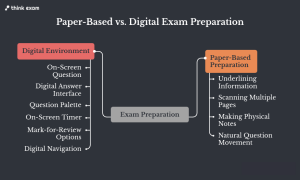
Paper-based preparation has clear advantages. Students can underline information, quickly scan multiple pages, make physical notes, and move between questions naturally.
A digital environment works differently.
During a computer based exam, students interact with:
- An on-screen question
- A digital answer interface
- A question palette
- An on-screen timer
- Mark-for-review options
- Digital navigation
These features may seem simple when demonstrated individually.
But during a high-pressure examination, unfamiliarity can become a distraction.
A student shouldn’t be learning how the test interface works while simultaneously trying to solve difficult questions.
The First CBT Test Shouldn’t Be the Real Exam
This is where regular digital practice becomes important.
Students don’t need to abandon their existing preparation methods. Instead, CBT test practice can be introduced alongside traditional mock tests.
For example:
Early preparation:
Mostly paper-based practice with occasional digital tests.
Middle stage:
Regular computer-based sectional and full-length tests.
Final stage:
Realistic computer-based mocks under strict exam conditions.
This gradual approach allows students to become comfortable with the environment without disrupting their academic preparation.
Screen Reading Can Affect Speed
One of the less obvious challenges is reading.
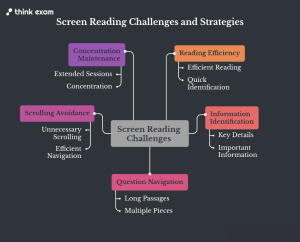
Many students are used to scanning a printed question quickly. Reading the same question from a screen can feel different, particularly when questions contain long passages, calculations, diagrams, or multiple pieces of information.
With repeated computer based test practice, students can learn how to:
- Read efficiently on screen
- Identify important information quickly
- Navigate long questions
- Avoid unnecessary scrolling
- Maintain concentration during extended sessions
The objective isn’t to make students faster at using a computer.
It is to make screen-based reading feel normal.
Time Management Looks Different on a Screen
Time management is already critical in competitive examinations.
But digital testing introduces another layer.
Students need to decide:
Should I answer this now?
Should I mark it for review?
How much time have I already spent?
How many questions are remaining?
In a computer based exam, these decisions happen alongside digital navigation.
A student who has practised only on paper may not have developed the same rhythm.
Repeated digital mocks can help students understand how much time they should realistically spend before moving forward.
Question Navigation Can Become a Hidden Problem
On paper, students can flip pages and quickly look through the question paper.
On a digital interface, navigation follows the structure provided by the testing platform.
Students may need to use question palettes, next/previous controls, review options, or section navigation.
This can become particularly important when a student prefers to skip difficult questions and return to them later.
Without practice, even a simple navigation process can interrupt concentration.
With practice, it becomes almost automatic.
A Realistic Mock Should Feel Like the Real Thing
Not every online test prepares students for a computer based exam.
A basic online quiz may check whether a student knows the answer, but it may not reproduce the pressure or workflow of a real examination.
A useful digital mock should replicate important elements such as:
- Full-length exam duration
- Realistic question navigation
- On-screen timer
- Mark-for-review functionality
- Section movement
- Question palette
- Automatic submission
- Similar difficulty and question structure
The closer the practice environment is to the expected examination experience, the more useful the practice becomes.
Don’t Just Measure Marks
One of the biggest advantages of online assessments is the amount of information they can provide beyond the final score.
A digital mock can help students and faculty understand:
- Time spent per question
- Subject-wise accuracy
- Questions skipped
- Questions revisited
- Changes in answers
- Performance across multiple tests
- Accuracy under time pressure
This creates a more complete picture of exam readiness.
A student scoring 650 consistently may appear ready. But if their performance drops sharply during the final 30 minutes of every test, there is an issue worth addressing.
The score alone may not reveal it.
Coaching Institutes Can Close the Preparation Gap
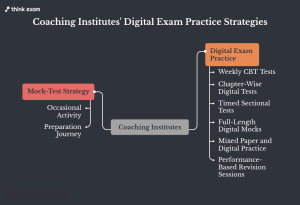
For coaching institutes, this creates an opportunity to improve mock-test strategy.
Instead of treating a CBT test as an occasional activity, institutes can make digital exam practice part of the preparation journey.
They can conduct:
- Weekly computer-based tests
- Chapter-wise digital tests
- Timed sectional tests
- Full-length digital mocks
- Mixed paper and digital practice
- Performance-based revision sessions
Faculty can then use assessment data to identify students who are academically strong but less comfortable with the digital environment.
This is particularly valuable because these students may not ask for help themselves.
They may simply assume that a poor digital-test performance means they weren’t prepared enough.
The Goal Isn’t to Replace Paper Overnight
Paper-based practice still has value.
Students need different forms of practice depending on the examination format, learning stage, and subject.
The objective is not:
Paper vs. computer
It is:
Academic preparation + exam-environment preparation
A balanced approach can allow students to strengthen their concepts while also becoming comfortable with the conditions under which they may eventually be tested.
Preparing for Performance, Not Just the Score
A strong student should enter an important examination with as few unknowns as possible.
They should know the syllabus.
They should know their strengths and weaknesses.
They should understand how they manage time.
And if the examination is computer-based, they should already know how to work comfortably within a digital testing environment.
That’s why a computer based exam should not be treated as simply a paper test displayed on a screen.
The environment itself becomes part of the preparation.
Make the Test Environment Familiar
Top rankers don’t usually fail because they suddenly forget everything they studied.
Sometimes, the pressure comes from having to manage an unfamiliar environment while also solving difficult questions.
Regular computer based test practice can remove one of those uncertainties.
When students have already experienced the timer, navigation, question review, and screen-based reading during preparation, they have fewer new things to process on exam day.
The goal is simple:
Don’t let the test interface become another problem to solve.
Prepare students for the questions,but also prepare them for the environment in which they’ll answer them.