Knowing the right answer and knowing what to do with that knowledge are two different things.
A candidate may score well on a traditional test but struggle when faced with a real customer problem, an unfamiliar situation, or a decision that has more than one possible answer. Similarly, a student may understand a concept in theory but find it difficult to apply it to a practical situation.
This is why organisations are looking beyond simple knowledge-based testing.
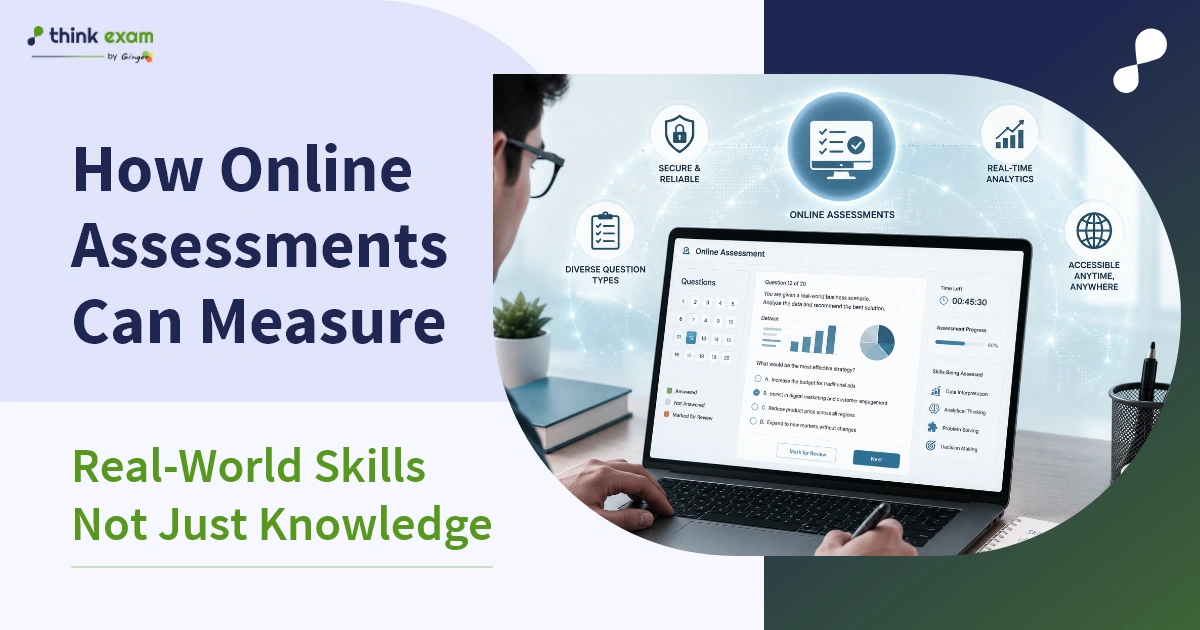
Modern online assessments can be designed to measure how people think, solve problems, make decisions, and apply what they know. For recruiters, universities, and training teams, this can provide a more useful picture of actual capability.
The key is not simply putting traditional questions on a screen. It is designing assessments around the skills that people are expected to use in the real world.
Knowledge Is Only the Starting Point
Traditional tests are useful for checking knowledge.
They can tell us whether someone understands a formula, remembers a process, knows a definition, or can identify the correct answer.
But many real-world tasks do not come with four options and one clearly correct answer.
A sales executive may need to respond to an unhappy customer. A manager may need to choose between competing priorities. A developer may need to find the cause of a technical problem. A student may need to apply a scientific concept to an unfamiliar situation.
These situations require more than recall.
They require application.
That is where well-designed online assessments can go beyond conventional testing.
Replace Direct Questions With Real Situations
One of the simplest ways to measure practical ability is to change the type of question being asked.
Instead of asking:
“What is the correct process for handling a customer complaint?”
an assessment could present a customer scenario and ask:
“A customer has received the wrong product and is demanding an immediate refund. What would you do first?”
The second question gives the candidate a situation to work through.
This approach can help assess:
- Decision-making
- Problem-solving
- Prioritization
- Critical thinking
- Communication
- Judgement
Scenario-based questions are particularly useful because they bring assessment closer to the situations candidates may actually face.
Measure Application, Not Just Recall
A strong digital assessment platform should allow organizations to create different types of assessments depending on the skill being measured.
For example, a finance candidate could be given a set of financial figures and asked to identify an issue.
A marketing candidate could be given campaign data and asked to decide where the budget should be allocated.
A customer support candidate could respond to a simulated customer interaction.
A technical candidate could solve a coding or troubleshooting task.
In each case, the candidate is not simply answering a question about their field.
They are using their knowledge to complete a task.
That difference can make assessment results more relevant to real performance.
Use Job-Specific Assessments
There is no single test that can accurately measure every type of professional ability.
A generic aptitude test may be useful for initial screening, but it may not tell a recruiter whether a candidate can actually perform a specific role.
This is where online assessments can be customized around job requirements.
For example:
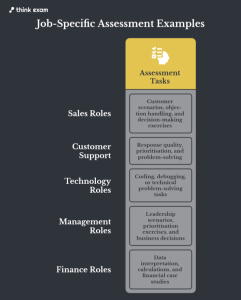
Sales Roles
Use customer scenarios, objection handling, and decision-making exercises.
Customer Support
Test response quality, prioritisation, and problem-solving.
Technology Roles
Use coding, debugging, or technical problem-solving tasks.
Management Roles
Use leadership scenarios, prioritisation exercises, and business decisions.
Finance Roles
Use data interpretation, calculations, and financial case studies.
The closer the assessment is to the actual job, the more meaningful the results can become.
Go Beyond the Final Score
A candidate’s final score is useful, but it does not always tell the complete story.
Modern online exam assessment systems can capture additional performance information that helps evaluators understand how a candidate approached the test.
Depending on the assessment, organisations can examine:
- Accuracy
- Time taken
- Attempts
- Question-level performance
- Section-wise performance
- Problem-solving patterns
- Changes in answers
- Performance under time limits
For example, two candidates may both score 80%.
One may reach the result quickly and consistently.
The other may take significantly longer and struggle with time pressure.
The final score is identical, but the performance story is different.
Create Conditions That Reflect Real Work
If an organisation wants to measure real-world skills, the assessment environment should reflect the conditions in which those skills are used.
That does not mean making every test unnecessarily difficult.
It means introducing realistic elements.
For example:
- Give candidates a limited amount of time.
- Provide multiple pieces of information.
- Ask them to prioritise competing tasks.
- Include incomplete or changing information.
- Present realistic customer or workplace situations.
- Require candidates to explain or justify decisions where appropriate.
These details can reveal how someone performs when the answer isn’t immediately obvious.
Online Platforms Make Practical Testing Easier to Scale
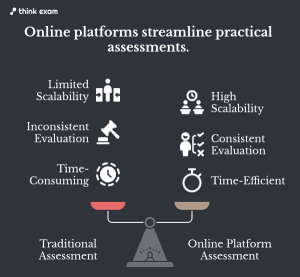
Practical assessments were once harder to deliver at scale because they often required individual evaluation.
Digital platforms can make parts of this process easier.
An online platform test can deliver the same scenario to hundreds or thousands of candidates while keeping the assessment structure consistent.
Automated scoring can handle objective tasks, while evaluators can review responses that require human judgement.
This is especially useful for organisations conducting:
- Campus recruitment
- High-volume hiring
- Professional certification
- University assessments
- Employee skill evaluations
- Training and development programs
The technology makes the assessment easier to deliver, but the quality still depends on how well the assessment itself is designed.
Recruitment Software Can Connect Assessment With Hiring
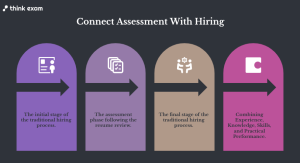
For recruitment teams, assessment is rarely the final step.
The results need to become part of a larger hiring process.
When assessment capabilities are connected with recruitment software, organisations can use candidate performance alongside other hiring information.
This can help recruiters move from:
Resume → Test → Interview
toward a more complete view:
Experience + Knowledge + Skills + Practical Performance
Instead of selecting candidates based only on qualifications or test scores, recruiters can identify people who demonstrate the capabilities required for the role.
Use Assessments to Identify Skill Gaps Too
Real-world skill measurement isn’t limited to recruitment.
Organisations can also use online assessments to understand where existing employees need development.
For example, a company may discover that employees understand a process but struggle to apply it when dealing with complex customer situations.
That insight can influence the next training program.
Similarly, universities can use practical assessments to identify areas where students understand concepts but struggle with application.
This makes assessment useful beyond simply deciding who passes or fails.
The Quality of the Assessment Matters More Than the Technology
It is easy to assume that putting an assessment online automatically makes it modern.
It doesn’t.
A poorly designed digital test can still measure memorisation.
If every question simply asks candidates to recall information, moving those questions from paper to an online exam does not suddenly measure real-world ability.
The important question is:
“What skill are we trying to measure, and what would that skill look like in practice?”
Only after answering that should organisations decide how to build the assessment.
A Better Way to Think About Assessment
The strongest online assessments don’t ask only:
“Does this person know the answer?”
They also ask:
“Can this person use what they know?”
That shift can make assessments more valuable for employers, educators, and training teams.
A candidate’s ability to solve a realistic problem, make a decision with limited information, or apply technical knowledge can tell evaluators much more about readiness than a simple recall question.
The future of digital assessment is therefore not about putting more questions online.
It is about asking better questions.
When assessment design reflects real situations, organisations can move closer to measuring the skills that actually matter—knowledge in action, not knowledge on paper.