
When an examination has hundreds or thousands of candidates, security becomes much more than preventing someone from cheating.
The organisation also needs to protect question papers, control candidate access, manage different exam sessions, prevent unauthorised activity, and maintain a reliable record of what happened during the test.
This is one reason the computer based test model has become increasingly important for large-scale examinations.
Modern CBT platforms are no longer simply digital versions of paper tests. They bring together exam delivery, access controls, question management, monitoring, and reporting in one environment.
For universities, government examination bodies, certification organisations, recruitment teams, and other institutions conducting large exams, this can create a much stronger security framework.
Why Large Exams Are Harder to Secure
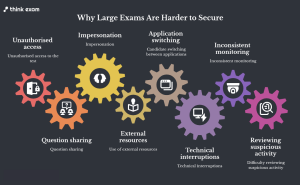
Security becomes more complicated as candidate numbers increase.
A small exam may be relatively easy to supervise. But when thousands of candidates are taking an online exam, organisations have to manage many possible risks at the same time.
These can include:
- Unauthorised access to the test
- Question sharing
- Impersonation
- Use of external resources
- Candidate switching between applications
- Technical interruptions
- Inconsistent monitoring
- Difficulty reviewing suspicious activity
A modern CBT Platform addresses these challenges through multiple layers of control rather than depending on one security feature.
Control Who Can Access the Examination
The first security layer begins before the test starts.
A reliable computer based test system should make sure that only eligible candidates can enter the examination.
Depending on the assessment requirements, this can include:
- Candidate authentication
- Secure login credentials
- OTP or additional verification
- Candidate registration checks
- Scheduled exam access
- Controlled test links
This reduces the possibility of unauthorised candidates entering an examination.
For high-stakes assessments, identity verification can also be combined with other monitoring measures to create stronger candidate authentication.
Protect Questions Before and During the Test
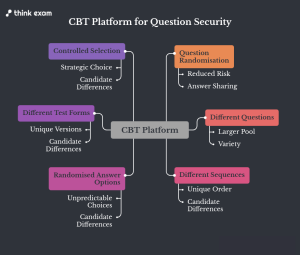
Question security is one of the biggest concerns in a large examination.
If the same questions appear in the same order for every candidate, sharing answers becomes easier.
A modern CBT Platform can reduce this risk through question randomisation.
For example, candidates may receive:
- Different questions from a larger question pool
- Different question sequences
- Randomised answer options
- Different test forms
- Controlled question selection
This doesn’t just make cheating harder. It also allows examination bodies to conduct large assessments without relying on one identical question paper for every candidate.
Secure the Candidate’s Digital Environment
A candidate taking a computer based examination may have access to multiple resources on their device.
Simply displaying questions on a screen does not prevent them from opening another website or application.
This is where secure testing environments become valuable.
A CBT solution can work with Secure Browser or lockdown capabilities to restrict activities such as:
- Opening unauthorized websites
- Switching applications
- Copying and pasting
- Using certain keyboard shortcuts
- Accessing external resources
This creates a more controlled environment for the computer based test and reduces opportunities for unauthorised assistance.
Add Monitoring Where the Exam Requires It
Not every examination needs the same level of monitoring.
A low-stakes practice test may require basic controls, while a university examination, professional certification, or recruitment assessment may need stronger supervision.
Modern CBT platforms can support additional monitoring through:
- Candidate authentication
- Webcam-based monitoring
- AI-assisted proctoring
- Audio monitoring
- Suspicious activity alerts
- Session recording
The advantage is flexibility.
Organisations can choose security measures based on the importance, format, and risk level of each assessment instead of applying the same controls everywhere.
Make Large Exam Sessions Easier to Manage
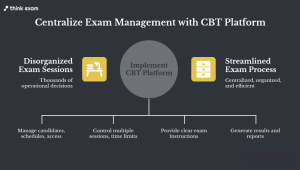
Security isn’t only about what happens during the test.
Large examinations involve thousands of operational decisions: who can access the exam, when they can start, which test they receive, and what happens if something goes wrong.
A modern CBT Platform can centralise these processes.
Administrators can manage:
- Candidate groups
- Exam schedules
- Test access
- Multiple sessions
- Time limits
- Exam instructions
- Results and reports
Centralised management reduces manual intervention and lowers the risk of administrative mistakes.
Create an Audit Trail
When something goes wrong, examination teams need more than a final score.
They need to understand what happened during the assessment.
Modern computer based test platforms can record important examination events and generate reports that help administrators review them.
Depending on the platform, this may include:
- Login and access records
- Candidate activity
- Time information
- Suspicious event alerts
- Test attempts
- Submission details
- Result history
This creates a clearer record of the examination and can support investigations when a candidate’s activity needs further review.
Security Should Not Make Exams Difficult
Strong security should not come at the cost of a poor candidate experience.
If candidates struggle with complicated login processes, unclear instructions, or unstable exam screens, the assessment itself can be affected.
A good CBT Platform should therefore combine security with usability.
Candidates should be able to understand:
- How to access the exam
- What system requirements they need
- What activities are restricted
- How to navigate questions
- What to do if a technical issue occurs
A smooth experience helps candidates focus on demonstrating their knowledge rather than dealing with unnecessary technical problems.
Scale Security Along With Candidate Numbers
The biggest test of a digital examination platform often comes when thousands of candidates access the system at the same time.
A platform that works for 100 candidates may not perform the same way during a large national examination.
Before choosing a solution, organisations should evaluate:
- Concurrent candidate capacity
- System stability during peak traffic
- Backup and recovery processes
- Network requirements
- Technical support
- Data protection
- Reporting capabilities
Scalability should be treated as part of exam security because system failures can disrupt an otherwise well-designed assessment.
Why Modern CBT Is Becoming More Secure
The biggest change in the computer based test model is that security is no longer dependent on a single layer.
A modern examination can combine:
Controlled access to verify candidates
Question randomisation to protect assessment content
Secure environments to restrict unauthorised resources
Monitoring to identify suspicious behaviour
Reporting to support post-exam review
Each layer addresses a different risk.
Together, they create a more controlled and transparent examination process.
Building Trust in Large-Scale Digital Exams
For organisations conducting large assessments, security is ultimately about trust.
Candidates need to believe they are competing on a level playing field. Institutions need confidence that results reflect genuine performance. Examination bodies need processes that can withstand scrutiny.
Modern CBT Platforms help achieve this by bringing security controls directly into the examination workflow.
As more universities, government bodies, certification organisations, and enterprises move toward digital testing, the focus will shift from simply asking whether an exam can be conducted online to asking whether it can be conducted securely, consistently, and at scale.
A well-designed computer based examination does more than replace paper. It creates an assessment environment where technology can protect the process from registration through submission.