Conducting an exam for 100 students is very different from conducting one for 10,000.
As the number of candidates grows, organisations face a familiar problem: how do you maintain exam security without hiring more people to monitor every candidate?
This challenge is becoming more important as universities, certification bodies, government organisations, and enterprises conduct online exams across multiple locations.
Simply adding more human invigilators is expensive and difficult to manage. It can also create inconsistencies in how different exam sessions are monitored.
This is where online proctoring can change the way large-scale assessments are managed. By combining automation, AI, controlled exam environments, and targeted human review, organisations can increase their assessment capacity without increasing manual monitoring at the same rate.
Why Large-Scale Exams Are Difficult to Monitor
When hundreds or thousands of candidates take an exam at the same time, monitoring becomes a resource-intensive task.
A traditional approach may require an invigilator to watch a fixed number of candidates throughout the examination. As the candidate count increases, the number of invigilators must increase as well.
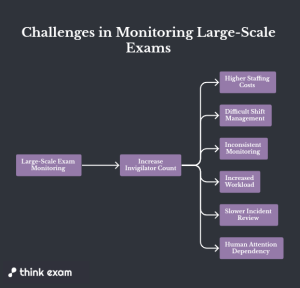
This creates several challenges:
- Higher staffing costs
- Difficult shift management
- Inconsistent monitoring
- Increased workload during peak exams
- Slower incident review
- Greater dependency on human attention
The challenge isn’t simply finding more people. It’s finding a way to use technology so human attention is focused where it matters most.
Move From Constant Monitoring to Smart Monitoring
The biggest advantage of modern online proctoring is that every candidate does not need the same level of manual attention throughout the entire exam.
AI can continuously monitor examination sessions and identify events that may require review.
For example, the system may flag:
- Multiple people appearing on camera
- Candidate absence
- Unusual movement
- Suspicious audio activity
- Unauthorised objects
- Camera obstruction
- Attempts to leave the examination environment
Instead of an invigilator watching every candidate continuously, reviewers can focus on sessions where the system has identified something unusual.
This changes the role of the human proctor from watching everything to reviewing what matters.
Use a Lockdown Browser to Control the Digital Environment
Monitoring the candidate is only one part of exam security.
If candidates are taking an assessment on their own computers, organisations also need to control what they can access during the exam.
A lockdown browser can restrict activities such as:
- Opening additional websites
- Switching to other applications
- Copying and pasting
- Using unauthorised resources
- Taking screenshots
- Using certain keyboard shortcuts
This reduces the need for manual monitoring of activities that can be controlled automatically.
For large-scale online exams, this can make a significant difference because security controls can be applied consistently across thousands of candidates.
Automate the Parts That Don’t Need Human Attention
Scaling doesn’t mean automating everything.
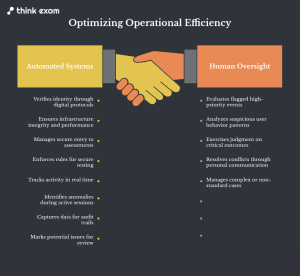
The better approach is to automate repetitive tasks while keeping humans involved in decisions that require judgement.
For example:
Automation can handle:
- Candidate authentication
- System checks
- Exam access
- Environment restrictions
- Continuous monitoring
- Event detection
- Session recording
- Initial incident flagging
Human teams can handle:
- Reviewing serious incidents
- Investigating suspicious sessions
- Making final decisions
- Handling candidate disputes
- Managing exceptional situations
This combination allows online exam proctoring to scale without completely removing human oversight.
Choose Technology That Can Handle Exam-Day Demand
A platform may work well with 200 candidates but struggle when 20,000 candidates log in at the same time.
This is why scalability should be one of the first questions organisations ask when evaluating online proctoring software.
Look for a platform that can support:
- High concurrent candidate volumes
- Multiple exam sessions
- Different time zones
- Multiple institutions or departments
- Automated session management
- Stable performance during peak usage
For universities in particular, online exam proctoring software for universities should be capable of supporting everything from smaller internal assessments to large semester or entrance examinations.
Reporting Reduces the Post-Exam Workload
Manual monitoring isn’t the only part of proctoring that consumes time.
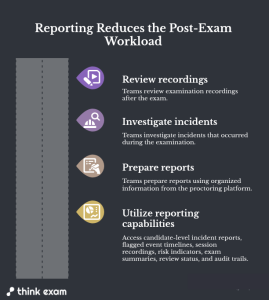
After an examination, teams may need to review recordings, investigate incidents, and prepare reports.
A scalable online proctoring platform should make this process easier by organising important information in one place.
Useful reporting capabilities can include:
- Candidate-level incident reports
- Flagged event timelines
- Session recordings
- Risk indicators
- Exam summaries
- Review status
- Audit trails
Instead of searching through hours of recordings, reviewers can start with the sessions that require attention.
This can significantly reduce the time spent on post-exam investigation.
AI Should Support, Not Replace, Human Judgement
AI can identify patterns and unusual events quickly, but an alert should not automatically become a penalty.
A candidate may look away from the screen because of a distraction. Background noise may come from outside the room. A temporary internet problem may interrupt the camera.
This is why an effective AI proctoring platform for online assessments should provide evidence that allows administrators to review the situation before taking action.
Human review adds context that automated systems may not always understand.
The goal should be AI-assisted decision-making, not blind automation.
How to Evaluate Proctoring Software for Scale
When searching for the best online proctoring software for exams, organizations should look beyond the number of features listed on a website.
Ask practical questions:
Can it handle our candidate volume?
A platform should be tested under realistic peak loads.
Can it integrate with our existing systems?
Integration with assessment platforms, LMSs, HR systems, or university portals can reduce administrative work.
How are incidents reviewed?
A good solution should make it easy for authorised reviewers to understand why a session was flagged.
What happens when something goes wrong?
Technical support and clear candidate workflows are especially important during high-volume exams.
How flexible is the security setup?
Different exams may require different levels of monitoring, browser restrictions, authentication, and review.
Scaling Security Without Scaling Complexity
Large-scale examinations don’t have to mean large-scale manual operations.
With the right combination of online proctoring, AI-powered monitoring, lockdown browser controls, automated workflows, and human review, organisations can handle significantly larger candidate volumes while keeping security standards consistent.
This approach is particularly valuable for universities, certification bodies, recruitment organisations, and government examination providers that conduct high-volume assessments.
The real advantage isn’t simply being able to monitor more candidates.
It’s being able to scale the examination while keeping the monitoring process manageable, consistent, and trustworthy.
Building a More Scalable Assessment Model
As digital testing expands, organisations will need assessment systems that can grow with their candidate base.
The future of proctoring is unlikely to depend on simply adding more invigilators every time candidate numbers increase. Instead, scalable assessment models will combine automation with targeted human oversight.
Organisations evaluating secure online exam proctoring solutions should therefore focus on the complete workflow, from candidate authentication and exam access to monitoring, incident review, reporting, and post-exam analysis.
When these pieces work together, large-scale digital assessments become easier to manage without sacrificing exam integrity.