
With the new technological advancements, the world of assessments has been transformed forever. The high-stakes exams were traditionally envisioned to involve thousands of students being brought together at physical centers, with tethers of paper sheets coming down from scattered desks, and weeks for results processing.
That model, untethered by time, lacks speed and discretion; and in today’s world, in which institutions, corporates, and certification bodies demand scaling, speed, and fairness, it is an anachronism.
There entered a Computer-Based Testing model was introduced that delivers exams in quick, secure, and candidate-friendly environments at scale.
In simpler terms, CBTs can deliver an exam to millions of learners scattered across the geography; results can be processed within hours rather than days; and exam credibility can be safeguarded with security measures laid down by the technology.
Thus, we at Think Exam have constituted a platform called Think Computer based Test (CBT) that deals with every complicated assessment problem and provides a solution for it.
Today, some 3500+ clients, 2500+ test centers, and millions of candidates use Think Computer based Test (CBT) annually to conduct academic, corporate, and certification-level exams with integrity.
 Fact: In 2022, India witnessed more than 120 million CBT based exams taking place for recruitment and higher education
Impact: Clients reported through Computer based Test (CBT) a drop in operational costs by 60-70% and a rise in candidate success by 20-25% while switching from traditional exams.
Fact: In 2022, India witnessed more than 120 million CBT based exams taking place for recruitment and higher education
Impact: Clients reported through Computer based Test (CBT) a drop in operational costs by 60-70% and a rise in candidate success by 20-25% while switching from traditional exams.
 Fact: Studies confirm that Computer based Test (CBT) exams conducted through secure browsers reduce by at least 70% the number of attempted malpractices as compared to unmonitored online tests (ResearchGate, 2023).
Fact: As per OECD, 82% of students consider Computer based Test (CBT) tests more convenient and faster in rendering results when compared to traditional exams.
Fact: Studies confirm that Computer based Test (CBT) exams conducted through secure browsers reduce by at least 70% the number of attempted malpractices as compared to unmonitored online tests (ResearchGate, 2023).
Fact: As per OECD, 82% of students consider Computer based Test (CBT) tests more convenient and faster in rendering results when compared to traditional exams.
 Fact: A Recent survey showed 78 percent of candidates favor self-scheduling online for their exams since it is less confusing and reduces dependence on traveling (Education Technology Insights, 2023).
Impact: Face and ID verification reduce impersonation fraud in online exams by 90 percent (ResearchGate, 2022).
Fact: The combination of remote AI proctoring and secure browsers has seen a drop of 70 percent in cheating attempts in Computer based Test (CBT) exams worldwide (HolonIQ, 2023).
Fact: Clients using Think Computer based Test (CBT) have brought down result declaration timelines from weeks to 24-48 hours, giving a boost to recruitment and admission cycles.
Fact: A Recent survey showed 78 percent of candidates favor self-scheduling online for their exams since it is less confusing and reduces dependence on traveling (Education Technology Insights, 2023).
Impact: Face and ID verification reduce impersonation fraud in online exams by 90 percent (ResearchGate, 2022).
Fact: The combination of remote AI proctoring and secure browsers has seen a drop of 70 percent in cheating attempts in Computer based Test (CBT) exams worldwide (HolonIQ, 2023).
Fact: Clients using Think Computer based Test (CBT) have brought down result declaration timelines from weeks to 24-48 hours, giving a boost to recruitment and admission cycles.
Fact: In 2022, India witnessed more than 120 million CBT based exams taking place for recruitment and higher education
The Need for Computer based Test (CBT)– Challenges in Traditional Exams
-
Scale & Reach
-
Fairness & Security
-
Accessibility & Inclusive Education
-
Result Delays
-
Data & Insights
Impact: Clients reported through Computer based Test (CBT) a drop in operational costs by 60-70% and a rise in candidate success by 20-25% while switching from traditional exams.
Key Features of Think CBT
1. Scalable and Reliable Delivery
From classroom quizzes to recruitment drives at a national level, Computer based Test (CBT) is set to effortless scaling. Attestation of millions of candidates versus candidates is taken care of by the platform and is ideally backed by cloud-based and LAN-boot offline modes. In areas with lesser connectivity, the conduct of exams is smooth, and automatic syncing occurs on the resumption of an internet connection.2. Holistic Question Paper Management
Exam administrators can prepare tests featuring all of the following kinds of questions:- Multiple choice, short answer, essay, coding, and case-based questions.
- Randomized and shuffled questions to prevent predictability.
- Sectional timing and adaptive difficulty option.
- Multi-language support for regional inclusivity.
3. End-to-End Security & Compliance
Every test in Computer based Test (CBT) is protected with Think Proctor (AI proctoring + secure browser). Some key layers are:- Candidates authenticate themselves by ID + facial recognition
- Centers conduct biometric authentication
- CCTV feeds and live invigilation
- 256-bit encryption of exam data
- Audit trails of every click
Fact: Studies confirm that Computer based Test (CBT) exams conducted through secure browsers reduce by at least 70% the number of attempted malpractices as compared to unmonitored online tests (ResearchGate, 2023).
4. Seamless Candidate Experience
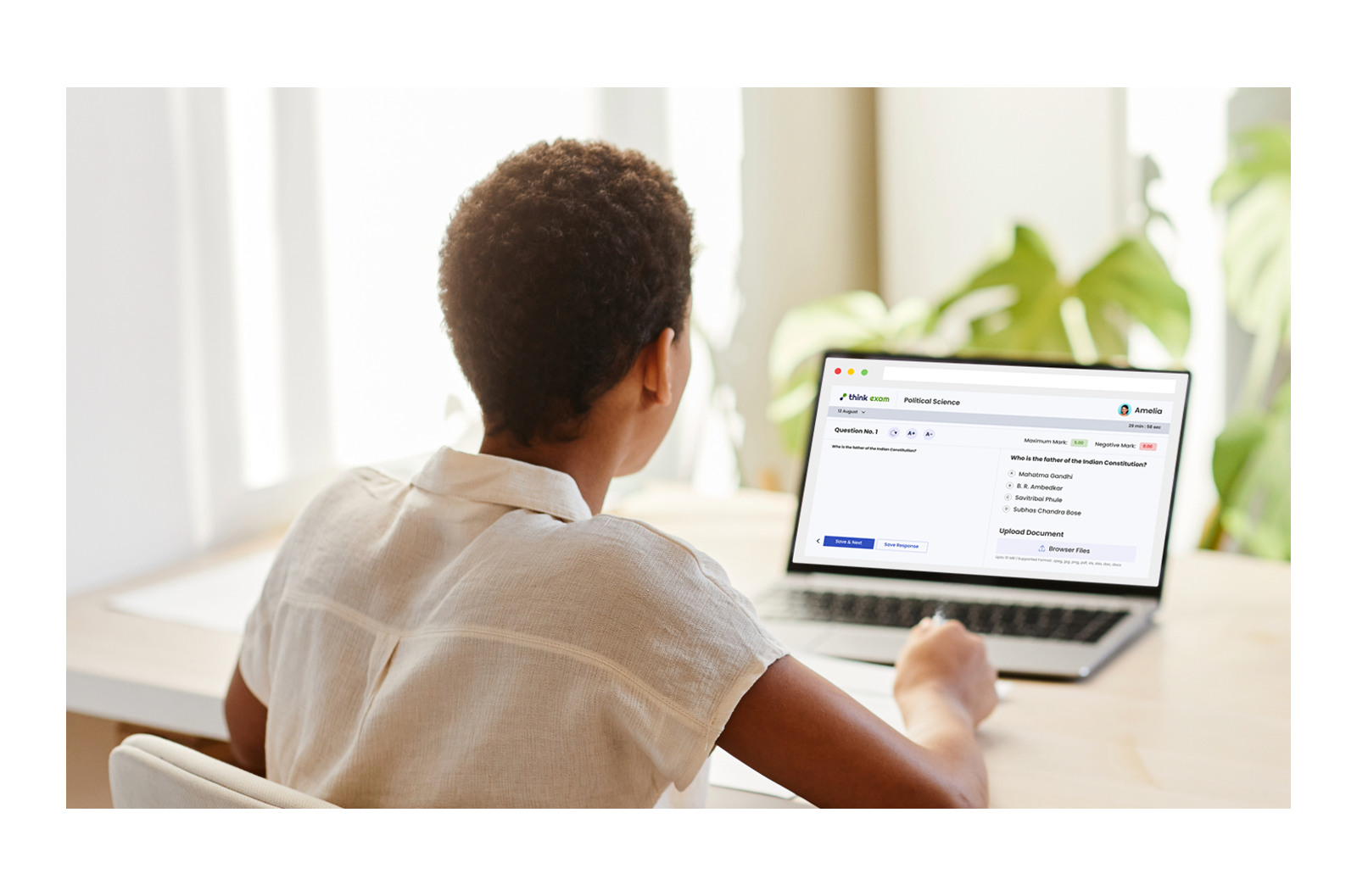
The Onion layers were meant to ensure the following in the candidate journey:- Log in using simple authentication steps.
- The exam interface is free from distractions.
- A myriad of features like flag-for-review, time tracker, auto-save, and instant submission confirmation.
- Accessibility from desktop, laptop, tablet, and mobile.
5. Advanced Analytics & Reporting
Institutions and corporates have access to:- Real-time dashboards for exam controllers.
- Detailed reports featuring section-wise performance, percentile scores, and trend analysis.
- AI-powered skill gap detection for Learning and Training Intervention.
- Export-ready reports for compliance and audits.
Fact: As per OECD, 82% of students consider Computer based Test (CBT) tests more convenient and faster in rendering results when compared to traditional exams.
The Computer based Test (CBT) Exam Process – From Registration to Results
Beyond everything else, one major advantage of Think Computer based Test (CBT) is its structured, seamless, and transparent workflow. Each step has been crafted to ensure exam security with a friendly environment for candidates. Here is a walkthrough of how a Computer based Test (CBT) exam takes place with Think Exam:1. Candidate Registration & Scheduling
The candidate will start the journey at a centralized registration portal where he/she can perform the following:- Create an exam profile with verified personal details.
- Select preferred exam slots and centers (wherever applicable).
- Make payment through secure payment gateways.
- Receive an instant confirmation by email/SMS.
Fact: A Recent survey showed 78 percent of candidates favor self-scheduling online for their exams since it is less confusing and reduces dependence on traveling (Education Technology Insights, 2023).
2. Secure Candidate Authentication
- No impersonation should be allowed through the authentication of identity before the exam starts:
- AI-based facial recognition and photo ID matching…
- Biometric checks could also be done at physical centers
- Verification by live proctors during remote tests.
Impact: Face and ID verification reduce impersonation fraud in online exams by 90 percent (ResearchGate, 2022).
3. Exam Delivery Environment
- Candidates, once authenticated, are routed to the Computer based Test (CBT) safe exam environment.
- LAN-based offline mode in centers where the internet is very limited.
- Cloud-hosted platform for country-wide or global reach.
- Multi-device compatible (PC, Laptop, Tablet).
- Accessibility facilities for candidates with special needs.
4. Question Paper Management
A dynamic paper-generating algorithm based on randomization to prevent any predictability.- Shuffling of questions and options.
- Adaptive difficulty setting is enabled.
- Set sectional timings, plus allow controls for navigation.
- Support for MCQs, Essay, Coding, Psychometric, and Doc-Based.
5. Exam Monitoring and Proctoring
The candidates have been monitored during the examination using multiple layers:- Think Proctor AI engine picks up face mismatch, voice detection, object detection, and screen focus loss.
- Multi-camera coverage without blind spots.
- Secure Browser lockdown prevents switching to any other application, including AI tools like ChatGPT or web searches.
- Live remote proctors can intervene when suspicious behavior is detected.
Fact: The combination of remote AI proctoring and secure browsers has seen a drop of 70 percent in cheating attempts in Computer based Test (CBT) exams worldwide (HolonIQ, 2023).
6. Candidate Exam Experience
- The candidate-facing platform is designed for ease of use and stress-free navigation:
- Clear question navigation panel with the option to “flag for review.”
- All responses are automatically saved so that the candidate doesn’t lose data due to technical issues.
- Integrated timer to ensure candidates are on task.
- Instant confirmation of submission once the test is complete.
7. Real-time Monitoring for Administrators
Examiners and administrators get the real advantage of complete control with live dashboards, allowing them to:- Observe ongoing exams in real-time across thousands of centers.
- Flag suspicious candidates.
- Pause, resume, or revoke exams when required.
- Get live status updates relating to test attempts and submission.
8. Result Processing and Analytics
One of the biggest advantages of Computer based Test (CBT) lies in the quick result generation.- Objective → Results generated instantly.
- Subjective/coding → AI-assisted evaluation and manual scoring.
- Analytics dashboards provide:
- Sectional scores.
- Percentiles and ranking.
- Skill gap and performance heatmaps.
Fact: Clients using Think Computer based Test (CBT) have brought down result declaration timelines from weeks to 24-48 hours, giving a boost to recruitment and admission cycles.
9. Reports, Certifications & Audit Trails
Exam integrity shall finally be strengthened through post-exam transparent reporting:- Scorecards and certificates are downloadable for candidates.
- Detailed audit trails for regulators and accreditation.
- Compliance with GDPR, ISO, and national exam regulations.
FAQ:
From Registration to Results: How Think Exam Reshaping the Computer Based Assessments Process