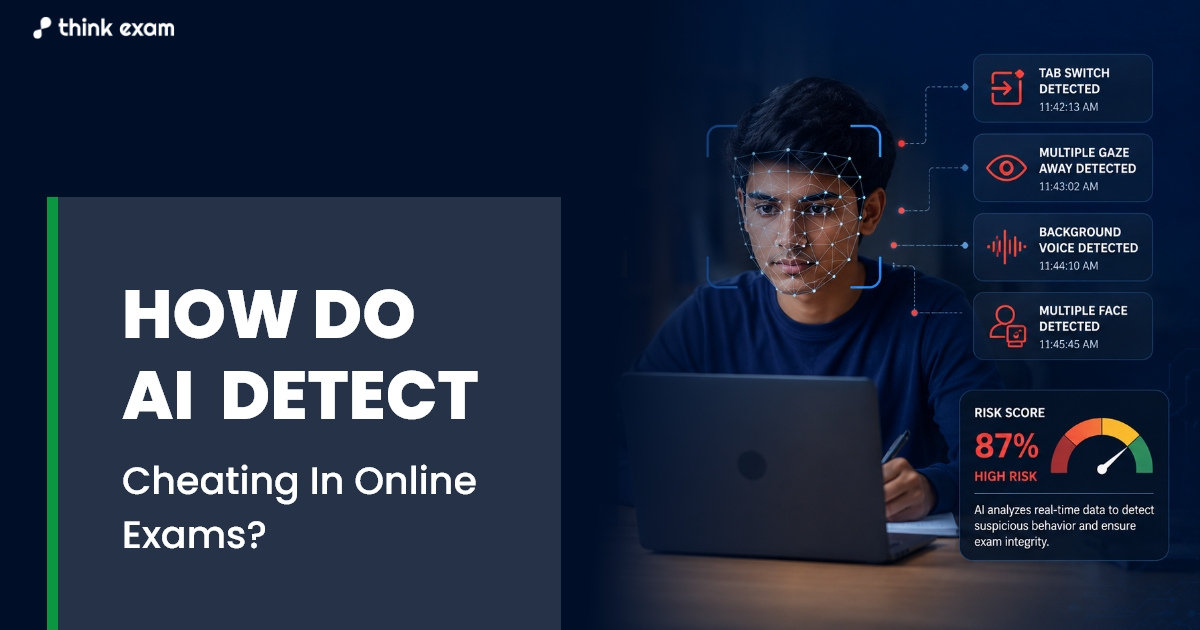
A student looks away from the screen for a few seconds. Another candidate opens a new browser tab. Someone else’s voice is heard in the background. Within moments, an AI system notices these activities and records them. But here’s the interesting part:
The system doesn’t immediately decide that someone is cheating.
Instead, it builds a picture based on patterns. Modern exam technology isn’t looking for one mistake. It’s looking for unusual behaviour that doesn’t align with a typical test-taking experience.
AI Doesn’t Watch Exams Like Humans Do
A human invigilator might notice one student acting suspiciously and keep an eye on them. AI works differently. It continuously analyses hundreds or even thousands of small actions throughout the exam.
Things like:
- Frequent head turns
- Long periods of looking away
- Multiple background voices
- Repeated attempts to leave the exam screen
- Unexpected changes in the camera view
One action alone usually means very little. But several unusual actions happening together may create a higher risk score. This is why modern proctoring systems focus more on behaviour patterns than isolated events.
Looking Away Isn’t Automatically Cheating
One of the biggest myths around online exam proctoring is that looking away from the screen immediately triggers a violation. In reality, AI understands that people naturally:
- Think while looking away
- Adjust their seating position
- Stretch during long exams
- Get briefly distracted
The system becomes more interested when these actions happen repeatedly or follow a consistent pattern. For example, if a candidate constantly looks toward the same side every few seconds, it may indicate that they are referring to something outside the camera’s view. The AI simply records the event for later review.
The Browser Can Tell a Story Too
Most secure online exams do not rely only on webcams. The computer itself provides valuable information. If a candidate repeatedly tries to:
- Open another website
- Switch applications
- Copy and paste content
- Minimize the exam window
the system can detect those actions. This is where a lockdown browser plays a major role. Rather than just blocking access, it helps create a controlled environment where the candidate stays focused on the assessment.
AI Listens, But It Doesn’t Understand Conversations
Many people think AI can hear exactly what is being said during an exam. That’s usually not how it works. Most systems simply detect sound patterns.
For example:
- Is there more than one voice?
- Is someone talking continuously?
- Is there unusual background activity?
The software isn’t judging the conversation itself. It simply notes that additional audio activity happened during the exam. This makes online exam proctoring more balanced because it focuses on events rather than assumptions.
Why Multiple Small Signals Matter More Than One Big One
A candidate looking away once may mean nothing. A background noise may simply be a passing vehicle. A temporary internet issue could freeze the webcam. But imagine this sequence:
- The candidate looks away multiple times.
- Another voice is detected.
- The exam window loses focus.
- The candidate attempts to switch tabs.
Individually, these events may seem harmless. Together, they create a stronger indication that something unusual may be happening. Modern proctoring systems are designed to connect these small signals rather than react to a single action.
Can Students Outsmart AI?
This is one of the most searched questions around digital assessments. The reality is that students often focus on avoiding one detection method. But AI does not rely on just one source. It combines information from:
- Webcam activity
- Audio events
- Browser behavior
- Screen interactions
- Device activity
Trying to bypass one layer does not remove the others. That is why many institutions now combine AI with human review to create a stronger and fairer process.
The Final Decision Is Usually Human
As digital assessments continue to grow, institutions need systems that are both secure and fair. The goal of online exam proctoring is not to make students feel watched. It is to create an environment where every candidate gets the same opportunity to succeed without unfair advantages. The smartest systems are not the ones that catch the most people. They are the ones that can tell the difference between normal human behavior and genuine attempts to break the rules. And that is exactly where AI is changing the future of online exams.
Why This Matters for the Future of Online Exams
As digital assessments continue to grow, institutions need systems that are both secure and fair. The goal of online exam proctoring is not to make students feel watched. It is to create an environment where every candidate gets the same opportunity to succeed without unfair advantages. The smartest systems are not the ones that catch the most people. They are the ones that can tell the difference between normal human behavior and genuine attempts to break the rules. And that is exactly where AI is changing the future of online exams.
FAQs
How does AI detect cheating during online exams?
AI looks for patterns such as repeated head movement, browser activity, multiple voices, and unusual screen behavior rather than relying on a single action.
Can looking away from the screen trigger a warning?
Looking away once is usually not a problem. AI pays more attention to repeated or unusual behavior patterns.
What does a lockdown browser do?
A lockdown browser helps create a secure exam environment by limiting access to other websites and applications during the test.
Does AI automatically fail students?
No. Most proctoring systems only flag suspicious events. Human reviewers generally make the final decision.
Can AI hear conversations during an online exam?
Most systems detect the presence of additional voices or unusual sounds rather than understanding the actual conversation.
Is online exam proctoring accurate?
Modern online exam proctoring systems are designed to improve exam security by combining multiple data points instead of relying on one indicator.
Can students bypass AI proctoring systems?
AI typically monitors several activities at the same time, making it difficult to avoid detection by bypassing only one security layer.