A good candidate may not be the right fit for every job. Someone who is excellent at numerical reasoning may struggle with customer communication, while a candidate with strong problem-solving skills may not be comfortable with data-heavy tasks.
This is why using the same aptitude test for every vacancy can lead to misleading hiring decisions.
An effective aptitude examination should reflect what a person will actually do in the role. The aim is not simply to test how quickly someone can solve questions, but to understand whether they have the abilities needed to perform the job.
Here’s how organisations can design an online exam assessment that makes this possible.
Start With the Work, Not the Questions
Before selecting questions, understand the role.
Look at the responsibilities, everyday tasks and decisions the employee will need to handle. A job description is a useful starting point, but it may not explain the actual skills required.
For example:
- A financial analyst works with numbers, reports and data interpretation.
- A customer support executive handles conversations, understands problems and responds appropriately.
- A software developer uses logical thinking, problem-solving and technical reasoning.
- A sales executive needs communication, decision-making and numerical understanding.
These differences should shape the examination from the beginning.
Build an Aptitude Blueprint for Each Role
Once the job requirements are clear, map them to the abilities the examination needs to measure.
An aptitude blueprint helps recruiters decide which sections to include, how much weight to give each skill and what type of questions will provide useful insights.
Here is a simple example:
| Job role | Aptitudes to assess |
| Software Developer | Logical reasoning, analytical thinking, problem-solving |
| Financial Analyst | Numerical ability, data interpretation, attention to detail |
| Customer Support | Verbal ability, comprehension, situational judgement |
| Sales Executive | Communication, numerical reasoning, decision-making |
| Operations Executive | Logical reasoning, planning, accuracy |
The weight assigned to each section should depend on how important that ability is to the role. Not every skill needs equal importance.
Choose Question Types That Reflect Real Job Requirements
The question format matters just as much as the skill being tested.
A general aptitude question may measure basic ability, but role-related scenarios can help assess how candidates apply that ability.
Consider these examples:
For a financial analyst
- Interpret a table of financial figures.
- Identify trends in a data set.
- Solve numerical reasoning problems.
For a customer support role
- Read a customer query and identify the main issue.
- Choose the most appropriate response to a situation.
- Interpret written instructions.
For a software developer
- Complete logical sequences.
- Identify errors in a problem-solving scenario.
- Work through algorithmic reasoning questions.
A mix of question formats can provide a more rounded view of a candidate’s abilities.
Set the Right Difficulty Level
A role-specific online aptitude test should be challenging enough to identify capability without making the examination unnecessarily difficult.
The level of difficulty should reflect the experience and expectations of the role.
For example:
- Entry-level roles: Focus on foundational reasoning, comprehension and basic problem-solving.
- Mid-level roles: Include more complex scenarios, data interpretation and decision-making.
- Senior roles: Assess analytical judgement, complex problem-solving and the ability to evaluate different situations.
A well-designed online aptitude assessment test should distinguish between levels of ability while keeping questions relevant to the job.
Use an Online Assessment Platform to Manage the Process
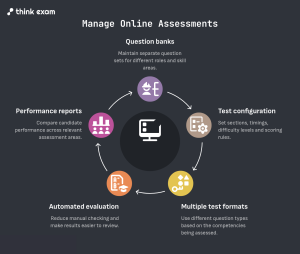
Creating different examinations for multiple job roles can become difficult to manage manually, particularly when hiring teams are handling several vacancies at once.
An online assessment platform helps organise the process through features such as:
- Question banks: Maintain separate question sets for different roles and skill areas.
- Test configuration: Set sections, timings, difficulty levels and scoring rules.
- Multiple test formats: Use different question types based on the competencies being assessed.
- Automated evaluation: Reduce manual checking and make results easier to review.
- Performance reports: Compare candidate performance across relevant assessment areas.
When connected with recruitment software, assessment results can also become part of a more organised hiring workflow.
Test the Examination Before Using It
A test should not go live simply because the questions are ready.
Run a pilot with a small group and check whether the examination measures what it is supposed to measure.
Pay attention to:
- Whether questions match the responsibilities of the role.
- Whether the difficulty is appropriate.
- Whether the allotted time is reasonable.
- Whether any questions are unclear or open to multiple interpretations.
- Whether the results help distinguish between different levels of ability.
Review candidate performance and recruiter feedback before making the examination part of the hiring process. It is also worth reviewing assessments periodically as job responsibilities change.
Make the Assessment Fair and Consistent
Role-specific does not mean creating an entirely different hiring standard for every candidate.
Candidates applying for the same position should be assessed against the same competencies, scoring criteria and examination conditions.
A well-managed online examination should also consider accessibility, clear instructions and a smooth test-taking experience. Secure delivery and consistent evaluation help maintain confidence in the process.
Better Hiring Starts With Better Questions
The purpose of an aptitude examination is not to find the candidate who scores highest on a generic test. It is to understand who has the abilities required for a particular role.
When assessments are built around actual job requirements, recruiters get more relevant information to support their decisions. Candidates, in turn, get an opportunity to demonstrate skills that matter to the position.
As organisations continue their digital transformation, a well-planned online exam assessment can make recruitment more structured, consistent and relevant to the work ahead.