The process of recruitment, learning, and certification has been changed completely by the digital transformation. In 2026, it is not possible for organizations to depend on various outdated systems of paper-based and guesswork interviews in assessing the competencies of an individual. The current process of recruitment, training, and up-skilling requires data-driven evidence of skills verification, reducing the disincentive towards recruitment and training, and this is the very reason these two technologies are disrupting the status quo: the online proctoring and the AI Item Generator.
The application of these tools complements each other and contributes to effective skill assessment, as they enable candidates to characterize themselves, provided that the examinations accurately reflect their actual scores.
Within this entry, we will illustrate both principles of operation of online proctoring and AI Item Generator tasks, as well as attempt to indicate how and why services such as that of Think Originate must become a must within the prevailing assessment climate conditions.
Reasoning behind skill verification being insufficient with mere Questions
Simply asking a lot of questions is not what skill verification is all about. Instead, quality questions—those which are compliant with the competencies of the post—are asked, and the candidates are not allowed to do anything which will skew the results.
Traditional approaches have several limitations, such as:
- The questions are repetitive and therefore predictable.
- It is not Bayesian-effective in terms of creating test items on paper.
- Enhancement of the evaluation of work ability depends on the paper-and-pencil test.
- The candidates can either copy or be assisted by others easily.
- Integrity of the practice cannot be controlled once the number of candidates increases.
The solution to the already discussed problems will require two technologies that work hand in hand; the following are the technologies:
- Generation of Exam Questions with AI- questions created are relevant and do not contain bias on the skills that are tested in the examination. The AI Item Generator is central to this creation.
- Offline exams submission monitoring- ensures all candidates face their examinations and perform all necessary tests under active invigilation.
The result is a reliable, elastic, and objective way of assessing individual performance in the industry.
What Does An AI Item Generator Look Like?
An AI Item Generator is nothing more than a technology that tries to build computer-based training exam items. Instead of developing the essence of the course content, the AI Item Generator generates a lot of high-quality questions quickly and effectively within a few minutes.
Structure of AI Item Generator:
- Refers to job descriptions or skill tags, or course syllabuses
- Builds the domain-specific language
- Provides questions for each difficulty level
- Develops helpful distractors about the core concepts, cases, scenarios or roles
- Ensures that content is not contradicted or disorganized
- Facilitates easy corrections or the user’s judgment
For instance, such a facility called Originate, at the disposal of exams and HR professionals, enhances the following aspects of assessment:
- Questions in aptitude tests
- Psychometric cases
- Domain knowledge test
- Programming problems
- Computer-Assisted Testing – CBT tasks
- Recruitment tests for campuses
It bridges the gap between exam content and performance that is actually required. In modern testing ecosystems, an AI Item Generator ensures question relevance and exam scalability.
What is Online Proctoring?
The best online proctoring solutions combine both AI and human intervention in order to monitor test-takers who take their tests remotely. This helps to ensure fairness in testing by authenticating the test taker, monitoring their activity as well as flagging inappropriate behaviors such as cheating.
The main features included in all major online exam proctoring solutions are the following:
- face identification using AI
- detection of the entrants’ presence
- voice activity pattern recognition
- browser restrictions
- video monitoring
- alerts in case of behavior
- reporting after the exam has been completed
These measures ensure that the exam is attempted by the same candidate who is being tested appears to be real or ethical.
Why Online Proctoring and AI Item Generator Improve Skills Testing
The deployment of both systems shows added value to the exam at each stage. Let us consider the following examples:
1. Mapping Skills to job requirements when Designing an Exam
AI Item Generator takes into consideration the job descriptions and competency models and comes up with … not just rote memorization based test questions but those related to real life functioning memorization.
In parallel, the online implementation of the proctoring technique makes sure that the questions determining such skills do not bring any distortions to the existing system or leak out.
The logical continuation of this would be:
- Real work-based assessments
- Simulated environment tests
- Challenge-based exams
- All applicants are treated the same
The basis for comparison is not what a candidate can recall but rather what a candidate is capable of doing.
2. Technology Empowers the Deconstruction of Bias in Question Creation
Stereotyping is pretty common in many things, especially in content created by humans:
- Sexist beliefs
- The choice of the speech
- Cultural context
- Educational background
AI Item Generator templates always apply the neutrality principles and refer to the machine for feedback on any emerging pattern.
The proctoring sets the same rules concerning the examination not only the paper but as well the examinee.
In combination, these produce:
- Impartial assessments
- Unified grading
- Outcome that is acceptable worldwide
3. Simple Expansion Upward Though proceeds from mass recruitment and campus hiring
There are several instances where any organization is expected to evaluate a large number of candidates in a short span of time. A traditional examination approach centers around a human-based process, which is not effective.
It means that with the use of the AI Item Generator, unlimited new test forms would be formed with immediate effect. And these tests would be taken at once and wherever there is a need, thanks to online proctoring.
Sectors that have embraced this approach:
- Employment in banks
- Recruitments to IT companies from petty officers
- Medical Qualifications
- Exams related to Administrative or Government Services
- Tech-education contributing centers
Here, the AI Item Generator becomes a cornerstone of scaling without compromising exam quality.
4. Why the Static Question Bank Is Ineffective Against Cheaters
Cheating has always been a challenge, even in the most traditional and rigid testing forms. Exam questions eventually end up being common knowledge, either through WhatsApp, Telegram, or mummy and daddy in coaching schools.
However, an AI Item Generator does the following:
- Ensures different variations of questions are used
- Generates low, medium, and high-level tests
- Generates mock incorrect answers
- Generates different versions using the same skill set
- Generates and utilizes question variations balancing for difficulty
Thanks to the proctoring system set in place, each test candidate will encounter a new challenge that is the same for all candidates, ensuring that no questions are shared.
When operating at scale, the AI Item Generator becomes the key to preventing exam leakage.
5. Plus Keeping Track of Behaviour and Putting it into Context in a Performance Analytics
Remote invigilation entails more than supervision—it extends to the cultivation of behavioral intelligence:
- Head/eye movement
- Detection of strange sounds
- Screen change behavior
- Several presence
- Posture deviations
Violations are registered by AI and reports are generated for managers.
Evaluators while using AI Item Generator based scoring with other AI scoring gain:
- Skills score
- Behavior index
- The link between knowledge and action
- Development of graph of performance on difficulty addiction
It is not mere scores but a leveled construction of skills. Combined monitoring and the AI Item Generator create an analytical system instead of a raw scoring sheet.
6. No time wasted to fate over reskilling the employees in them
Compulsive elements in reskilling the workforce now require.
Functionalities of AI Item Generator includes:
- Development of tests
- Generating occupational tests
- Evaluation checks of transformation automated
- Training course completion certificates
Without such supervision, employees can easily evade accountability and basic know your knowledge tests.
This is effective for checking the following:
- Safe practices towards maintenance of IT system
- ISO courses to refresh
- Training execution re-training programsPr친and certification
- Self Improvement
How Think Originate is Transforming the Evaluation System Rolled Out
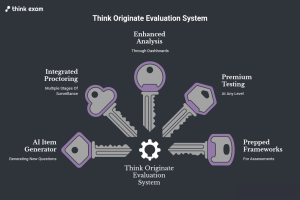
Incorporates Innovation In Error-Free Management Of Assessment
- AI Item Generator for Generating New Questions
- Integrated Proctoring With Multiple Stages Of Surveillance
- Enhanced Analysis Through Dashboards
- Premium Testing At Any Level
- Prepped Frameworks For Assessments
The system assists the following:
- Mass recruitment by corporations
- Remote examinations conducted by universities
- Important assessment learning approved by participants
- High-stakes testing by certification bodies
In this system, assessments are:
- Swifter
- Juster
- Qualifications-led
- Module-cum-answerable
Conclusion
By 2026 and later, advanced testing methods will be vital to any organization.
- Validation of skills today includes an accuracy scale, a fairness scale, as well as a security scale.
- Using AI guard-in-place and question making is an improvement of make richer to practice richer.
- Organizer question formulation on whatever basis.
- Prevention of scandal in the delivery of the exams.
- Instantaneous admin support
- All effectiveness reporting data
The limits in the inner workings of the system should not be the reason for one’s popularity or winning. Not this dual-function technology.